Measurement
Expand a checker’s fixed-plus-percentage specification correctly
Work through Hanna HI713’s stated phosphate accuracy specification at 25 °C, keeping its fixed term, percentage of reading, resolution and limits separate.
By FishyMag · Published
Worked arithmetic example · Not a clinical review or treatment recommendation.
Quick answer
Hanna states HI713 accuracy at 25 °C as±0.04 ppm±4%of reading. For an example reading of 0.50 ppm, the arithmetic allowance is 0.04+0.04×0.50=0.06 ppm. Keep both terms and the stated conditions. This specification calculation is not a measured error or a confidence interval.
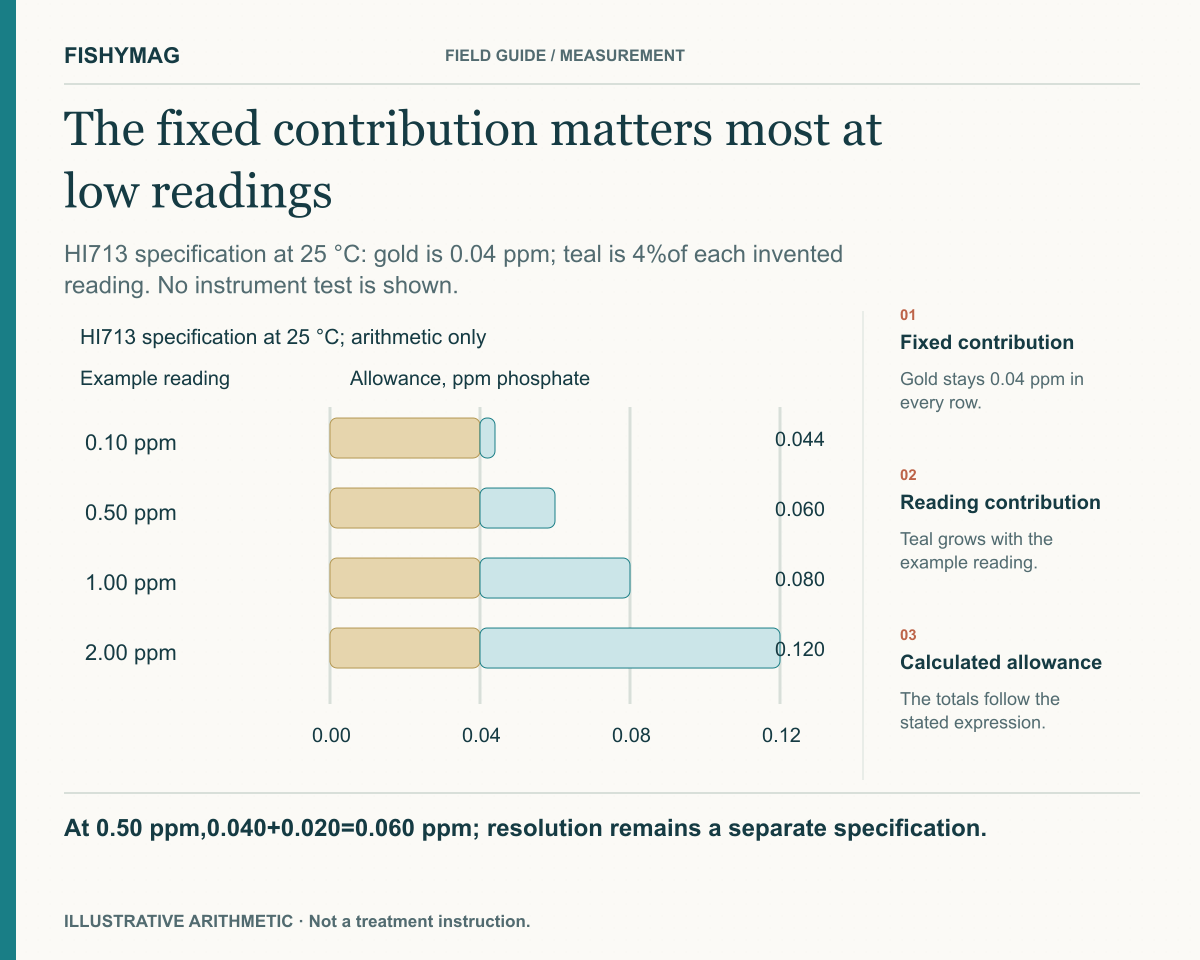
Figure data and explanation
HI713 specification at 25 °C: gold is 0.04 ppm; teal is 4%of each invented reading. No instrument test is shown.
- Fixed contribution
- Gold stays 0.04 ppm in every row.
- Reading contribution
- Teal grows with the example reading.
- Calculated allowance
- The totals follow the stated expression.
At 0.50 ppm,0.040+0.020=0.060 ppm; resolution remains a separate specification.
Use the statement for the identified instrument
The manufacturer’s HI713 page lists a phosphate range of 0.00 to 2.50 ppm, resolution 0.01 ppm and accuracy at 25 °C of±0.04 ppm±4%of reading. The worked readings below are invented calculation inputs within that stated range. They are not results from FishyMag testing. The manual identifies the reporting basis as phosphate. Do not apply these figures to another checker or use them to establish a treatment concentration.
Add the fixed and reading-dependent terms
Let r be the reported reading in ppm. The specification-derived allowance is 0.04+0.04 r ppm. The first 0.04 is an absolute term; the second 0.04 is the decimal form of 4%. At 0.50 ppm, the proportional contribution is 0.020 ppm and the fixed contribution is 0.040 ppm. Their sum is 0.060 ppm. The endpoints below are simply r minus and plus that allowance, retaining the original unit.
| Example r, ppm | 4%of r, ppm | Fixed term, ppm | Total allowance,±ppm | Arithmetic endpoints, ppm |
|---|---|---|---|---|
| 0.10 | 0.004 | 0.040 | 0.044 | 0.056 to 0.144 |
| 0.50 | 0.020 | 0.040 | 0.060 | 0.440 to 0.560 |
| 1.00 | 0.040 | 0.040 | 0.080 | 0.920 to 1.080 |
| 2.00 | 0.080 | 0.040 | 0.120 | 1.880 to 2.120 |
Keep resolution and probability separate
The 0.01 ppm display resolution is a different specification from the stated accuracy expression. A display step does not establish the actual error of a reading. Nor does this table assign a probability that the true value lies between its endpoints. Converting a specification into standard uncertainty requires an appropriate interpretation and supported model; it is not achieved by changing the column label. Retain the manufacturer’s temperature condition and full applicable instructions with the calculation.
Record the basis before comparing results
A complete calculation record identifies HI713, the actual document used, the reading and unit, the 4%of-reading basis, the fixed contribution and the 25 °C condition. Keep the original reading unchanged. If a different document instead uses percentage of full scale, its multiplication needs the applicable full-scale value; the reading is not a substitute. This worked table checks expansion of the stated expression. It does not validate sample suitability, instrument condition or any aquarium decision.
Use your own details
Expand a checker’s fixed-plus-percentage specification correctly worksheet
Download the editable text file, fill it in on your device and keep it with the relevant record. This blank worksheet records your information; it does not verify entries or approve treatment.
- Instrument and exact model
- Source document and review date
- Original reading and reporting basis
- Applicable range and stated conditions
- Percentage basis and decimal multiplier
- Fixed contribution with unit
- Total calculated allowance and endpoints
- Unresolved applicability or uncertainty interpretation
Put it into practice
Your checklist
- Retain the fixed term as well as the percentage term.
- Use the stated percentage of reading, not an assumed full-scale value.
- Label the output as specification arithmetic, without an invented confidence level.
Sources and scope
This article distinguishes manufacturer statements from FishyMag’s own workflows and arithmetic examples. Linked formulation records retain their own evidence dates; publishing this article does not refresh those records.
- Hanna HI713 phosphate low-range specifications; reviewed November 8, 2026 ↗
- Hanna HI713 manual IST71309/20; reviewed November 8, 2026 ↗
- NIST TN1297 Appendix D1: measurement terminology; reviewed November 8, 2026 ↗
- NIST: evaluating Type B uncertainty components; reviewed November 8, 2026 ↗
AI-assisted writing and development. Not hands-on product testing or veterinary review. How we publish →
FishyMag reports what manufacturers say, quoted and linked. It does not diagnose illness or recommend a treatment, and it never infers that a product is safe from the absence of a warning — where no statement exists, it says so.
Formulations change. Always read the label on the bottle in your hand, and contact the manufacturer if your tank contains anything valuable or unusual.