Measurement
Is your aquarium metal-speciation model answerable?
Complete the input-to-output audit for a fictional copper-speciation model without filling unknown ligands or database choices with convenient defaults.
By FishyMag · Published
Worked arithmetic example · Not a clinical review or treatment recommendation.
Quick answer
Total copper, pH and temperature alone do not make this fictional speciation question answerable. The relevant ligand characterization and applicable database choice are unresolved. No free-ion activity or chelated fraction is issued for the sample. A conditional scenario would be a different, explicitly assumed model case.
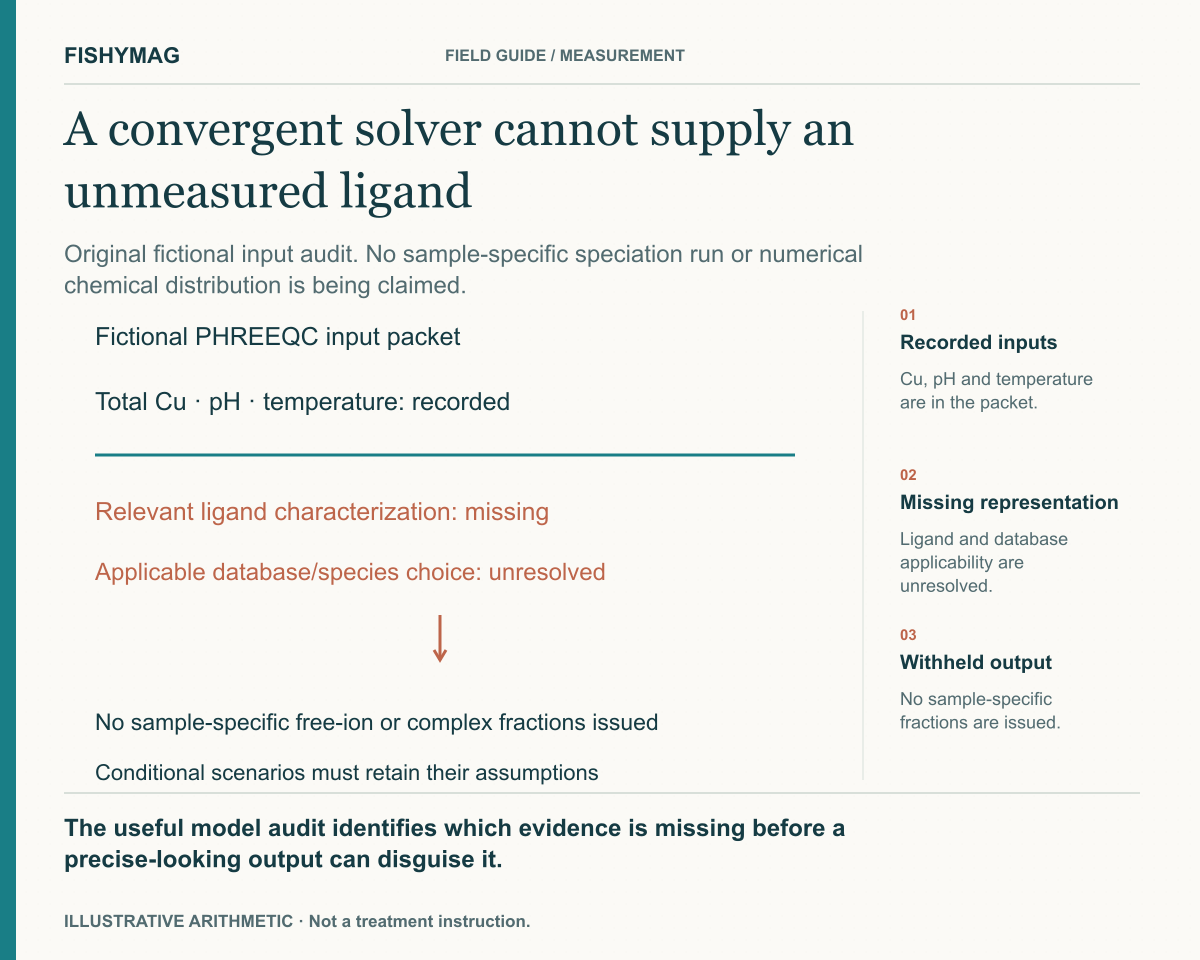
Figure data and explanation
Original fictional input audit. No sample-specific speciation run or numerical chemical distribution is being claimed.
- Recorded inputs
- Cu, pH and temperature are in the packet.
- Missing representation
- Ligand and database applicability are unresolved.
- Withheld output
- No sample-specific fractions are issued.
The useful model audit identifies which evidence is missing before a precise-looking output can disguise it.
Identify the output before opening a solver
The fictional question asks for free cupric-ion activity and the fraction bound to an unspecified organic ligand. The packet contains total copper, pH and temperature records but does not characterize that ligand or establish which database representation covers it. PHREEQC is a named equilibrium framework, not a source of missing sample facts. Its inputs and selected thermodynamic database define which species and reactions can be represented.
Complete the dependency audit
A blank ligand field is not evidence of zero ligand. A database with an element named copper is also not proof that it represents every complex in a proprietary formulation. The table separates facts already recorded from assumptions that would have to be introduced.
| Dependency | Packet status | Effect on requested output |
|---|---|---|
| Total copper and analytical fraction | Recorded, retain its actual method scope | Provides an input boundary, not all species |
| pH and temperature | Recorded | Necessary conditions, not complete composition |
| Relevant ligand identity and total | Missing | Requested bound fraction unsupported |
| Applicable database species/constants | Unresolved | No defensible sample-specific distribution |
| Equilibrium applicability | Not demonstrated | Kinetic or handling effects not resolved |
| A no-ligand scenario | Could be separately declared as hypothetical | Not the actual sample reconstructed |
Make a conditional run visibly different from an answer
An exploratory scenario can show how a declared assumption changes model output, but its input file, database version and excluded processes must accompany it. Do not silently default missing ligand information to zero or call a converged solution validated. For this packet, the completed action is to obtain the relevant composition and model-applicability evidence before running the requested interpretation. No invented model values or aquarium compatibility verdict are published.
Use your own details
Is your aquarium metal-speciation model answerable? worksheet
Download the editable text file, fill it in on your device and keep it with the relevant record. This blank worksheet records your information; it does not verify entries or approve treatment.
- Requested output and its chemical definition
- Original total-copper fraction and method
- pH, temperature and major-ion composition
- Ligand identities, totals and binding representation
- Database, species and equilibrium constants
- Activity treatment and applicable matrix domain
- Equilibrium versus kinetic assumptions
- Unsupported outputs and evidence needed for a defensible run
Put it into practice
Your checklist
- Define the requested species or activity first.
- Retain missing ligand information as missing.
- Separate solver convergence from sample and database applicability.
Sources and scope
This article distinguishes manufacturer statements from FishyMag’s own workflows and arithmetic examples. Linked formulation records retain their own evidence dates; publishing this article does not refresh those records.
- USGS PHREEQC Version 3 manual: capabilities and computational scope; reviewed November 9, 2026 ↗
- USGS PHREEQC SOLUTION: units, calculated density, pH and alkalinity; reviewed November 9, 2026 ↗
- Vitens PhreeqPython primary repository and local version 1.6.2; reviewed November 9, 2026 ↗
- Thermo Scientific cupric ion-selective electrode user guide; reviewed November 9, 2026 ↗
AI-assisted writing and development. Not hands-on product testing or veterinary review. How we publish →
FishyMag reports what manufacturers say, quoted and linked. It does not diagnose illness or recommend a treatment, and it never infers that a product is safe from the absence of a warning — where no statement exists, it says so.
Formulations change. Always read the label on the bottle in your hand, and contact the manufacturer if your tank contains anything valuable or unusual.