Measurement
What a spike-recovery check can reveal about an aquarium test
Calculate a laboratory matrix-spike recovery on the correct incremental basis and distinguish an out-of-range finding from a proven chemical mechanism.
By FishyMag · Published
Worked arithmetic example · Not a clinical review or treatment recommendation.
Quick answer
For the fictional supplied report, (2.7 − 2.0)/1.0 × 100 = 70% incremental recovery. That is outside EPA 353.2’s stated 90 to 110% LFM range. If laboratory performance is otherwise in control, the method identifies a matrix- or solution-related question. It does not prove which constituent caused it or justify dividing the native result by 0.70.
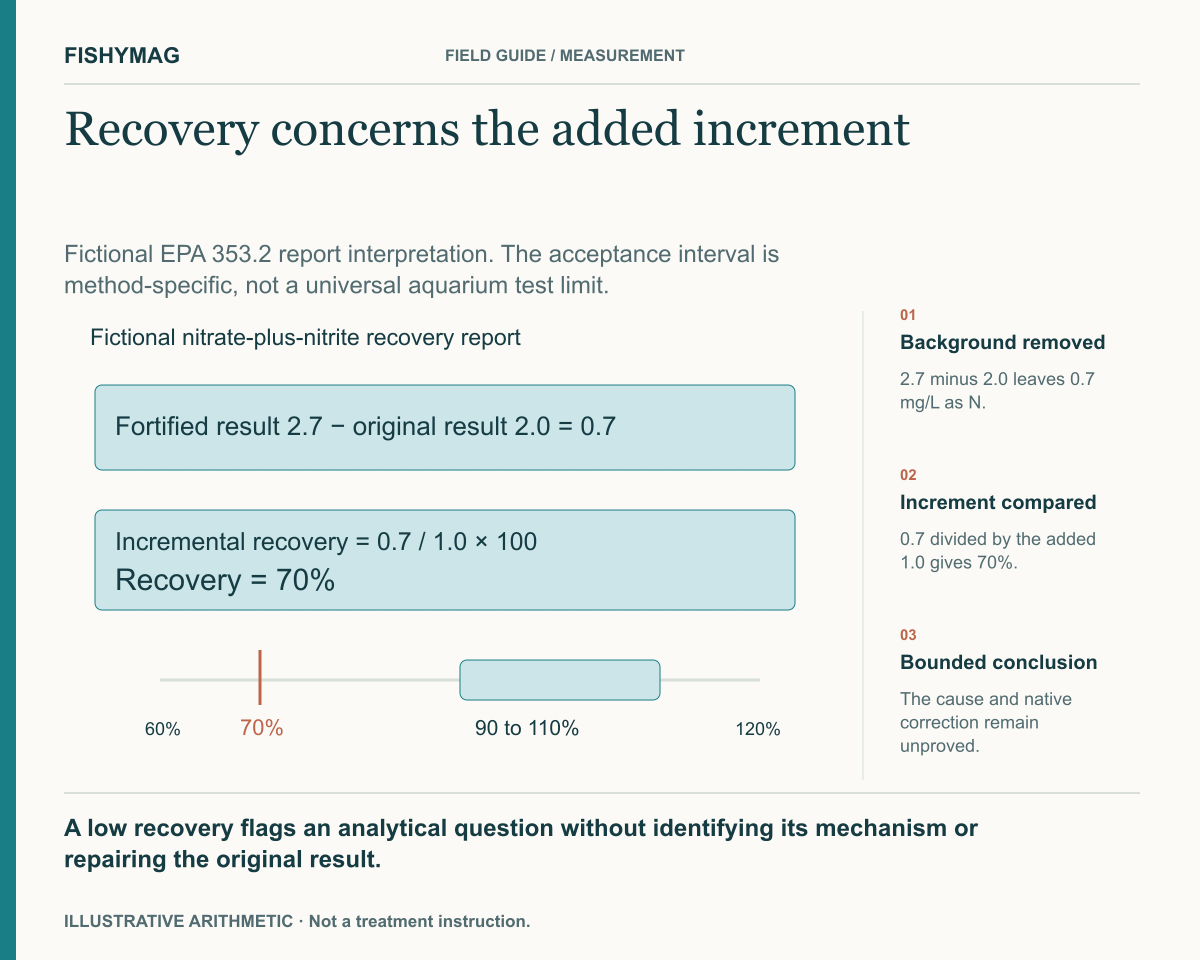
Figure data and explanation
Fictional EPA 353.2 report interpretation. The acceptance interval is method-specific, not a universal aquarium test limit.
- Background removed
- 2.7 minus 2.0 leaves 0.7 mg/L as N.
- Increment compared
- 0.7 divided by the added 1.0 gives 70%.
- Bounded conclusion
- The cause and native correction remain unproved.
A low recovery flags an analytical question without identifying its mechanism or repairing the original result.
Read the laboratory’s final-volume basis
EPA 353.2 evaluates a laboratory fortified sample matrix using background-corrected recovery. This teaching packet supplies final-volume-compatible concentrations from a laboratory record: original sample 2.0 mg/L as N, fortified sample 2.7 mg/L as N and an added increment equivalent to 1.0 mg/L as N. It does not provide stock preparation, spiking instructions or a household experiment.
Subtract the native background once
The observed increment is 0.7 mg/L as N, not the full fortified result of 2.7. Dividing that increment by the documented addition gives a recovery fraction of 0.70. Multiplying by 100 gives 70%. All numbers are invented, including the accompanying laboratory control result.
| Record | Case value | Review meaning |
|---|---|---|
| Original sample | 2.0 mg/L as N | Background to subtract in recovery calculation |
| Fortified sample | 2.7 mg/L as N | Includes original background and recovered increment |
| Added increment | 1.0 mg/L as N | Supplied final-volume-equivalent basis |
| LFM recovery | 70% | Outside the method’s stated 90 to 110% range |
| Laboratory fortified blank | 100%; other controls in control as declared | Case supports a matrix- or solution-related review question |
Do not turn a failed recovery into a corrected aquarium value
The completed conclusion is that this fictional LFM result is outside the specified range and needs the laboratory’s qualified assessment. It does not establish that native analyte and freshly added analyte behave identically. A calculation of 2.0/0.70 would therefore create an unsupported corrected sample result. Keep native measurement, fortified measurement, addition basis and control evidence separate. Ask about relevant method qualifications, uncertainty and the final reporting decision. An outlying recovery supports investigation of the analytical result; it does not identify an aquarium treatment, diagnose an animal or prove a particular additive caused the discrepancy.
Use your own details
What a spike-recovery check can reveal about an aquarium test worksheet
Download the editable text file, fill it in on your device and keep it with the relevant record. This blank worksheet records your information; it does not verify entries or approve treatment.
- Aquarium and sample identity
- Instrument or laboratory method revision
- Original reading including flags
- Chemical basis and unit
- Sample preparation or blank identity recorded
- Quality-control evidence
- Supported finding and calculation
- Unresolved question and source
Put it into practice
Your checklist
- Use the increment above background, not the full fortified result.
- Check the method’s actual recovery range and accompanying controls.
- Do not invent a native-result correction from spike recovery.
Sources and scope
This article distinguishes manufacturer statements from FishyMag’s own workflows and arithmetic examples. Linked formulation records retain their own evidence dates; publishing this article does not refresh those records.
AI-assisted writing and development. Not hands-on product testing or veterinary review. How we publish →
FishyMag reports what manufacturers say, quoted and linked. It does not diagnose illness or recommend a treatment, and it never infers that a product is safe from the absence of a warning — where no statement exists, it says so.
Formulations change. Always read the label on the bottle in your hand, and contact the manufacturer if your tank contains anything valuable or unusual.