Measurement
A phosphorus blank problem is not repaired by subtraction
Review a fictional EPA 365.1 batch where the reagent blank exceeds the established detection limit, including a higher-signal sample.
By FishyMag · Published
Worked arithmetic example · Not a clinical review or treatment recommendation.
Quick answer
Under EPA 365.1, a laboratory reagent blank above the established method detection limit calls for investigation before analysis continues. Subtracting that blank from a low aquarium result does not repair the batch. A larger sample result also does not cancel the documented quality-control problem.
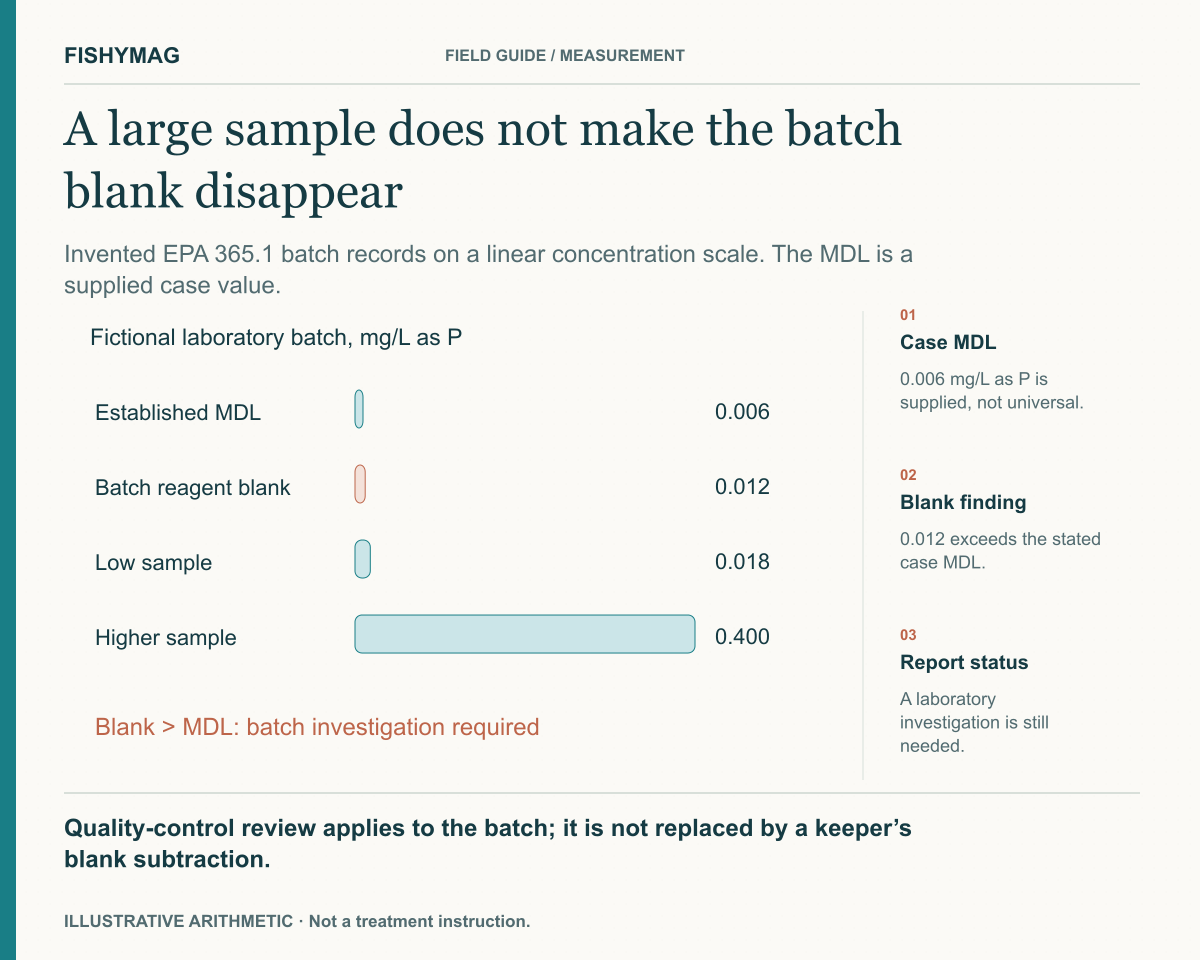
Figure data and explanation
Invented EPA 365.1 batch records on a linear concentration scale. The MDL is a supplied case value.
- Case MDL
- 0.006 mg/L as P is supplied, not universal.
- Blank finding
- 0.012 exceeds the stated case MDL.
- Report status
- A laboratory investigation is still needed.
Quality-control review applies to the batch; it is not replaced by a keeper’s blank subtraction.
Know which blank the report means
EPA 365.1 uses a laboratory reagent blank to assess contamination through the analytical process. Its batch response is not simply a keeper’s instruction to subtract a number. Distinguish this record from an optical zero, a calibration blank and a value already corrected in the laboratory’s reporting calculation. Ask the laboratory what the supplied blank represents.
Work the case as a batch review
All values below are fictional concentration-equivalent reports from one declared batch. The laboratory has supplied an established MDL of 0.006 mg/L as P. The reagent blank is 0.012. The low sample is 0.018 and a higher sample is 0.400. The low sample minus blank is arithmetically 0.006, but no correction is authorized by this exercise.
| Record | mg/L as P | Completed review |
|---|---|---|
| Established MDL | 0.006 | Case-specific supplied limit, not a universal method number |
| Reagent blank | 0.012 | Above the supplied MDL; batch problem requires review |
| Low sample | 0.018 | No repaired report created by subtraction |
| Higher sample | 0.400 | Larger signal does not erase the batch problem |
| 0.018 − 0.012 | 0.006 | Arithmetic only; not an authorized corrected result |
Request the corrected analytical record
The completed response is to ask for the laboratory’s investigation and final qualified or reissued report. Retain the original sample outputs and blank data with their batch identity. Do not replace a laboratory result with the arithmetic difference or use the derived number as a reporting limit. If the laboratory later supplies an amended report, preserve the relationship to the original and the reason for the change. This case illustrates a documented quality-control trigger; it does not diagnose the source of contamination or tell a household keeper how to prepare or clean laboratory equipment.
Use your own details
A phosphorus blank problem is not repaired by subtraction worksheet
Download the editable text file, fill it in on your device and keep it with the relevant record. This blank worksheet records your information; it does not verify entries or approve treatment.
- Aquarium and matched sample identity
- Analyte and chemical reporting basis
- Filtered or unfiltered fraction
- Method and pretreatment recorded by laboratory
- Original values and qualifiers
- Permitted derivation and units
- Uncertainty or applicability limits
- Completed interpretation and unresolved questions
Put it into practice
Your checklist
- Identify the actual blank type and whether correction already occurred.
- Apply the method’s batch rule to the supplied QC data.
- Keep subtraction separate from an authorized final report.
Sources and scope
This article distinguishes manufacturer statements from FishyMag’s own workflows and arithmetic examples. Linked formulation records retain their own evidence dates; publishing this article does not refresh those records.
AI-assisted writing and development. Not hands-on product testing or veterinary review. How we publish →
FishyMag reports what manufacturers say, quoted and linked. It does not diagnose illness or recommend a treatment, and it never infers that a product is safe from the absence of a warning — where no statement exists, it says so.
Formulations change. Always read the label on the bottle in your hand, and contact the manufacturer if your tank contains anything valuable or unusual.