Measurement
2% of what? Read the basis of a treatment strength statement
A fictional mass-and-volume example shows why a bare percentage cannot always be converted to milligrams per millilitre.
By FishyMag · Published · Updated
Worked arithmetic example · Not a clinical review or treatment recommendation.
Quick answer
A percentage needs its basis. A mass-per-volume percentage and a mass-per-mass percentage have different denominators. Do not convert a bare percentage to mg/mL unless the label or manufacturer establishes what it means.
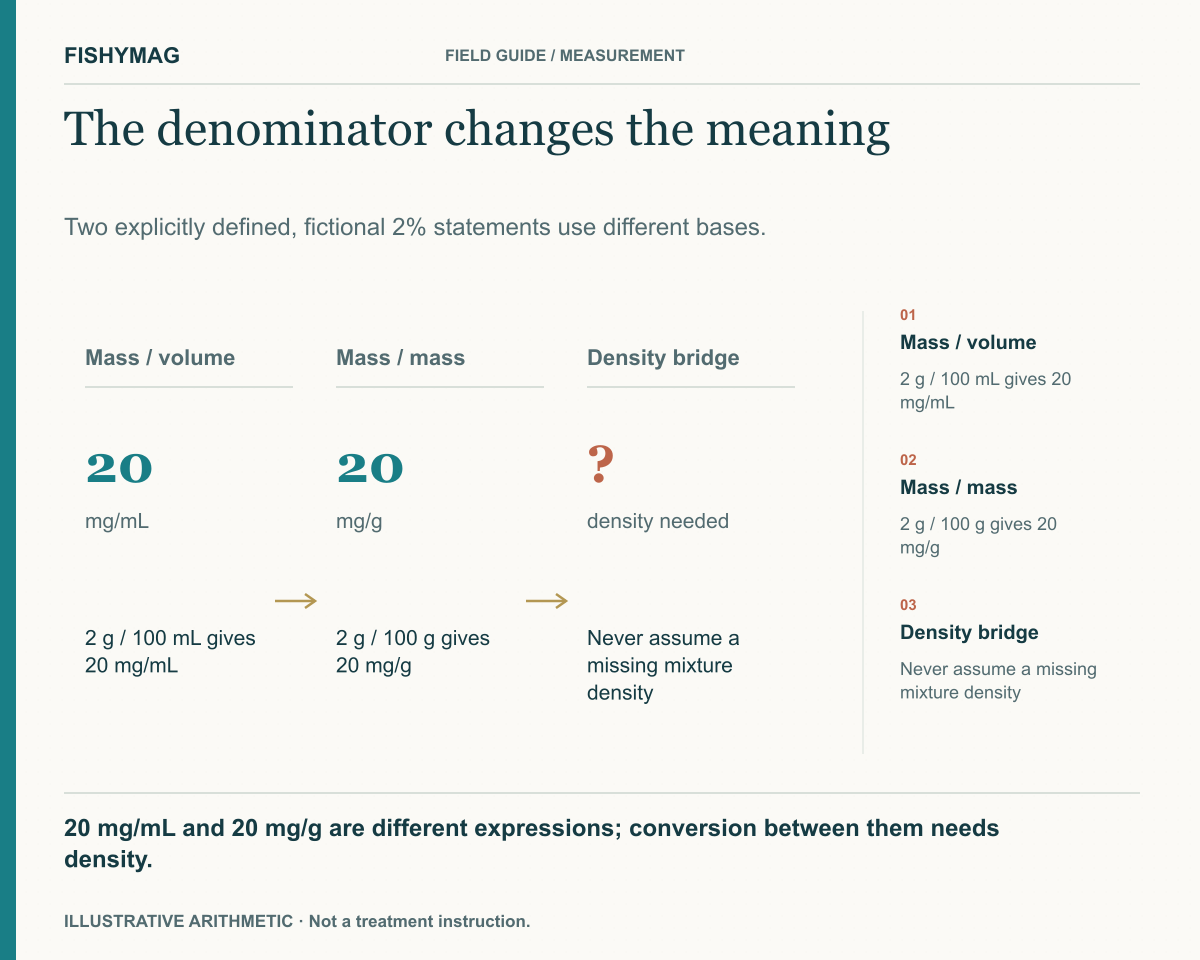
Figure data and explanation
Two explicitly defined, fictional 2% statements use different bases.
- Mass / volume
- 20 mg/mL. 2 g / 100 mL gives 20 mg/mL
- Mass / mass
- 20 mg/g. 2 g / 100 g gives 20 mg/g
- Density bridge
- ? density needed. Never assume a missing mixture density
20 mg/mL and 20 mg/g are different expressions; conversion between them needs density.
Write the denominator in full
In this fictional example, 2% mass per volume is defined as 2 g of a substance in 100 mL of final solution. A 2% mass-per-mass example means 2 g in 100 g of final mixture. The definitions here are explicit; a real product may use another convention or leave the basis unclear. Copy the product’s complete strength statement rather than filling in an assumed denominator.
Work the defined volume example
For the defined 2 g per 100 mL example, 2 g equals 2,000 mg. Dividing by 100 mL gives 20 mg/mL. A hypothetical 3 mL quantity then contains 60 mg of that named substance. This is unit arithmetic for an invented liquid, not a dose, a formulation identity or a claim about a real aquarium product.
See why the mass example needs more information
For 2 g in 100 g of mixture, the equivalent is 20 mg per gram of mixture. Converting that to mg per millilitre requires the mixture’s density under applicable conditions. Assuming one gram equals one millilitre silently inserts information that the mass statement did not provide. Ingredient purity and the chemical form named can raise further identity questions.
Use the missing basis as the question
Ask: “Does this percentage mean mass per volume, mass per mass or another basis, and which chemical form does it describe?” Keep the reply with the bottle identity. Even a valid conversion does not establish compatibility or select a tank concentration. The point is to expose the missing input, not to formulate a substitute product.
Put it into practice
Your checklist
- Copy the complete strength statement and its denominator.
- Convert mass and volume only when the required basis is defined.
- Ask for missing density or chemical-form information instead of assuming it.
Sources and scope
This article distinguishes manufacturer statements from FishyMag’s own workflows and arithmetic examples. Linked formulation records retain their own evidence dates; publishing this article does not refresh those records.
- FishyMag evidence methodology and editorial scope ↗
- FishyMag dose calculator: scope and unit limits ↗
AI-assisted writing and development. Not hands-on product testing or veterinary review. How we publish →
FishyMag reports what manufacturers say, quoted and linked. It does not diagnose illness or recommend a treatment, and it never infers that a product is safe from the absence of a warning — where no statement exists, it says so.
Formulations change. Always read the label on the bottle in your hand, and contact the manufacturer if your tank contains anything valuable or unusual.