Measurement
What a Gran-plot intercept needs in an aquarium laboratory report
Reanalyse actual published rounded USGS data with three explicit fit windows, retaining transformation, point selection and the limits of the new intercepts.
By FishyMag · Published
Worked arithmetic example · Not a clinical review or treatment recommendation.
Quick answer
A Gran intercept needs the transformed observations and the fitted region, not just a straight line on a screenshot. Reanalysis of the same published rounded USGS points gives intercepts of 142.01, 143.41 and 143.15 counts for three explicit windows. These are new fits, not the source’s published 139.5-count result or three validated analytical alternatives.
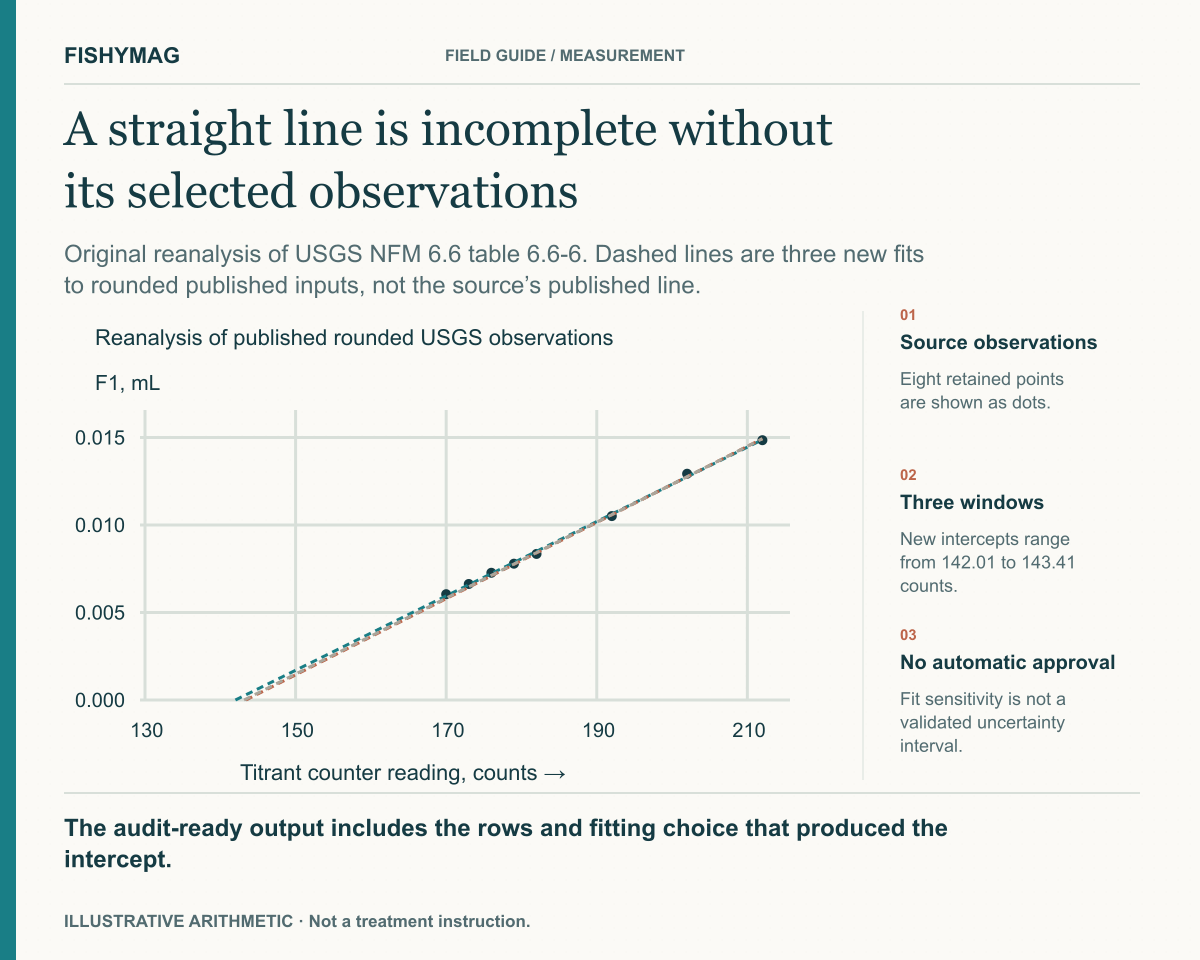
Figure data and explanation
Original reanalysis of USGS NFM 6.6 table 6.6-6. Dashed lines are three new fits to rounded published inputs, not the source’s published line.
- Source observations
- Eight retained points are shown as dots.
- Three windows
- New intercepts range from 142.01 to 143.41 counts.
- No automatic approval
- Fit sensitivity is not a validated uncertainty interval.
The audit-ready output includes the rows and fitting choice that produced the intercept.
Retain enough data to audit the line
This example reanalyses the USGS NFM 6.6 table 6.6-6 data, not aquarium samples. The cited basic F1 function is (V0 + Vt) × 10 to the power of minus pH, without activity correction. Here V0 is 200 mL and Vt is the printed count divided by 800. The eight retained source rows run from 170 to 212 counts. Published pH is rounded to two decimals; the downloadable calculation preserves that limitation.
Work the transformation and compare explicit windows
At 170 counts, Vt = 0.2125 mL, so F1 = 200.2125 × 10^(-4.52), approximately 0.006046 mL. Ordinary least squares is then applied to F1 versus counts. Its zero crossing is minus the fitted intercept divided by the slope. The table keeps the observation count separate from the instrument’s titrant counter.
| Retained counter range | Observations | New zero crossing, counts | What the result supports |
|---|---|---|---|
| 170 to 212 | 8 | 142.0051 | Explicit calculation from these rounded rows |
| 179 to 212 | 5 | 143.4074 | Sensitivity to a narrower selected window |
| 192 to 212 | 3 | 143.1528 | A three-point fit, not independent validation |
| Published source analysis | Source’s own selection | 139.5 | Retain as the published result, not this reanalysis |
Resolve the fitting question before converting it to a capacity
The window comparison spans about 1.40 counts. That spread is not an uncertainty interval: the fits reuse observations and none is independently approved as the applicable region. The source’s line and rounding history also cannot be reconstructed solely from these selected rounded inputs. A real aquarium laboratory packet should retain its original export, applicable region, titrant standardization, sample volume and analysis method before an intercept becomes a capacity result. No aquarium alkalinity is calculated from the historical example, and no fitting window is recommended from visual straightness alone.
Use your own details
What a Gran-plot intercept needs in an aquarium laboratory report worksheet
Download the editable text file, fill it in on your device and keep it with the relevant record. This blank worksheet records your information; it does not verify entries or approve treatment.
- Report method and actual sample identity
- Sample volume and titrant-volume conversion
- Original pH precision and full retained observations
- Gran function and activity convention
- Chosen fitting window and excluded rows
- Slope, intercept and residual information
- Original source result versus new reanalysis
- Evidence supporting region applicability and any reported capacity
Worked example files
These files contain the article’s worked example. Read its source and scope notes, and keep your own current records before opening an example in a tool.
Put it into practice
Your checklist
- Retain the transformed source rows and their precision.
- State the actual fitting window and zero-crossing calculation.
- Do not call window sensitivity an uncertainty estimate or method validation.
Sources and scope
This article distinguishes manufacturer statements from FishyMag’s own workflows and arithmetic examples. Linked formulation records retain their own evidence dates; publishing this article does not refresh those records.
- USGS NFM 6.6 v4.0 (2012), full primary-authored manual via NEON mirror; reviewed November 9, 2026 ↗
- USGS NFM 6.6, 2012: alkalinity and acid-neutralizing capacity; reviewed November 9, 2026 ↗
AI-assisted writing and development. Not hands-on product testing or veterinary review. How we publish →
FishyMag reports what manufacturers say, quoted and linked. It does not diagnose illness or recommend a treatment, and it never infers that a product is safe from the absence of a warning — where no statement exists, it says so.
Formulations change. Always read the label on the bottle in your hand, and contact the manufacturer if your tank contains anything valuable or unusual.