Measurement
When an aquarium ion total disagrees with dissolved solids
Reconcile a constituent sum with a gravimetric dissolved-solids result through field membership and bicarbonate-residue conventions, leaving the remaining gap visible.
By FishyMag · Published
Worked arithmetic example · Not a clinical review or treatment recommendation.
Quick answer
Do not add every numeric field in a water report. In this fictional packet, a raw sum of 180 mg/L includes a 20 mg/L-as-CaCO3 equivalent field that is not another constituent mass. Removing it gives 160. A stated bicarbonate-residue convention then gives 144.751, leaving a 15.249 mg/L difference from the gravimetric result. The unexplained remainder is retained.
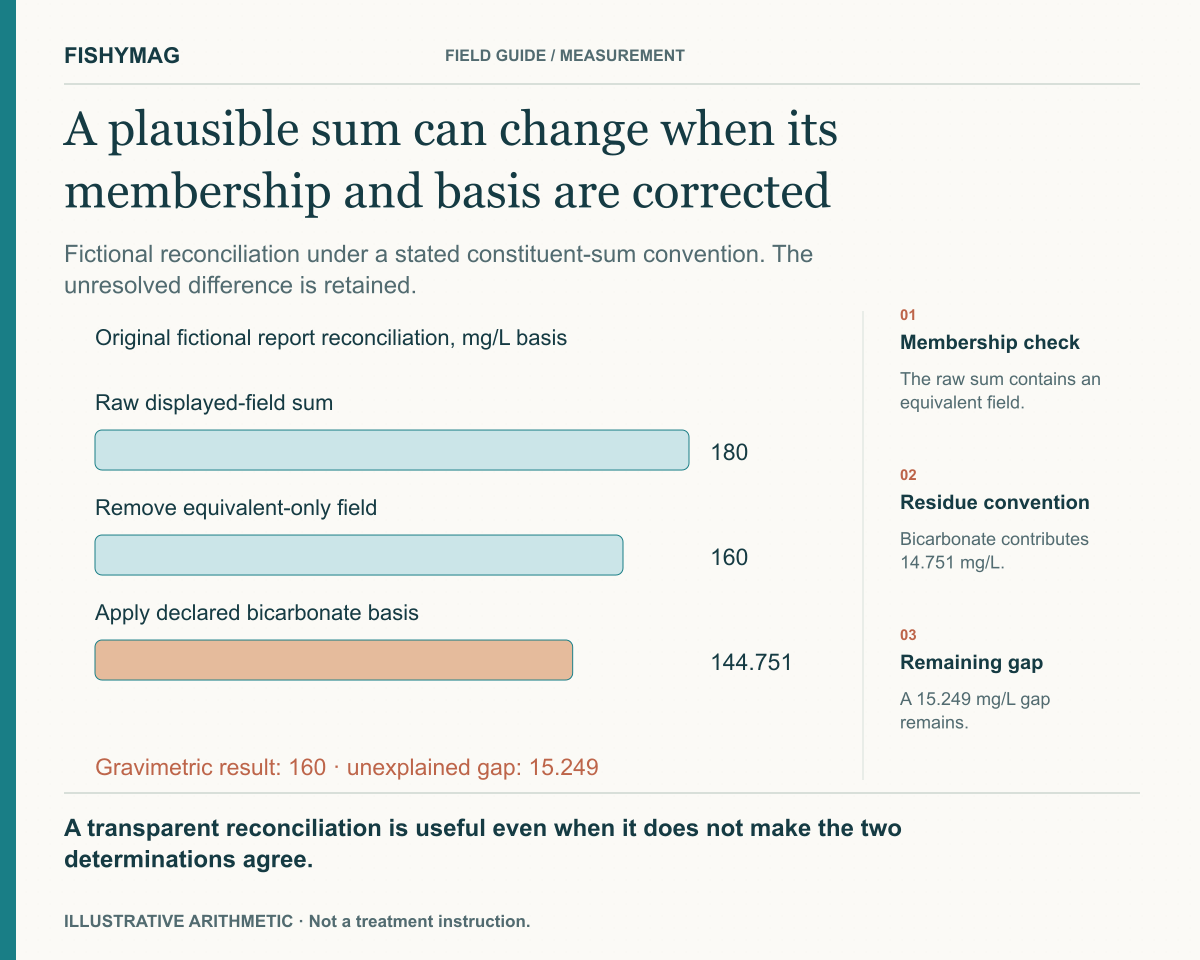
Figure data and explanation
Fictional reconciliation under a stated constituent-sum convention. The unresolved difference is retained.
- Membership check
- The raw sum contains an equivalent field.
- Residue convention
- Bicarbonate contributes 14.751 mg/L.
- Remaining gap
- A 15.249 mg/L gap remains.
A transparent reconciliation is useful even when it does not make the two determinations agree.
Audit membership before comparing totals
The constructed raw list adds 180 mg/L by treating every displayed value as mass on the same basis. Twenty units come from a derived CaCO3-equivalent field whose underlying constituents are already represented. It is not an additional 20 mg/L of dissolved material. The retained constituent subtotal is therefore 160 mg/L. This packet deliberately demonstrates bad spreadsheet membership, rather than presenting the raw sum as a valid chemical inventory.
Work the selected residue-basis adjustment
The retained list includes 30.000 mg HCO3/L and 130.000 mg/L of other non-overlapping constituent masses. The stated calculation adopts the TWDB constituent-sum convention, 0.4917 times bicarbonate. Its bicarbonate contribution becomes 14.751 mg/L, and the calculated subtotal is 144.751. EPA 160.1 and the cited USGS comparison explain why a dry-residue basis need not retain the full dissolved bicarbonate mass unchanged.
| Reconciliation step | Calculation | mg/L on the stated comparison basis |
|---|---|---|
| Raw displayed-field sum | Uncritical addition | 180.000, invalid membership |
| Remove derived equivalent-only field | 180 − 20 | 160.000 constituent subtotal |
| Bicarbonate residue contribution | 30 × 0.4917 | 14.751 |
| Retain other constituent masses | 130 + 14.751 | 144.751 calculated subtotal |
| Separate gravimetric report | Original fictional laboratory value | 160.000 |
| Unexplained difference | 160 − 144.751 | 15.249, not forced to zero |
Do not confuse reconciliation with identifying the missing mass
The near match after removing the bad field was coincidental within the constructed example: the reporting convention still mattered. The remaining gap does not identify an organic fraction, prove a laboratory error or supply a correction factor. A real comparison needs appropriate constituent membership, analytical fractions, method conditions and uncertainty information; additional dissolved components can also be unmeasured. No extra adjustment should be invented merely to close the account. The finished worksheet retains each justified step and the unresolved remainder.
Use your own details
When an aquarium ion total disagrees with dissolved solids worksheet
Download the editable text file, fill it in on your device and keep it with the relevant record. This blank worksheet records your information; it does not verify entries or approve treatment.
- Complete original report and sample identity
- Each row’s constituent or derived-quantity status
- Element, ion and equivalent reporting bases
- Duplicate or overlapping entries
- Selected residue or constituent-sum convention
- Documented adjustments with their reasons
- Final comparison and unadjusted remainder
- Uncertainties and unmeasured contributions
Put it into practice
Your checklist
- Separate constituent masses from equivalent and derived fields.
- Apply only the named comparison convention.
- Leave an unexplained remainder visible instead of forcing closure.
Sources and scope
This article distinguishes manufacturer statements from FishyMag’s own workflows and arithmetic examples. Linked formulation records retain their own evidence dates; publishing this article does not refresh those records.
- EPA 160.1 official NEMI method record: filterable residue; reviewed November 9, 2026 ↗
- USGS 2024 comparison of dissolved-solids calculations; reviewed November 9, 2026 ↗
- Texas Water Development Board: groundwater database definitions; reviewed November 9, 2026 ↗
AI-assisted writing and development. Not hands-on product testing or veterinary review. How we publish →
FishyMag reports what manufacturers say, quoted and linked. It does not diagnose illness or recommend a treatment, and it never infers that a product is safe from the absence of a warning — where no statement exists, it says so.
Formulations change. Always read the label on the bottle in your hand, and contact the manufacturer if your tank contains anything valuable or unusual.