Measurement
Hardness and alkalinity: what “as CaCO3” does not tell you
Compare three checked freshwater model states with independently varying calcium-magnesium hardness and alkalinity instead of inferring one from the other.
By FishyMag · Published
Worked arithmetic example · Not a clinical review or treatment recommendation.
Quick answer
Hardness and alkalinity are different quantities. In the checked examples, A and C both have 2.00 meq/L calcium hardness, but alkalinity is approximately zero in A and 2.00 in C. B and C share 2.00 meq/L alkalinity while their calcium hardness differs. These are constructed states, not waters to prepare or aquarium targets.
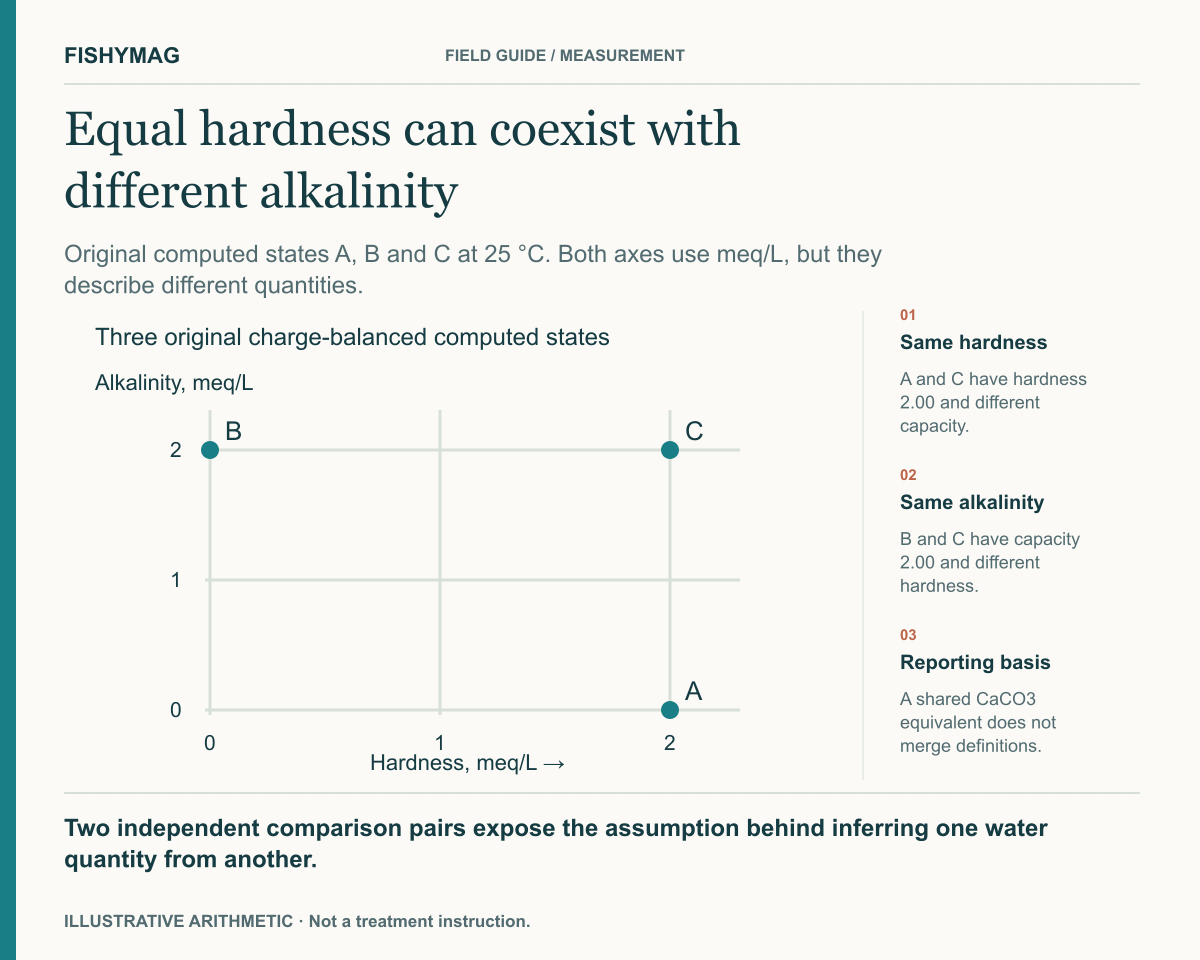
Figure data and explanation
Original computed states A, B and C at 25 °C. Both axes use meq/L, but they describe different quantities.
- Same hardness
- A and C have hardness 2.00 and different capacity.
- Same alkalinity
- B and C have capacity 2.00 and different hardness.
- Reporting basis
- A shared CaCO3 equivalent does not merge definitions.
Two independent comparison pairs expose the assumption behind inferring one water quantity from another.
Keep the two definitions separate
USGS describes water hardness primarily through dissolved calcium and magnesium. Alkalinity instead describes acid-neutralizing capacity under its applicable definition. A calcium result therefore cannot fill a missing alkalinity field. The original model states below retain their counterions and carbon totals, so they do not rely on a list of positive charges without a matching solution composition.
Complete both comparison pairs
All states are at 25 °C and 1 atm, with calculated density and electrical charge balance checked. Values are per liter of computed solution. Magnesium is absent from these deliberately simple cases. DIC is dissolved inorganic carbon; the table describes states, not salt additions.
| State | Ca, mmol/L | Na, mmol/L | Cl, mmol/L | DIC, mmol/L | Hardness, meq/L | Alkalinity, meq/L |
|---|---|---|---|---|---|---|
| A | 1.00 | 0 | 2.00 | 0 | 2.00 | Approximately 0 |
| B | 0 | 2.00 | 0 | 2.00 | 0 | 2.00 |
| C | 1.00 | 2.00 | 2.00 | 2.00 | 2.00 | 2.00 |
A shared reporting unit does not make the quantities interchangeable
The A-C pair holds hardness constant and changes capacity. The B-C pair holds capacity constant and changes hardness. Using an approximate 50.04 mg per meq calcium-carbonate equivalent, the 2.00 meq/L quantity corresponds to about 100.08 mg/L as CaCO3; that reporting convention does not turn hardness into alkalinity. Keep the actual analytical identities, fractions and conditions when interpreting a real packet. These model counterexamples establish why an inference is insufficient; they do not estimate a particular aquarium’s composition or predict treatment compatibility.
Read “as CaCO3” as a reporting equivalent
Using the approximate 50.04 mg/meq convention, an alkalinity report of 100 mg/L as CaCO3 converts to 100 ÷ 50.04 = 1.9984 meq/L, about 2.00. That report is not a reconstruction of the model states, whose exact 2.00 meq/L corresponds to about 100.08 mg/L on the stated convention. The A-B-C comparison already demonstrates why the equivalent does not determine calcium. Keep the measured quantity and its method beside the unit.
| Claim about the 100 mg/L alkalinity report | Finding |
|---|---|
| Approximately 2.00 meq/L capacity | Supported by the stated equivalent conversion |
| 100 mg/L elemental calcium | Not established |
| 100 mg/L dissolved CaCO3 molecules | Not established |
| A particular mineral or calcium source | Not established |
Use your own details
Why aquarium hardness and alkalinity can diverge worksheet
Download the editable text file, fill it in on your device and keep it with the relevant record. This blank worksheet records your information; it does not verify entries or approve treatment.
- Original calcium and magnesium quantities and bases
- Original alkalinity result and selected method
- Other major ions and inorganic-carbon evidence
- Temperature, model and charge-balance convention
- Hardness calculation and calcium-carbonate equivalent convention
- Independent capacity result or model output
- Completed same-hardness and same-alkalinity comparisons
- Unsupported inference about a real aquarium sample
- Reported quantity beside the CaCO3-equivalent unit
- Equivalent-mass convention and bounded composition claim
Worked example files
These files contain the article’s worked example. Read its source and scope notes, and keep your own current records before opening an example in a tool.
Put it into practice
Your checklist
- Retain hardness and alkalinity as separate quantities.
- Check complete charge-consistent composition in a model example.
- Do not infer one missing result from the other.
Sources and scope
This article distinguishes manufacturer statements from FishyMag’s own workflows and arithmetic examples. Linked formulation records retain their own evidence dates; publishing this article does not refresh those records.
- USGS: hardness of water; reviewed November 8, 2026 ↗
- USGS PHREEQC Version 3 manual: capabilities and computational scope; reviewed November 9, 2026 ↗
- USGS PHREEQC SOLUTION: units, calculated density, pH and alkalinity; reviewed November 9, 2026 ↗
- Vitens PhreeqPython primary repository and local version 1.6.2; reviewed November 9, 2026 ↗
AI-assisted writing and development. Not hands-on product testing or veterinary review. How we publish →
FishyMag reports what manufacturers say, quoted and linked. It does not diagnose illness or recommend a treatment, and it never infers that a product is safe from the absence of a warning — where no statement exists, it says so.
Formulations change. Always read the label on the bottle in your hand, and contact the manufacturer if your tank contains anything valuable or unusual.