Measurement
A DPD chlorine colour can fade at the wrong end of the range
Use the documented DPD bleaching mechanism to avoid interpreting a faded chlorine-test response as proof of zero.
By FishyMag · Published
Manufacturer-source commentary · Not a clinical review or treatment recommendation.
Quick answer
Palintest describes further oxidation of the DPD dye that can remove its colour above the selected test’s range. A faded response can therefore be analytically invalid rather than evidence of zero chlorine. Use the actual method’s range and documented response route; do not add reagent or invent a correction from colour strength.
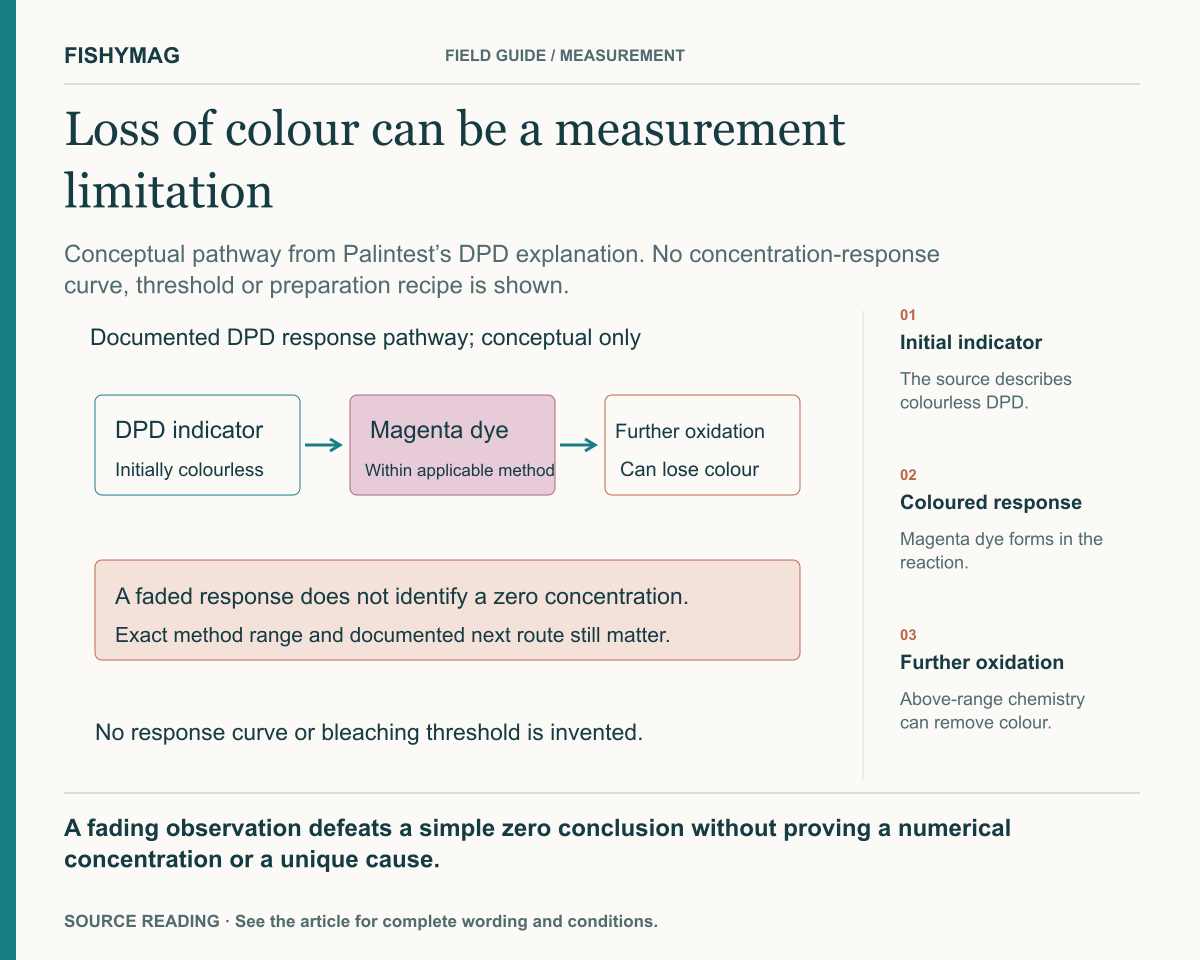
Figure data and explanation
Conceptual pathway from Palintest’s DPD explanation. No concentration-response curve, threshold or preparation recipe is shown.
- Initial indicator
- The source describes colourless DPD.
- Coloured response
- Magenta dye forms in the reaction.
- Further oxidation
- Above-range chemistry can remove colour.
A fading observation defeats a simple zero conclusion without proving a numerical concentration or a unique cause.
A coloured reaction has a supported response region
Palintest explains that DPD oxidation produces a magenta dye and further oxidation can form a colourless product. The selected test’s range matters. This example concerns interpretation of an existing source-water chlorine report before aquarium use, not a proposal to add chlorine, reproduce bleaching or test animals. A threshold from a different DPD reagent system cannot be copied across methods.
Work an archived source-water record
The fictional packet W4 records a brief pink response followed by fading. The particular test revision and applicable upper range were not retained. The observation is a reason to review the method, not enough to establish its cause or quantify the original water.
| Proposed conclusion | Evidence in W4 | Completed finding |
|---|---|---|
| “No colour means zero chlorine” | Fading was recorded | Unsupported; documented bleaching is an alternative |
| “Bleaching definitely caused it” | No method-specific investigation retained | Cause remains unresolved |
| “The reagent is exhausted or defective” | No independent reagent evidence | Not established by fading alone |
| “Use a higher corrected number” | No valid quantification supplied | No corrected concentration issued |
Resolve range and response before interpreting the number
Recover the exact method, reagent identity, observation timing and original instrument flags. Then follow its documented investigation route or ask the analytical provider for a qualified result. Do not convert the conceptual diagram into a calibration curve; it contains no numerical response data. Nor does this source establish that adding extra reagent, changing the sample volume or treating the lowest reading as correct would repair W4. The completed outcome is a bounded analytical finding: fading prevents the simple zero inference, while the actual cause and concentration are not established by the supplied record.
Use your own details
A DPD chlorine colour can fade at the wrong end of the range worksheet
Download the editable text file, fill it in on your device and keep it with the relevant record. This blank worksheet records your information; it does not verify entries or approve treatment.
- Aquarium or sample identity
- Method, study and revision
- Original response and reporting basis
- Applicable measurement conditions
- Comparison data and calculation
- Scope or selectivity evidence
- Completed conclusion
- Unresolved transfer or mechanism question
Put it into practice
Your checklist
- Keep the exact DPD method and response range attached.
- Do not infer zero from a faded reaction.
- Seek a documented investigation rather than changing reagent amounts.
Sources and scope
This article distinguishes manufacturer statements from FishyMag’s own workflows and arithmetic examples. Linked formulation records retain their own evidence dates; publishing this article does not refresh those records.
AI-assisted writing and development. Not hands-on product testing or veterinary review. How we publish →
FishyMag reports what manufacturers say, quoted and linked. It does not diagnose illness or recommend a treatment, and it never infers that a product is safe from the absence of a warning — where no statement exists, it says so.
Formulations change. Always read the label on the bottle in your hand, and contact the manufacturer if your tank contains anything valuable or unusual.