Measurement
Dissolved inorganic carbon is not alkalinity
Compare two checked states with the same alkalinity but different inorganic-carbon inventories, retaining the conversion to mg C/L and its distinct mass basis.
By FishyMag · Published
Worked arithmetic example · Not a clinical review or treatment recommendation.
Quick answer
Equal alkalinity does not force equal inorganic-carbon inventory. The two checked states both have 2.000 meq/L alkalinity, but DIC is 2.10 and 2.60 mmol C/L. On the declared carbon-mass convention, that is about 25.22 and 31.23 mg C/L. These are carbon totals, not mg/L CO2 or recommended aquarium conditions.
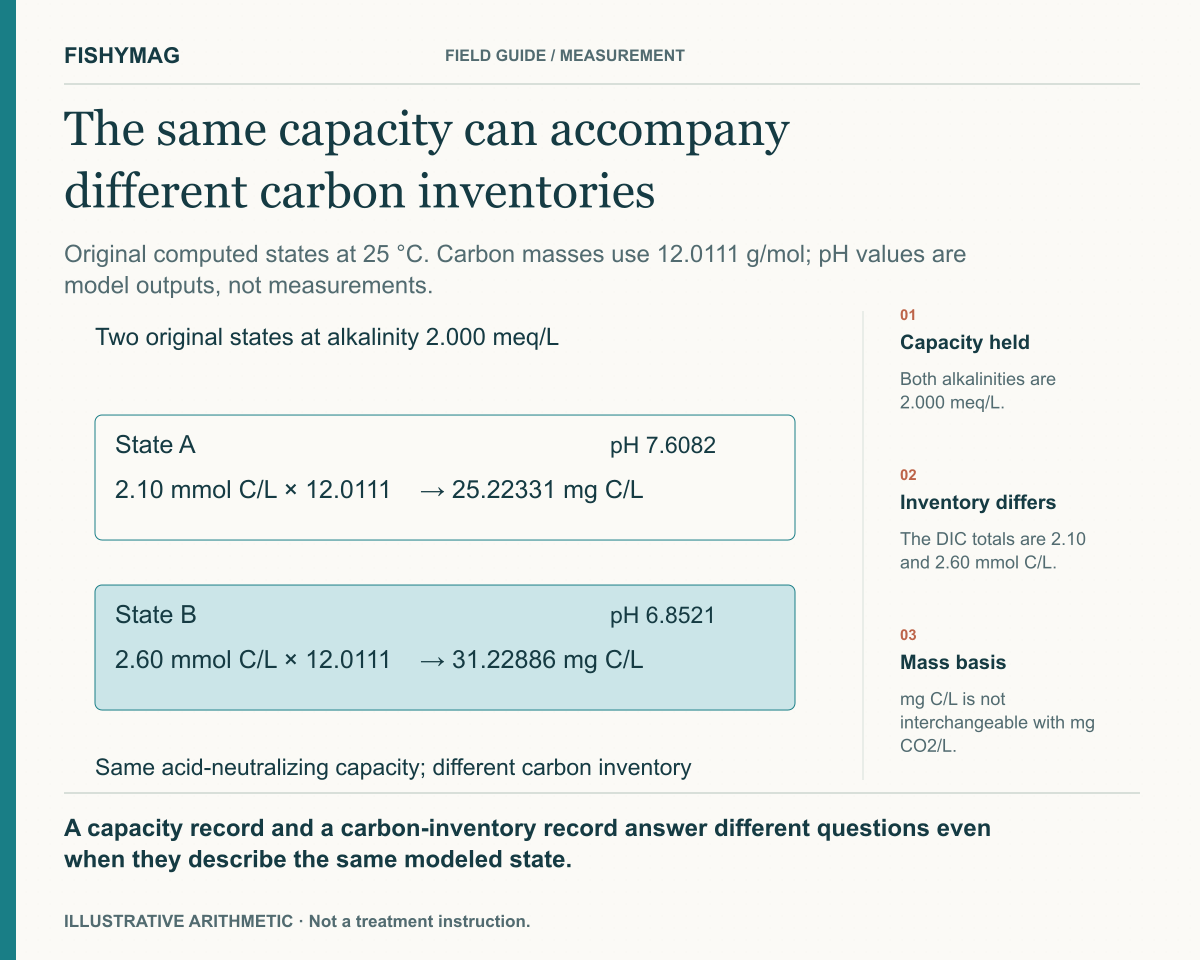
Figure data and explanation
Original computed states at 25 °C. Carbon masses use 12.0111 g/mol; pH values are model outputs, not measurements.
- Capacity held
- Both alkalinities are 2.000 meq/L.
- Inventory differs
- The DIC totals are 2.10 and 2.60 mmol C/L.
- Mass basis
- mg C/L is not interchangeable with mg CO2/L.
A capacity record and a carbon-inventory record answer different questions even when they describe the same modeled state.
Keep capacity and inventory in different fields
The original calculations specify alkalinity 2.000 meq/L, sodium countercharge about 2.000 mmol/L, 25 °C and 1 atm. DIC is separately set to 2.10 or 2.60 mmol C/L. Other major components in these deliberately simple states are absent as declared in the downloadable record. The solver adjusts pH to satisfy the supplied carbon and alkalinity conditions; no aquarium was changed or tested.
Complete both the model and the carbon-mass conversion
The stated database uses 12.0111 g/mol for carbon. Thus one mmol of carbon corresponds to 12.0111 mg C. The calculation uses computed solution volume rather than treating a kilogram of solvent as a liter by default.
| Quantity | State A | State B |
|---|---|---|
| Alkalinity | 2.000 meq/L | 2.000 meq/L |
| DIC | 2.10 mmol C/L | 2.60 mmol C/L |
| Carbon-mass calculation | 2.10 × 12.0111 | 2.60 × 12.0111 |
| DIC mass | 25.22331 mg C/L | 31.22886 mg C/L |
| Computed pH | 7.6082 | 6.8521 |
| Model interpretation | Lower carbon total at the same capacity | Higher carbon total at the same capacity |
Do not relabel the carbon total as dissolved CO2
DIC includes the carbon in bicarbonate, carbonate, aqueous CO2 and modeled complexes. A mass result expressed as C cannot be relabelled as CO2 merely because both involve carbon. The model record retains the species distribution and independent mass, charge and equilibrium checks. Its two states demonstrate that a capacity result alone does not determine the carbon inventory. They do not explain a real aquarium change without its own sampling, gas-exchange, composition and method evidence, and they do not identify a suitable treatment or CO2 setting.
Use your own details
Dissolved inorganic carbon is not alkalinity worksheet
Download the editable text file, fill it in on your device and keep it with the relevant record. This blank worksheet records your information; it does not verify entries or approve treatment.
- Original alkalinity with method and reporting basis
- DIC result or declared model input
- Carbon versus CO2 mass convention
- Temperature, full composition and charge balance
- Calculated pH and species distribution
- Molar-to-mass factor and its source convention
- Completed same-capacity inventory comparison
- Evidence needed to explain an actual change
Worked example files
These files contain the article’s worked example. Read its source and scope notes, and keep your own current records before opening an example in a tool.
Put it into practice
Your checklist
- Keep DIC and alkalinity as separate quantities.
- Preserve “as C” versus “as CO2” in mass results.
- Do not use equal capacity as proof of an unchanged carbon inventory.
Sources and scope
This article distinguishes manufacturer statements from FishyMag’s own workflows and arithmetic examples. Linked formulation records retain their own evidence dates; publishing this article does not refresh those records.
- USGS PHREEQC Version 3 manual: capabilities and computational scope; reviewed November 9, 2026 ↗
- USGS PHREEQC SOLUTION: units, calculated density, pH and alkalinity; reviewed November 9, 2026 ↗
- USGS PHREEQC SELECTED_OUTPUT: alkalinity and concentration output bases; reviewed November 9, 2026 ↗
- Vitens PhreeqPython primary repository and local version 1.6.2; reviewed November 9, 2026 ↗
AI-assisted writing and development. Not hands-on product testing or veterinary review. How we publish →
FishyMag reports what manufacturers say, quoted and linked. It does not diagnose illness or recommend a treatment, and it never infers that a product is safe from the absence of a warning — where no statement exists, it says so.
Formulations change. Always read the label on the bottle in your hand, and contact the manufacturer if your tank contains anything valuable or unusual.