Measurement
Is aquarium water different near the bottom?
Keep depth and operating-state blocks separate when comparing an aquarium temperature profile.
By FishyMag · Published
Worked arithmetic example · Not a clinical review or treatment recommendation.
Quick answer
Compare depths within the same documented state. In the fictional profiles, bottom minus top is +0.2 °C in block A and +1.0 °C in block B. Pooling all six values would hide that distinction. The records do not prove that equipment state caused the larger contrast.
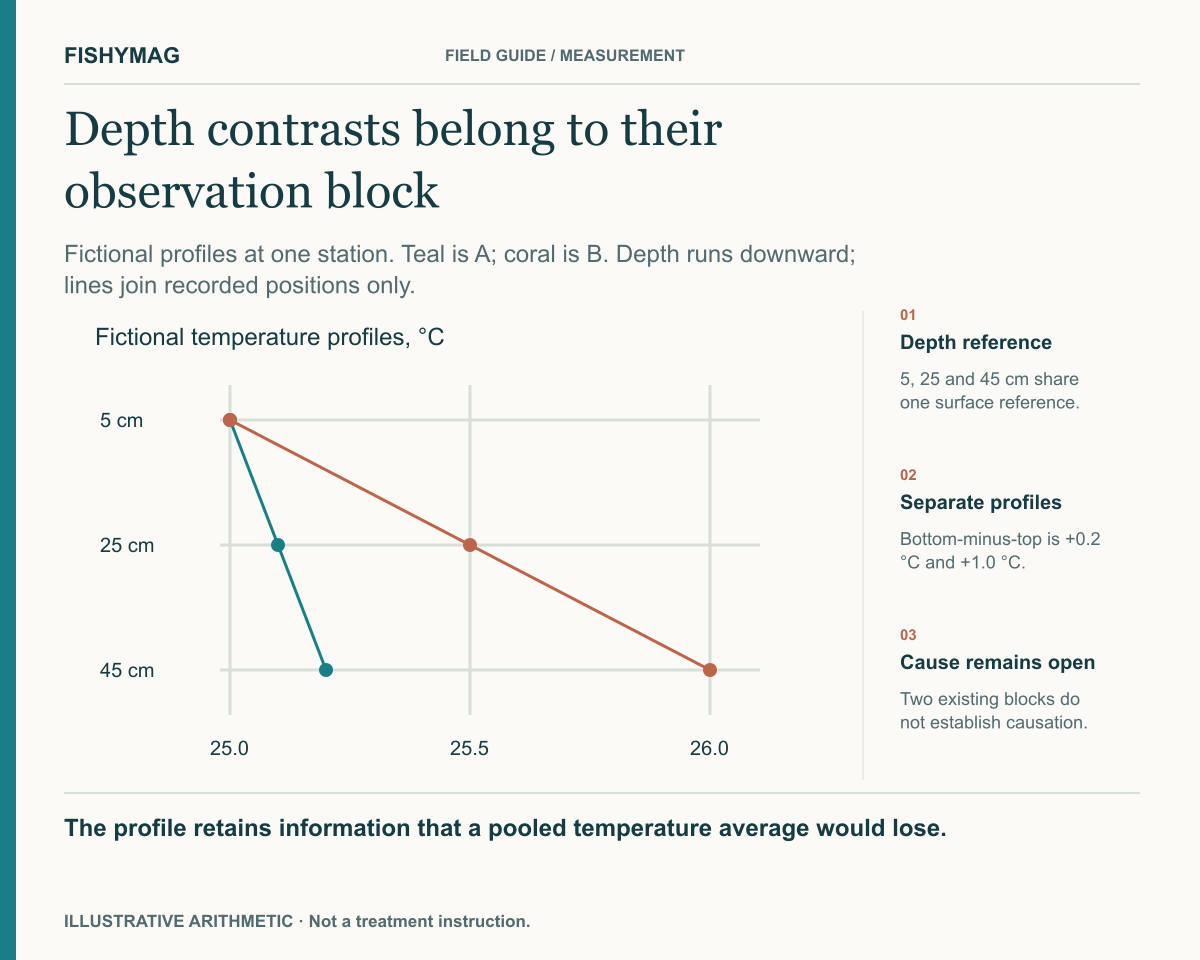
Figure data and explanation
Fictional profiles at one station. Teal is A; coral is B. Depth runs downward; lines join recorded positions only.
- Depth reference
- 5, 25 and 45 cm share one surface reference.
- Separate profiles
- Bottom-minus-top is +0.2 °C and +1.0 °C.
- Cause remains open
- Two existing blocks do not establish causation.
The profile retains information that a pooled temperature average would lose.
Define both the depth and the observation block
This invented record measures 5, 25 and 45 cm below the water surface at one horizontal station. Block A documents normal circulation running. Block B is an existing separately documented operating state; the example does not instruct anyone to interrupt equipment. Treat depth and block as two distinct identifiers. A reading from a different corner or state is not a substitute for a missing position in the profile.
Compare the two retained profiles
Use the top and bottom readings within each block. The contrast is descriptive and retains the temperature unit. It is not a claim about the accuracy of a real sensor.
| Depth below surface | Block A, °C | Block B, °C |
|---|---|---|
| 5 cm | 25.0 | 25.0 |
| 25 cm | 25.1 | 25.5 |
| 45 cm | 25.2 | 26.0 |
| Bottom minus top | +0.2 | +1.0 |
Keep the larger contrast with its block
The larger observed vertical contrast belongs to B. A mean across all six values would answer a different question and erase the profile structure. These two blocks alone cannot identify the cause, separate temporal change from the stated operating difference or establish how long the pattern persisted. Retain the probe identity, stabilization and measurement method record, sequence, depth reference and block timing. A repeat comparison should be chosen for the actual question and system access, rather than treating three depths as a universal sampling prescription. If a position cannot be reached without disturbing the system, record the coverage gap instead of moving equipment to force the example’s geometry.
Use your own details
Is aquarium water different near the bottom? worksheet
Download the editable text file, fill it in on your device and keep it with the relevant record. This blank worksheet records your information; it does not verify entries or approve treatment.
- Question the observations must answer
- Aquarium boundary and exact site identities
- Method, units and compensation settings
- Observation times and operating-state record
- Matched raw values and qualifiers
- Completed descriptive calculation
- Unsupported cause or interval inference
- Next evidence needed for the declared question
Put it into practice
Your checklist
- Measure depth from the same stated reference.
- Keep operating-state blocks separate.
- Report profile contrasts without assigning an untested cause.
Sources and scope
This article distinguishes manufacturer statements from FishyMag’s own workflows and arithmetic examples. Linked formulation records retain their own evidence dates; publishing this article does not refresh those records.
- Australian and New Zealand water-quality field sampling guidance; reviewed November 8, 2026 ↗
- Australian and New Zealand guidelines: water-quality data analysis; reviewed November 8, 2026 ↗
AI-assisted writing and development. Not hands-on product testing or veterinary review. How we publish →
FishyMag reports what manufacturers say, quoted and linked. It does not diagnose illness or recommend a treatment, and it never infers that a product is safe from the absence of a warning — where no statement exists, it says so.
Formulations change. Always read the label on the bottle in your hand, and contact the manufacturer if your tank contains anything valuable or unusual.