Evidence decisions
Extraction fractions are not forecasts of aquarium metal release
Normalize three fictional sequential-extraction fractions while preserving their operational denominator and refusing to turn them into aquarium release forecasts.
By FishyMag · Published
FishyMag editorial workflow · Not a clinical review or treatment recommendation.
Quick answer
The fictional 40%, 35% and 25% fractions sum to 100% of metal recovered in three stated analytical steps. They do not establish complete recovery from the original sample, and “40% in step one” does not mean 40% will enter aquarium water.

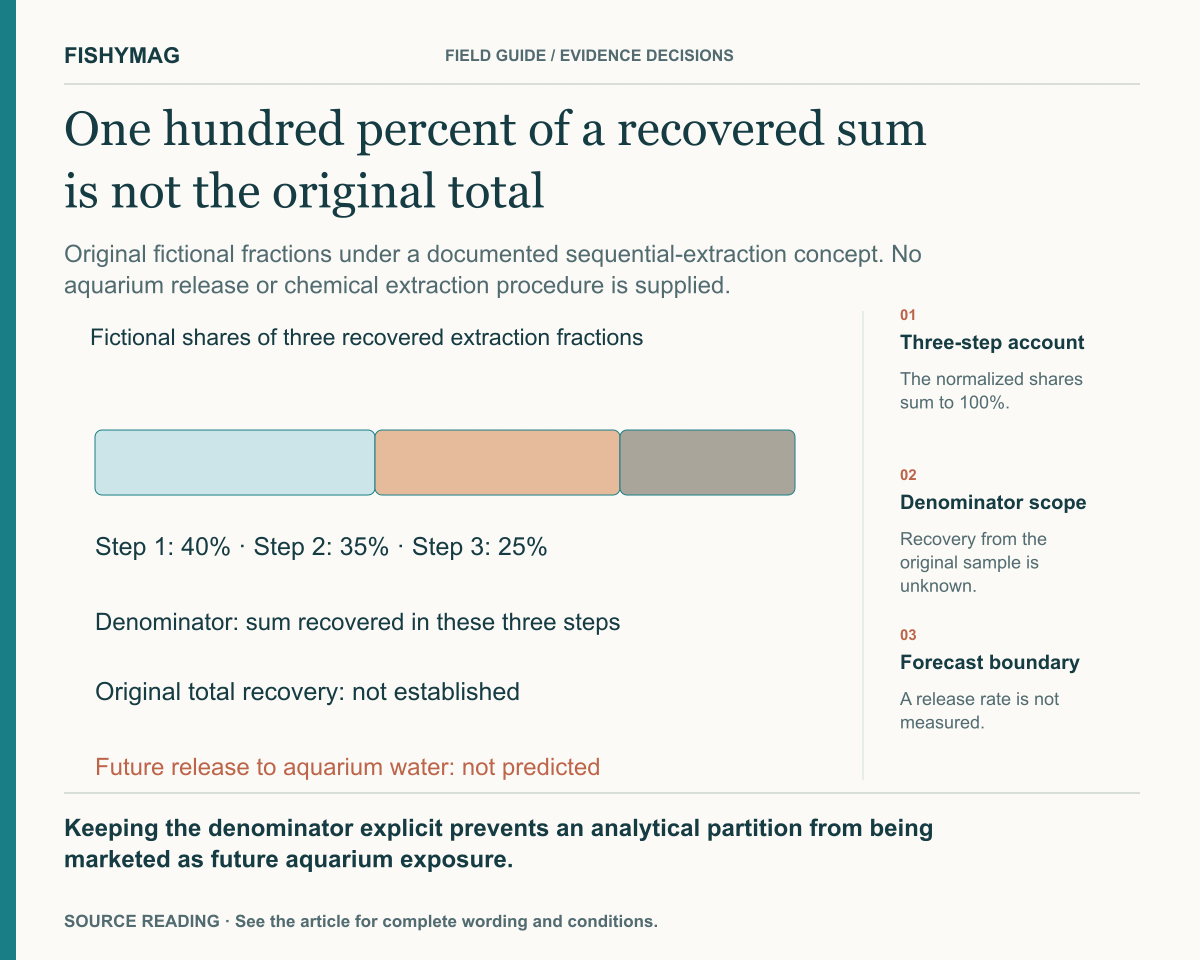
Figure data and explanation
Original fictional fractions under a documented sequential-extraction concept. No aquarium release or chemical extraction procedure is supplied.
- Three-step account
- The normalized shares sum to 100%.
- Denominator scope
- Recovery from the original sample is unknown.
- Forecast boundary
- A release rate is not measured.
Keeping the denominator explicit prevents an analytical partition from being marketed as future aquarium exposure.
Keep an operational fraction tied to its protocol
The JRC BCR-701 certificate assigns extractable mass fractions to three specified sequential steps and lists residual-extraction information separately. That is evidence about a defined analytical scheme, not a forecast of aquarium water exposure. No extraction recipe or claim about the current validity of a purchased reference bottle is given here.
Complete the normalized fictional account
Suppose the reported recovered quantities are 40, 35 and 25 arbitrary metal units. Their sum is 100 units, so the normalized shares are 40%, 35% and 25%. The original sample total and compatible recovery evidence are deliberately absent.
| Reported item | Fictional quantity | Share of recovered sum | Supported meaning |
|---|---|---|---|
| Protocol step 1 | 40 units | 40% | Recovered by that defined step |
| Protocol step 2 | 35 units | 35% | Recovered by that defined step |
| Protocol step 3 | 25 units | 25% | Recovered by that defined step |
| Sum of included steps | 100 units | 100% | Normalization denominator only |
| Original total metal | Not independently established | Unknown recovery | Cannot call the normalization complete recovery |
| Aquarium release | No applicable contact study | Not calculated | No forecast follows |
Separate a release question from a fraction label
A release forecast needs its own material, water composition, contact duration, geometry and measured endpoint. The extraction fractions do not supply those conditions, nor do their labels identify pure mineral species without further evidence. A real recovery comparison also needs compatible total and residual measurements. Preserve the three-step account as an analytical result and keep future aquarium exposure unanswered.
Use your own details
Extraction fractions are not forecasts of aquarium metal release worksheet
Download the editable text file, fill it in on your device and keep it with the relevant record. This blank worksheet records your information; it does not verify entries or approve treatment.
- Extraction scheme and exact protocol identity
- Original material and dry-mass basis
- Each step’s recovered quantity
- Denominator used for normalized fractions
- Residual or unrecovered material evidence
- Independent total and recovery comparability
- Actual water-contact conditions for any release question
- Claim supported by extraction versus unmeasured forecast
Put it into practice
Your checklist
- Name the extraction protocol and denominator.
- Do not confuse normalized shares with complete recovery.
- Require separate contact evidence for a release forecast.
Sources and scope
This article distinguishes manufacturer statements from FishyMag’s own workflows and arithmetic examples. Linked formulation records retain their own evidence dates; publishing this article does not refresh those records.
- JRC BCR-701 sediment certificate, revision2017; reviewed November 9, 2026 ↗
- US EPA Method 200.8 revision 5.4 (1994); reviewed November 9, 2026 ↗
AI-assisted writing and development. Not hands-on product testing or veterinary review. How we publish →
FishyMag reports what manufacturers say, quoted and linked. It does not diagnose illness or recommend a treatment, and it never infers that a product is safe from the absence of a warning — where no statement exists, it says so.
Formulations change. Always read the label on the bottle in your hand, and contact the manufacturer if your tank contains anything valuable or unusual.