Measurement
A daily aquarium cycle or a change after an event?
Compare an event-day pH change with matched morning and evening baselines instead of attributing the ordinary daily difference to the event.
By FishyMag · Published
Worked arithmetic example · Not a clinical review or treatment recommendation.
Quick answer
Compare like times before attributing a before/after difference to an event. In this fictional record, pH rises 0.30 units within every day, including the event day. Its morning and evening values exactly match the corresponding baseline means. The record does not show an extra event-day shift beyond that matched pattern.
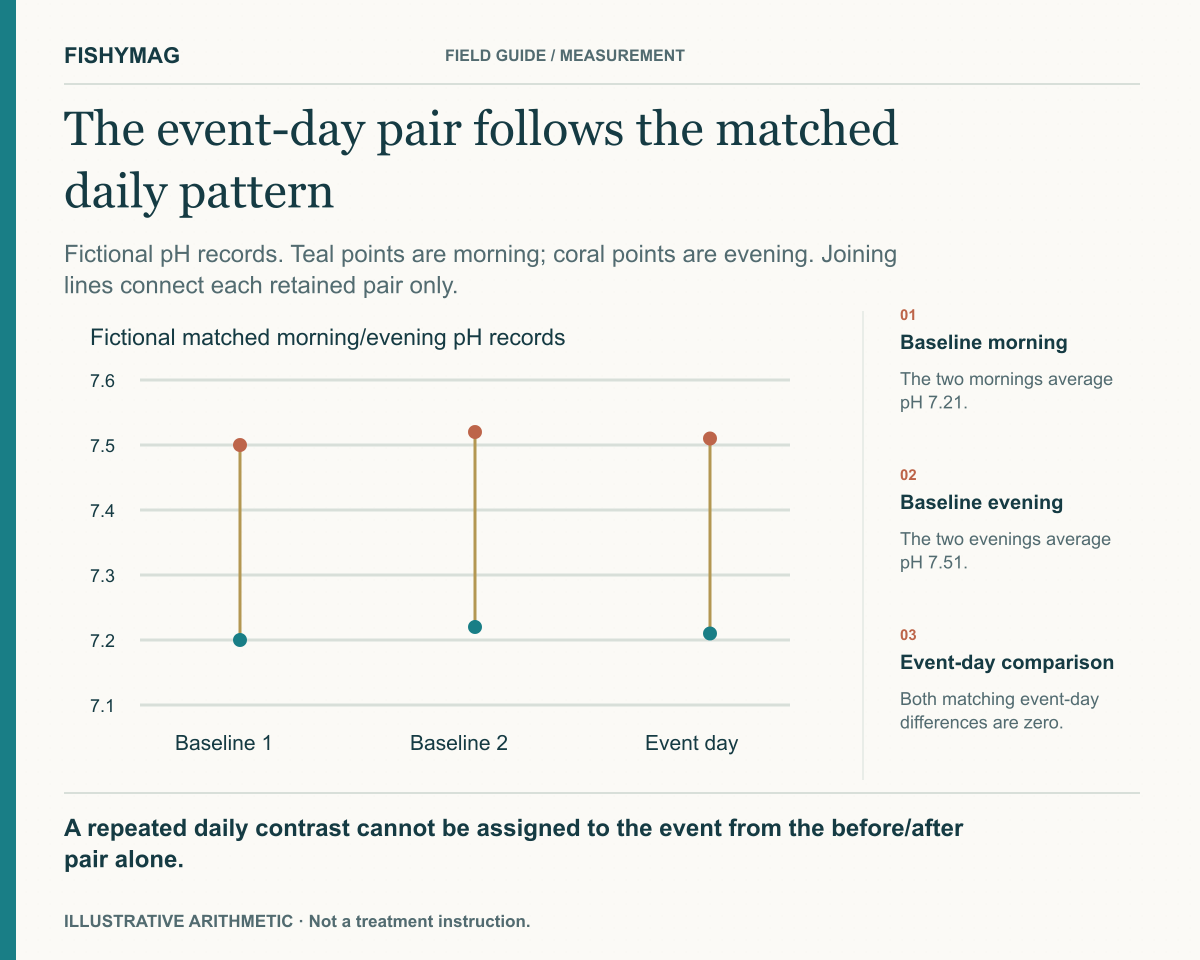
Figure data and explanation
Fictional pH records. Teal points are morning; coral points are evening. Joining lines connect each retained pair only.
- Baseline morning
- The two mornings average pH 7.21.
- Baseline evening
- The two evenings average pH 7.51.
- Event-day comparison
- Both matching event-day differences are zero.
A repeated daily contrast cannot be assigned to the event from the before/after pair alone.
Keep time of day in the comparison
An observation made before a routine event may also be a morning observation, while the later observation is in the evening. Those two differences are confounded in a single before/after pair. This invented archive supplies two baseline days and an event day at matching morning and evening times. It does not prescribe the event or demonstrate any actual biological response.
Complete the matched arithmetic
The baseline morning mean is (7.20 + 7.22)/2 = 7.21. The evening mean is (7.50 + 7.52)/2 = 7.51. Compare the event day with those matching means, rather than comparing its evening reading only with its own morning reading.
| Day or comparison | Morning pH | Evening pH | Within-day difference |
|---|---|---|---|
| Baseline 1 | 7.20 | 7.50 | +0.30 |
| Baseline 2 | 7.22 | 7.52 | +0.30 |
| Event day | 7.21 | 7.51 | +0.30 |
| Baseline mean | 7.21 | 7.51 | +0.30 |
| Event minus matching baseline | 0.00 | 0.00 | No extra difference in this comparison |
State what the baseline resolves
The apparent +0.30 before/after change does not exceed the matched daily pattern in this constructed record. That result removes the basis for claiming an extra numerical shift from these observations alone. It does not prove the event had no effect of any kind, or exclude a shorter excursion between the retained times. Keep method identity, measurement uncertainty and operating conditions with the raw values. The next useful question is whether the available times and baseline days cover the effect actually claimed. Do not treat a visually persuasive before/after line as a controlled causal study.
Use your own details
A daily aquarium cycle or a change after an event? worksheet
Download the editable text file, fill it in on your device and keep it with the relevant record. This blank worksheet records your information; it does not verify entries or approve treatment.
- Question the observations must answer
- Aquarium boundary and exact site identities
- Method, units and compensation settings
- Observation times and operating-state record
- Matched raw values and qualifiers
- Completed descriptive calculation
- Unsupported cause or interval inference
- Next evidence needed for the declared question
Put it into practice
Your checklist
- Retain morning/evening timing rather than only before/after labels.
- Compare each event-day time with its matching baseline.
- Limit the finding to the observed variable and time coverage.
Sources and scope
This article distinguishes manufacturer statements from FishyMag’s own workflows and arithmetic examples. Linked formulation records retain their own evidence dates; publishing this article does not refresh those records.
- Australian and New Zealand water-quality field sampling guidance; reviewed November 8, 2026 ↗
- Australian and New Zealand guidelines: water-quality data analysis; reviewed November 8, 2026 ↗
AI-assisted writing and development. Not hands-on product testing or veterinary review. How we publish →
FishyMag reports what manufacturers say, quoted and linked. It does not diagnose illness or recommend a treatment, and it never infers that a product is safe from the absence of a warning — where no statement exists, it says so.
Formulations change. Always read the label on the bottle in your hand, and contact the manufacturer if your tank contains anything valuable or unusual.