Evidence decisions
A copper-to-organic-carbon ratio is not a binding-capacity measurement
Read a real constructed-wetland copper/DOM study through its measured quantities and defined ratio before transferring its binding language to an aquarium claim.
By FishyMag · Published
FishyMag editorial workflow · Not a clinical review or treatment recommendation.
Quick answer
The cited study defines its CuBA ratio as copper concentration divided by dissolved organic carbon concentration. Its published bulk means are 74.9 ± 24.0 and 17.3 ± 2.6 µmol Cu/g-C. Those are not direct measurements of an aquarium’s free-ion copper, a ligand’s maximum capacity or animal exposure.
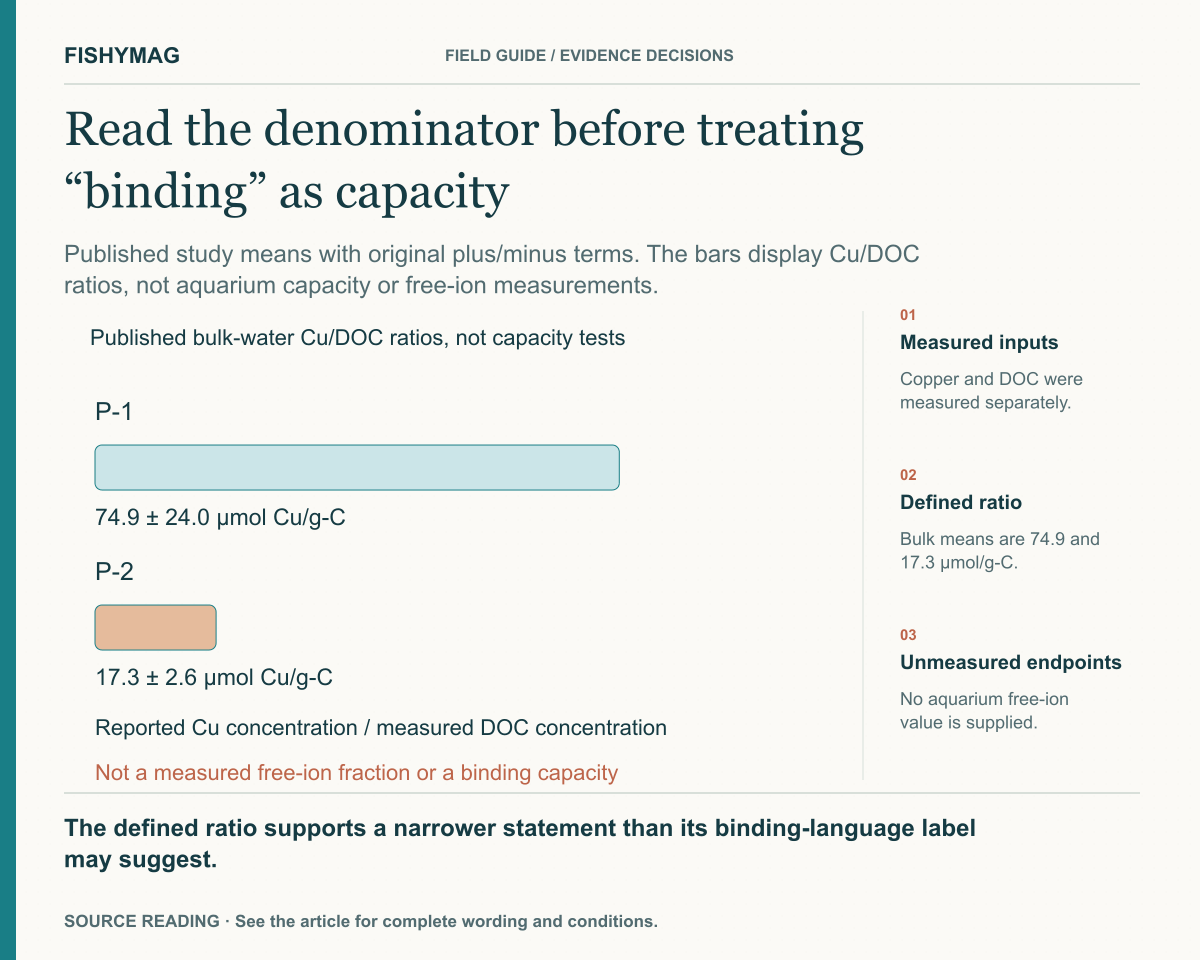
Figure data and explanation
Published study means with original plus/minus terms. The bars display Cu/DOC ratios, not aquarium capacity or free-ion measurements.
- Measured inputs
- Copper and DOC were measured separately.
- Defined ratio
- Bulk means are 74.9 and 17.3 µmol/g-C.
- Unmeasured endpoints
- No aquarium free-ion value is supplied.
The defined ratio supports a narrower statement than its binding-language label may suggest.
Recover the measured quantities behind the label
Hung and colleagues studied a constructed wetland, with three collections in July 2015 at its influent P-1 and internal site P-2. Bulk water passed the stated 0.45 micrometer fraction boundary. The paper reports copper by graphite-furnace atomic spectrometry and DOC by a TOC analyzer, alongside size fractionation and optical indicators. Its CuBA definition divides µmol Cu/L by g-C/L. It is not a maximum-capacity titration or a free-ion electrode result.
Complete the source-to-claim comparison
The table retains the reported bulk means and plus/minus terms without relabelling the latter as confidence intervals. The separate arithmetic ratio of means is 74.9/17.3, about 4.33. That calculation does not establish a fourfold difference in maximum ligand capacity.
| Evidence item | Published or calculated result | Permissible claim |
|---|---|---|
| P-1 bulk CuBA | 74.9 ± 24.0 µmol/g-C | Reported concentration-normalized ratio |
| P-2 bulk CuBA | 17.3 ± 2.6 µmol/g-C | Same defined ratio at another site |
| FishyMag arithmetic | 74.9 ÷ 17.3 ≈ 4.33 | Ratio of the reported means only |
| Free cupric-ion activity | Not directly supplied by those ratios | No activity value derived |
| Aquarium binding capacity or animal exposure | Not established by this comparison | No compatibility or capacity claim |
Keep the aquarium inference separate
A fictional keeper packet cites the paper as proof that adding organic material will bind a known amount of aquarium copper. That conclusion needs different evidence: the actual ligand and water composition, an applicable capacity or speciation measurement and the endpoint being claimed. The paper’s site pH values also differ, so this is not an isolated pH-controlled aquarium experiment. Retain the study’s own ratio and interpretation while refusing an unmeasured free fraction or a material-addition recommendation.
Use your own details
A copper-to-organic-carbon ratio is not a binding-capacity measurement worksheet
Download the editable text file, fill it in on your device and keep it with the relevant record. This blank worksheet records your information; it does not verify entries or approve treatment.
- Study identity and exact ratio definition
- Sample sites, dates and operational fraction
- Copper and DOC analytical methods
- Published values and unchanged plus/minus notation
- Original calculation versus authors’ interpretation
- Free-ion or capacity measurement actually supplied
- Aquarium composition and transfer evidence
- Supported statement and withheld endpoints
Put it into practice
Your checklist
- Read the ratio definition rather than relying on its name.
- Keep measured inputs separate from binding interpretations.
- Do not transform a field concentration ratio into aquarium capacity or safety.
Sources and scope
This article distinguishes manufacturer statements from FishyMag’s own workflows and arithmetic examples. Linked formulation records retain their own evidence dates; publishing this article does not refresh those records.
- Hung et al. (2024), Separations11:191, copper/DOM study; reviewed November 9, 2026 ↗
- Thermo Scientific cupric ion-selective electrode user guide; reviewed November 9, 2026 ↗
AI-assisted writing and development. Not hands-on product testing or veterinary review. How we publish →
FishyMag reports what manufacturers say, quoted and linked. It does not diagnose illness or recommend a treatment, and it never infers that a product is safe from the absence of a warning — where no statement exists, it says so.
Formulations change. Always read the label on the bottle in your hand, and contact the manufacturer if your tank contains anything valuable or unusual.