Measurement
Free, labile and total copper in aquarium reports
Complete a free-ion, labile and digested-copper comparison by identifying each response definition and refusing a subtraction that lacks compatible fractions.
By FishyMag · Published
Worked arithmetic example · Not a clinical review or treatment recommendation.
Quick answer
Free-ion activity, method-defined labile copper and digested elemental copper are different results. In the fictional packet, subtracting labile 10 µg/L from digested 30 µg/L gives arithmetic 20, but does not establish a bound-copper concentration. The activity basis, response window and fraction comparability remain unresolved.
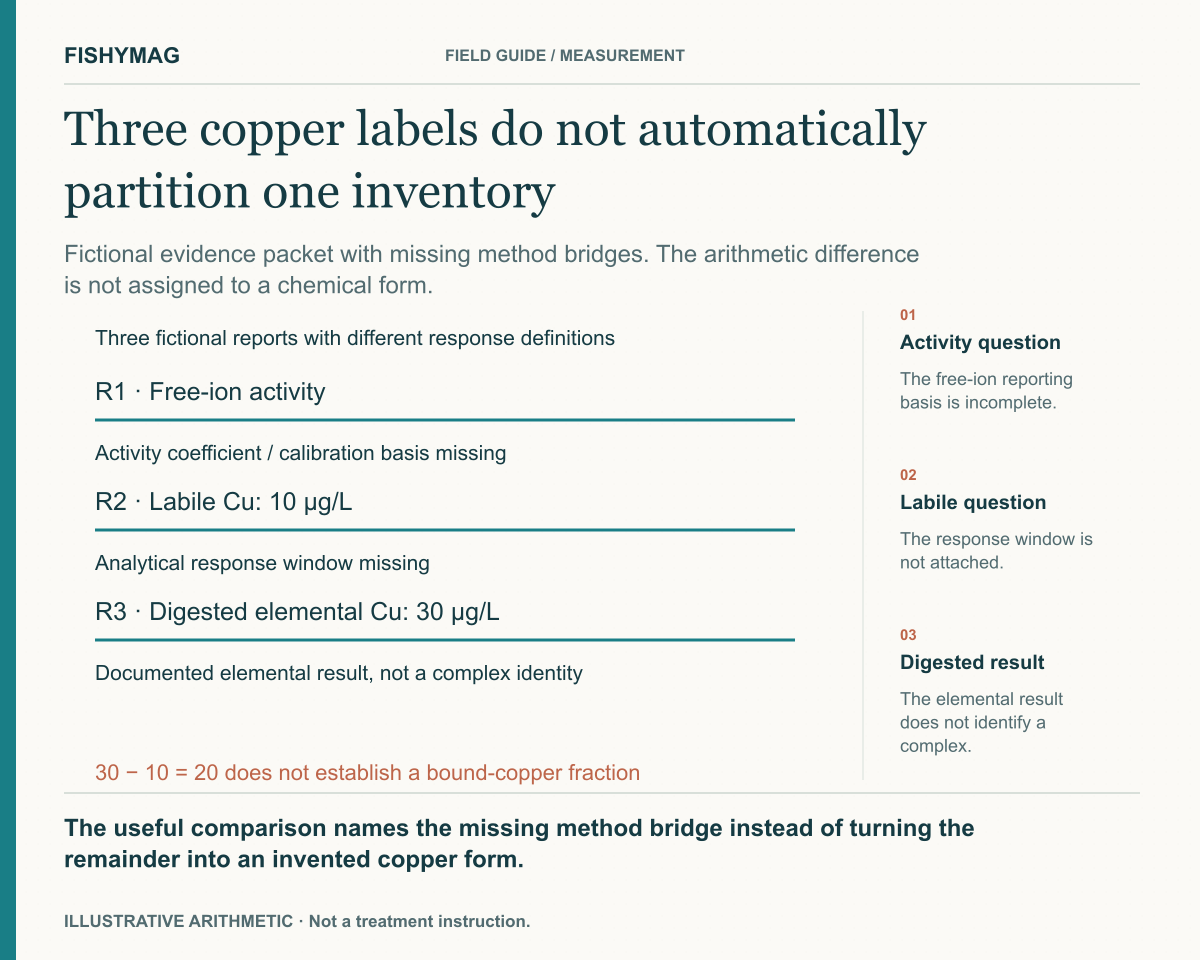
Figure data and explanation
Fictional evidence packet with missing method bridges. The arithmetic difference is not assigned to a chemical form.
- Activity question
- The free-ion reporting basis is incomplete.
- Labile question
- The response window is not attached.
- Digested result
- The elemental result does not identify a complex.
The useful comparison names the missing method bridge instead of turning the remainder into an invented copper form.
Identify three different measurement questions
The Thermo cupric electrode guide distinguishes free-ion activity from concentration through an activity coefficient. The Metrohm monograph describes labile and inert complex distinctions within analytical speciation. A digested elemental result answers a third question. None of those names alone supplies a universal set of mutually exclusive aquarium fractions.
Complete every comparison in the packet
These records are fictional. R1 is labelled free-ion activity but its calibration and reporting convention are missing. R2 reports 10 µg Cu/L under a labile-method heading without the response-window attachment. R3 reports 30 µg Cu/L after its documented digestion. The numbers are not treatment levels.
| Comparison | Required bridge | Packet decision |
|---|---|---|
| R1 activity to a mass concentration | Applicable activity coefficient, reference convention and free-ion method record | Unresolved; do not relabel the activity as µg/L |
| R2 labile to R3 digested | Compatible sample fraction and a documented relationship between method responses | Not established |
| R3 minus R2 | Proof that the responses partition one defined inventory | 20 µg/L arithmetic, not an identified bound fraction |
| R3 alone | Its sample and preparation record | Retain as an elemental result within that scope |
Request the attachments that could change the answer
For R1, obtain the actual calibration mode and reported quantity. For R2, obtain the complete method, preparation and response conditions. For R3, retain fraction, digestion and uncertainty information. Then ask whether a validated comparison exists for the same matrix and sampling event. Similar labels or a shared copper unit do not establish those relationships. The completed record preserves all three reports without inventing a chemical fraction or an aquarium compatibility verdict.
Use your own details
Free, labile and total copper in aquarium reports worksheet
Download the editable text file, fill it in on your device and keep it with the relevant record. This blank worksheet records your information; it does not verify entries or approve treatment.
- Report identity and common collection evidence
- Free-ion activity versus concentration convention
- Activity coefficient or applicable calibration record
- Labile method and analytical response window
- Digestion and elemental reporting basis
- Sample-fraction and timing comparability
- Permissible arithmetic versus unproved fraction subtraction
- Exact attachments needed to complete the comparison
Put it into practice
Your checklist
- Keep activity, concentration and method response distinct.
- Require a fraction relationship before subtraction.
- Request the specific missing attachment for each comparison.
Sources and scope
This article distinguishes manufacturer statements from FishyMag’s own workflows and arithmetic examples. Linked formulation records retain their own evidence dates; publishing this article does not refresh those records.
- Thermo Scientific cupric ion-selective electrode user guide; reviewed November 9, 2026 ↗
- Metrohm: Introduction to Polarography and Voltammetry (2003); reviewed November 9, 2026 ↗
- US EPA Method 200.8 revision 5.4 (1994); reviewed November 9, 2026 ↗
AI-assisted writing and development. Not hands-on product testing or veterinary review. How we publish →
FishyMag reports what manufacturers say, quoted and linked. It does not diagnose illness or recommend a treatment, and it never infers that a product is safe from the absence of a warning — where no statement exists, it says so.
Formulations change. Always read the label on the bottle in your hand, and contact the manufacturer if your tank contains anything valuable or unusual.