Measurement
Are your aquarium conductivity readings on the same temperature basis?
Recover reference temperature, coefficient and compensation mode before comparing aquarium conductivity values with identical units.
By FishyMag · Published
Worked evidence example · Not a clinical review or treatment recommendation.
Quick answer
Matching µS/cm units is not enough. In this fictional edge-meter packet, A and B share ATC, a 25 °C reference and a 1.90%/°C coefficient, so their recorded common-basis contrast is +10 µS/cm. C is uncompensated and lacks sample temperature; it cannot be harmonized from the supplied record.
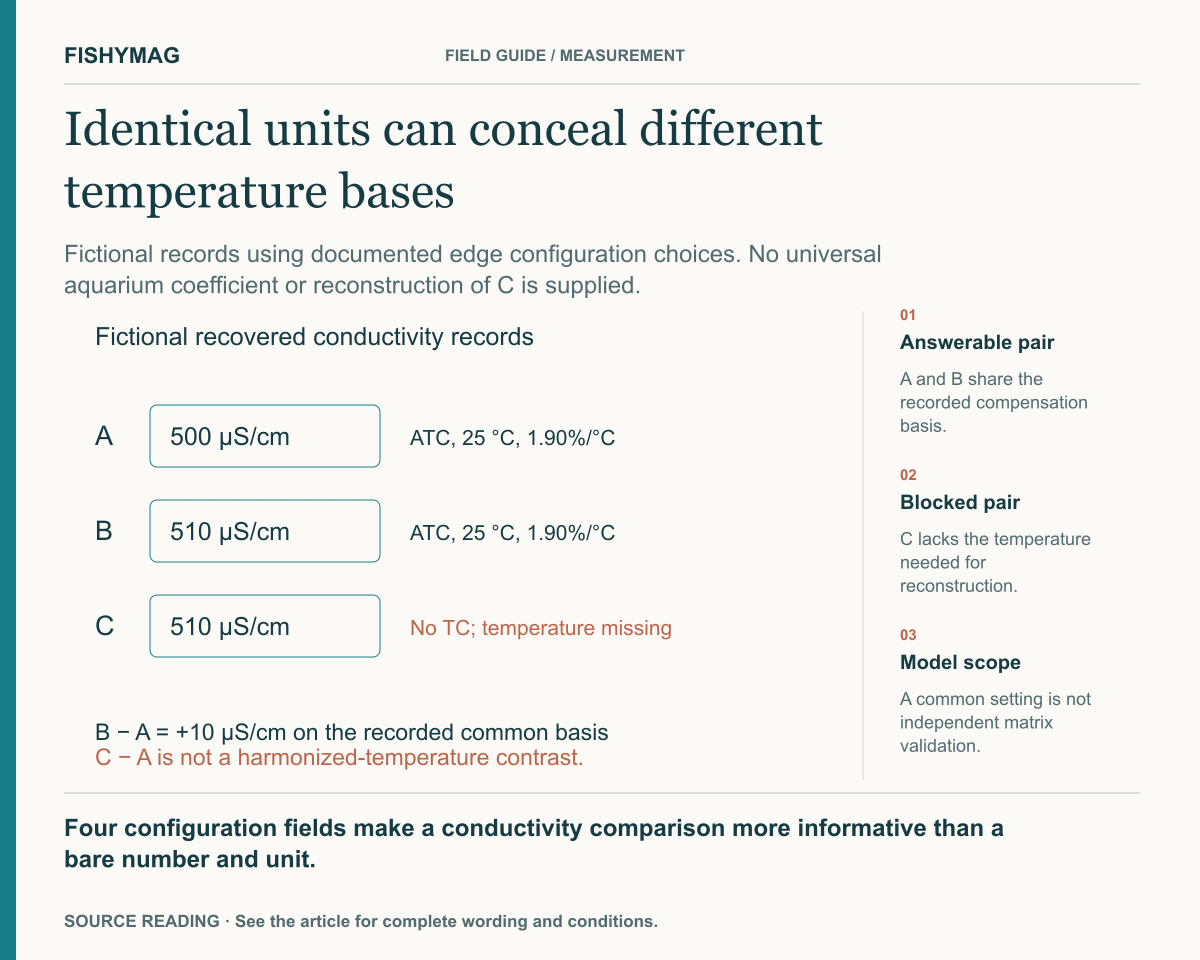
Figure data and explanation
Fictional records using documented edge configuration choices. No universal aquarium coefficient or reconstruction of C is supplied.
- Answerable pair
- A and B share the recorded compensation basis.
- Blocked pair
- C lacks the temperature needed for reconstruction.
- Model scope
- A common setting is not independent matrix validation.
Four configuration fields make a conductivity comparison more informative than a bare number and unit.
Read the configuration behind the conductivity field
The Hanna edge manual distinguishes compensated conductivity from its uncompensated mode. It allows a 20 °C or 25 °C reference and a configurable linear coefficient in the relevant mode. The default 1.90%/°C setting is not a measured universal coefficient for every aquarium sample. Recover the actual setup or original log rather than assuming a default survived a software reset or a meter change.
Resolve one answerable pair and one blocked pair
The invented packet contains three records. A and B have sample temperatures of 24 °C and 26 °C respectively, with the same documented compensation configuration. C has no retained temperature. Its “conductivity” heading was clarified by the saved setup as No TC.
| Record | Reported output | Retained basis | Completed comparison with A |
|---|---|---|---|
| A | 500 µS/cm | ATC; 25 °C reference; 1.90%/°C | Reference record |
| B | 510 µS/cm | Same ATC, reference and coefficient | +10 µS/cm on recorded common basis |
| C | 510 µS/cm | No TC; sample temperature absent | No common-temperature contrast issued |
Do not manufacture missing raw information
The A-B result is a comparison on the instrument’s recorded model basis. That does not independently validate the model for the aquarium matrix or establish a chemical cause for the difference. The C record lacks what a defensible reconstruction needs. Do not apply 1.90%/°C blindly or guess a temperature to make C comparable. Seek the original measurement file or obtain a properly documented comparison for the question. Keep actual sample temperature, compensation mode, reference temperature and coefficient as separate fields; the display’s unit alone carries none of that history.
Use your own details
Are your aquarium conductivity readings on the same temperature basis? worksheet
Download the editable text file, fill it in on your device and keep it with the relevant record. This blank worksheet records your information; it does not verify entries or approve treatment.
- Aquarium and sample boundary
- Complete meter, probe and document revision
- Sample quantity and temperature basis
- Original observations with timestamps
- Relevant manufacturer claim and conditions
- Completed comparison or calculation
- What the available evidence cannot resolve
- Specific next document or comparison required
Put it into practice
Your checklist
- Recover mode, reference temperature and coefficient.
- Distinguish common recorded basis from validated model suitability.
- Leave an unharmonizable record unresolved instead of guessing its temperature.
Sources and scope
This article distinguishes manufacturer statements from FishyMag’s own workflows and arithmetic examples. Linked formulation records retain their own evidence dates; publishing this article does not refresh those records.
AI-assisted writing and development. Not hands-on product testing or veterinary review. How we publish →
FishyMag reports what manufacturers say, quoted and linked. It does not diagnose illness or recommend a treatment, and it never infers that a product is safe from the absence of a warning — where no statement exists, it says so.
Formulations change. Always read the label on the bottle in your hand, and contact the manufacturer if your tank contains anything valuable or unusual.