Measurement
Audit an aquarium conductivity-to-salinity conversion
Reproduce a declared PSS-78 calculation with the correct temperature and pressure basis, then keep numerical reproducibility separate from sample-matrix applicability.
By FishyMag · Published
Worked arithmetic example · Not a clinical review or treatment recommendation.
Quick answer
A salinity algorithm can reproduce a number without establishing that the number answers the question for your aquarium’s ionic mixture. In the declared reference example, 42.914 mS/cm at 14.99640086 °C ITS-90 and zero sea pressure gives Practical Salinity approximately 35. The calculation does not independently validate a non-seawater mixture.
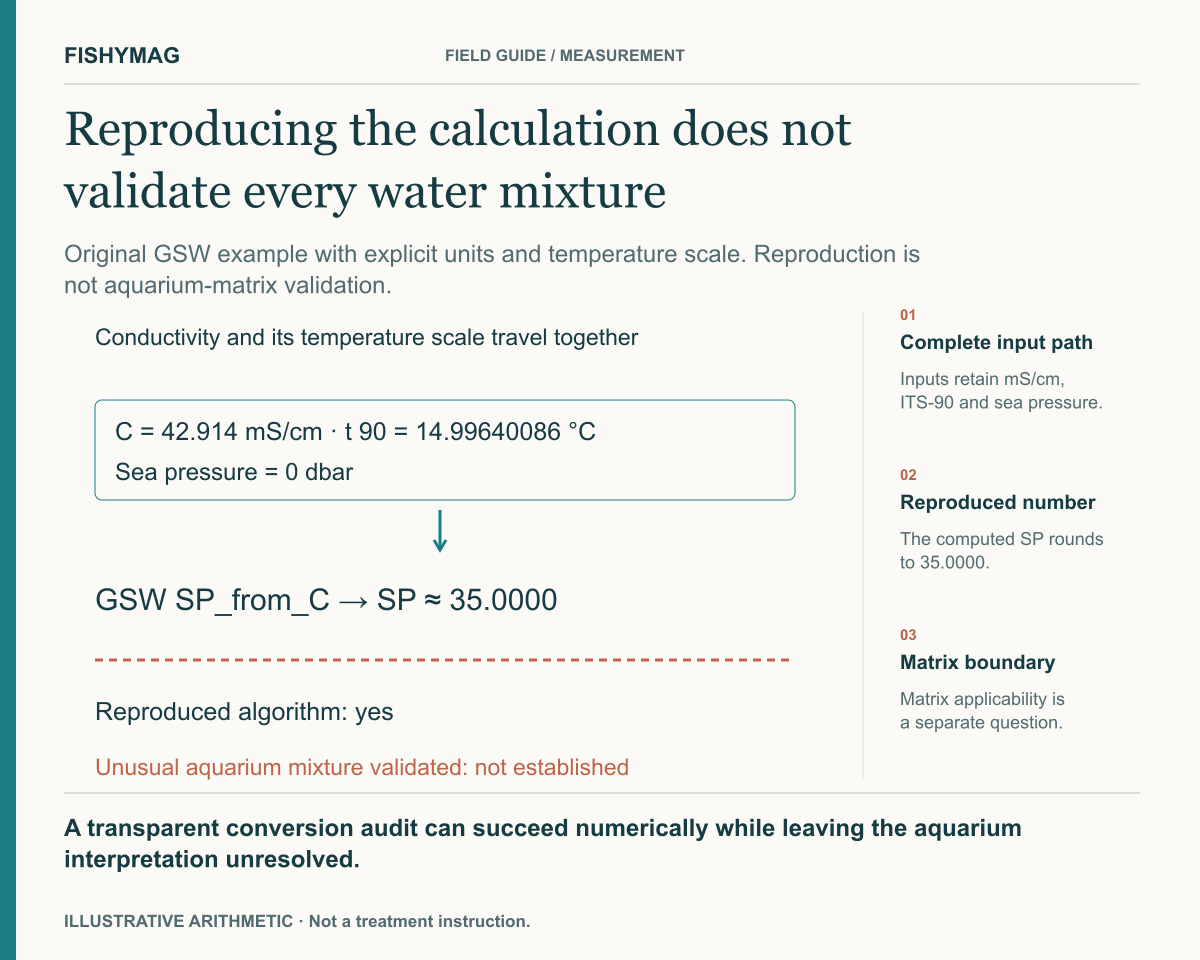
Figure data and explanation
Original GSW example with explicit units and temperature scale. Reproduction is not aquarium-matrix validation.
- Complete input path
- Inputs retain mS/cm, ITS-90 and sea pressure.
- Reproduced number
- The computed SP rounds to 35.0000.
- Matrix boundary
- Matrix applicability is a separate question.
A transparent conversion audit can succeed numerically while leaving the aquarium interpretation unresolved.
Identify the documented algorithm rather than guessing from a label
YSI lists PSS-78 as the salinity method for CastAway-CTD. That gives the reader a named scale to investigate. This example uses the independently documented GSW implementation; it does not claim bit-for-bit reproduction of YSI firmware. The GSW function takes conductivity in mS/cm, temperature on ITS-90 and sea pressure in dbar. Feeding it a conductivity already normalized to another temperature while also supplying the original in-situ temperature would describe a different input packet.
Reproduce one fully declared conversion
The reference temperature is 15 °C on IPTS-68, expressed as 15/1.00024 = 14.99640086 °C on ITS-90. Local GSW 3.6.23 returns 34.9999999241, rounded here to 35.0000. Six official GSW examples were independently reproduced to numerical precision before constructing this case. Those software checks are not physical meter tests.
| Input or output | Declared value | Audit result |
|---|---|---|
| Conductivity | 42.914 mS/cm | Unit matches function input |
| Temperature | 14.99640086 °C ITS-90 | 15 °C IPTS-68 converted explicitly |
| Sea pressure | 0 dbar | Not entered as one atmosphere in dbar |
| Implementation | GSW 3.6.23 SP_from_C | Original local calculation retained |
| Output | SP approximately 35.0000 | Numerically reproduced, not an aquarium suitability claim |
Make the second packet an applicability decision
A fictional second sample has the same measured conductivity but a documented non-seawater ionic composition. The function can still return a number. That does not establish its equivalence to the sample’s salt mass fraction or validate the intended aquarium interpretation. Keep algorithm output, reported quantity and matrix coverage in separate fields. The published GSW PSS-78 description also states a 2 < SP < 42 range and a modified low-salinity formulation below 2; a software extension is not blanket validation of every freshwater or brackish mixture.
Do not replace one out-of-domain calculation with another
The same audit applies when someone proposes transferring a freshwater conductivity-to-solids regression into brackish water. Recover its calibration population, conductivity and composition range, and actual quantity predicted. A computable extrapolation is not validation. This guide supplies the completed algorithm-path example, not an invented freshwater regression or a new true salinity for the second sample. Request the missing domain evidence instead of borrowing a familiar conversion factor.
Use your own details
Audit an aquarium conductivity-to-salinity conversion worksheet
Download the editable text file, fill it in on your device and keep it with the relevant record. This blank worksheet records your information; it does not verify entries or approve treatment.
- Instrument model and firmware or reporting documentation
- Measured conductivity with mS/cm versus S/m basis
- In-situ versus reference-corrected conductivity
- Temperature value and ITS-90 or IPTS-68 convention
- Sea pressure versus absolute pressure
- Algorithm, version and numerical range
- Matrix or composition applicability evidence
- Computed output and separately bounded validation claim
Worked example files
These files contain the article’s worked example. Read its source and scope notes, and keep your own current records before opening an example in a tool.
Put it into practice
Your checklist
- Match conductivity, temperature and pressure conventions before calculating.
- Record numerical reproduction separately from matrix applicability.
- Withhold an interpreted sample quantity when its conversion domain is unsupported.
Sources and scope
This article distinguishes manufacturer statements from FishyMag’s own workflows and arithmetic examples. Linked formulation records retain their own evidence dates; publishing this article does not refresh those records.
- TEOS-10 GSW: Practical Salinity from conductivity; reviewed November 9, 2026 ↗
- TEOS-10 GSW: ITS-90 and IPTS-68 temperature conversion; reviewed November 9, 2026 ↗
- YSI CastAway-CTD manufacturer specifications; reviewed November 9, 2026 ↗
- USGS PHREEQC Version 3 manual: capabilities and computational scope; reviewed November 9, 2026 ↗
AI-assisted writing and development. Not hands-on product testing or veterinary review. How we publish →
FishyMag reports what manufacturers say, quoted and linked. It does not diagnose illness or recommend a treatment, and it never infers that a product is safe from the absence of a warning — where no statement exists, it says so.
Formulations change. Always read the label on the bottle in your hand, and contact the manufacturer if your tank contains anything valuable or unusual.