Measurement
What a conductivity cell constant tells you
Work conductivity from conductance and cell constant, then distinguish a nominal specification from the constant actually used by the aquarium measurement chain.
By FishyMag · Published
Worked arithmetic example · Not a clinical review or treatment recommendation.
Quick answer
Conductivity is conductance multiplied by cell constant. With hypothetical inputs of 500 µS and 0.100 cm⁻¹, the result is 50.0 µS/cm. That arithmetic does not prove which constant an aquarium meter stored, whether a calibration was valid or whether the probe suits the sample.
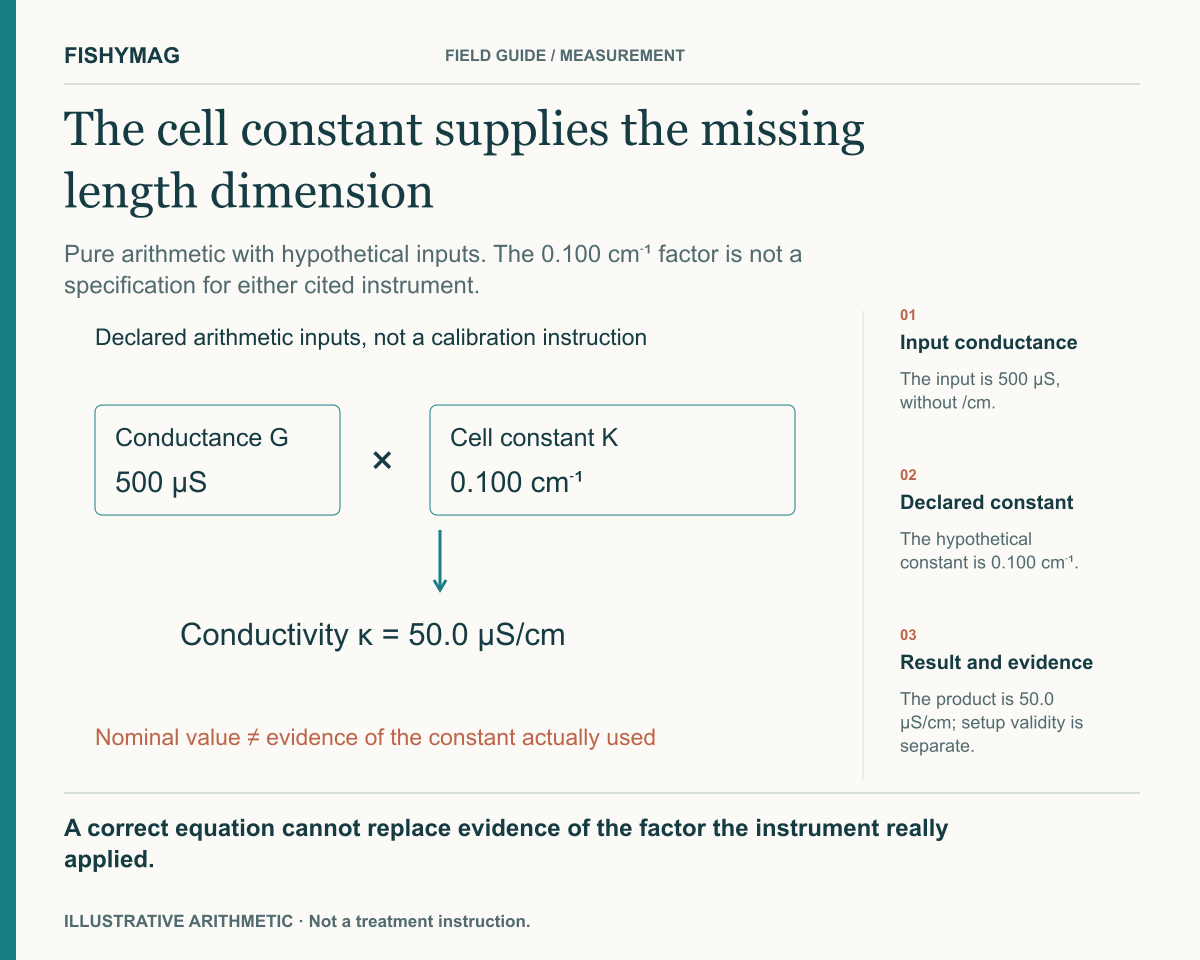
Figure data and explanation
Pure arithmetic with hypothetical inputs. The 0.100 cm⁻¹ factor is not a specification for either cited instrument.
- Input conductance
- The input is 500 µS, without /cm.
- Declared constant
- The hypothetical constant is 0.100 cm⁻¹.
- Result and evidence
- The product is 50.0 µS/cm; setup validity is separate.
A correct equation cannot replace evidence of the factor the instrument really applied.
Keep conductance and conductivity dimensionally distinct
Vernier’s CON-BTA manual explicitly gives conductivity as conductance times cell constant. It describes that particular probe’s constant as 1.0 cm⁻¹, not the 0.100 value used in the hypothetical arithmetic here. The edge manual separately exposes a stored cell-factor field and calibration information. These sources support the distinction between a physical measurement, the factor applied and the final output; they do not authorize changing an aquarium meter until a desired number appears.
Complete the dimensional calculation
Both inputs in this worked example are invented, with no real probe or reference solution assigned to them. The inverse-centimeter factor supplies the length dimension that distinguishes conductivity from conductance.
| Quantity | Hypothetical input or result | Evidence meaning |
|---|---|---|
| Conductance G | 500 µS | Electrical conductance input |
| Cell constant K | 0.100 cm⁻¹ | Declared geometry-related factor |
| Product G × K | 500 × 0.100 = 50.0 µS/cm | Dimensional conductivity result |
| Actual aquarium meter output | Not supplied | Cannot be verified by this arithmetic alone |
Close the record on the constant actually used
A fictional aquarium packet contains a probe brochure stating a nominal constant of 1.0 cm⁻¹ but no meter export, serial-linked calibration or retained check result. The completed finding is that the nominal specification is known and the applied constant remains unverified. Request the actual meter-probe record and appropriate verification evidence. A product-sheet number cannot stand in for the stored configuration or prove sample applicability. Vernier also identifies its products as educational equipment rather than life-support or industrial control devices; this equation explanation is not a recommendation to use that probe for aquarium control. Keep any temperature normalization separate from the conductance-to-conductivity step.
Use your own details
What a conductivity cell constant tells you worksheet
Download the editable text file, fill it in on your device and keep it with the relevant record. This blank worksheet records your information; it does not verify entries or approve treatment.
- Aquarium and sample boundary
- Complete meter, probe and document revision
- Sample quantity and temperature basis
- Original observations with timestamps
- Relevant manufacturer claim and conditions
- Completed comparison or calculation
- What the available evidence cannot resolve
- Specific next document or comparison required
Put it into practice
Your checklist
- Retain conductance and conductivity as different quantities.
- Label hypothetical constants instead of attaching them to a real probe.
- Verify the applied constant through the actual measurement record.
Sources and scope
This article distinguishes manufacturer statements from FishyMag’s own workflows and arithmetic examples. Linked formulation records retain their own evidence dates; publishing this article does not refresh those records.
- Vernier CON-BTA conductivity probe manufacturer manual; reviewed November 8, 2026 ↗
- Hanna edge pH/EC/DO manual, document380; reviewed November 8, 2026 ↗
AI-assisted writing and development. Not hands-on product testing or veterinary review. How we publish →
FishyMag reports what manufacturers say, quoted and linked. It does not diagnose illness or recommend a treatment, and it never infers that a product is safe from the absence of a warning — where no statement exists, it says so.
Formulations change. Always read the label on the bottle in your hand, and contact the manufacturer if your tank contains anything valuable or unusual.