Measurement
When an aquarium concentration ratio becomes unreliable
A completed fictional worksheet shows first-order ratio uncertainty, the independence requirement and a denominator check that stops an unstable summary.
By FishyMag · Published
Worked arithmetic example · Not a clinical review or treatment recommendation.
Quick answer
For fictional independent concentrations of 10.0 ± 1.0 mg/L and 2.0 ± 0.2 mg/L, the quotient is 5.0 and its first-order standard uncertainty is approximately 0.707, both dimensionless. This is conditional arithmetic, not proof that the approximation is adequate. If the denominator instead is 0.10 ± 0.20 mg/L, an illustrative denominator interval crosses zero. Retain 100 only as the nominal arithmetic quotient and block the routine ratio-uncertainty summary.

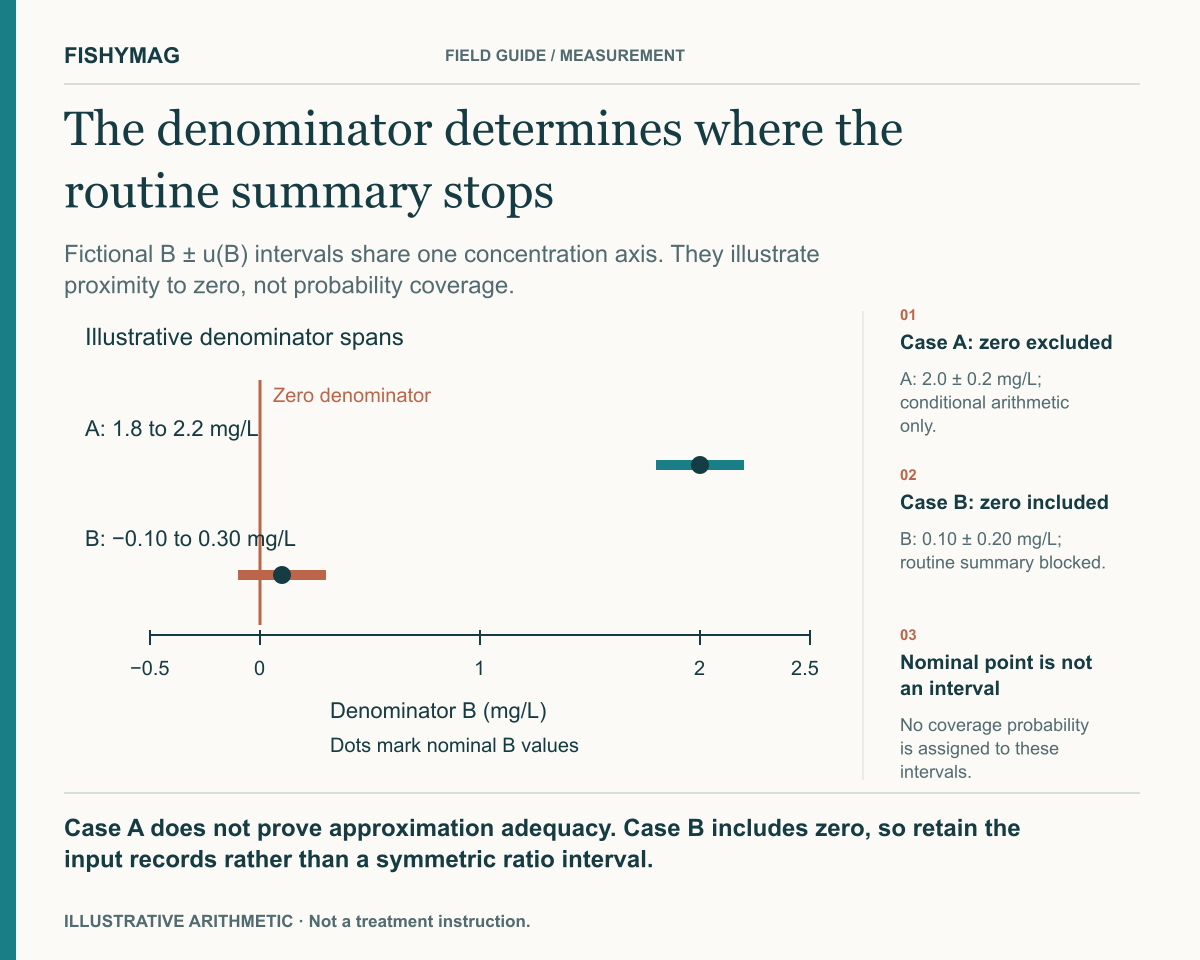
Figure data and explanation
Fictional B ± u(B) intervals share one concentration axis. They illustrate proximity to zero, not probability coverage.
- Case A: zero excluded
- A: 2.0 ± 0.2 mg/L; conditional arithmetic only.
- Case B: zero included
- B: 0.10 ± 0.20 mg/L; routine summary blocked.
- Nominal point is not an interval
- No coverage probability is assigned to these intervals.
Case A does not prove approximation adequacy. Case B includes zero, so retain the input records rather than a symmetric ratio interval.
Keep the concentration records attached to the division
A concentration ratio compares a numerator concentration A with a denominator concentration B: R = A/B. In this article, both fictional results concern the same analyte on the same reporting basis, with concentrations expressed in mg/L. Their units therefore cancel. The ratio is dimensionless, not a concentration in mg/L. The examples below are invented arithmetic records, not measurements from aquariums or claims about a test device. Each ± value is declared to be a standard uncertainty. It is not a device tolerance, a detection limit or an interval with established coverage. Independence is also declared for these fictional examples only. For an actual comparison, preserve the full analyte name, reporting basis, original qualifiers and uncertainty definition. A low result reported with a less-than qualifier is not automatically an ordinary numerical denominator. Record any reporting limit rather than replacing the qualified result with zero or an invented concentration. NIST's uncertainty approach treats uncertainty as belonging to a particular result and measurement configuration. Its propagation guidance also requires attention to covariance when inputs share error sources. Two different sampling locations do not, by themselves, establish independent uncertainties.
Work the local calculation, then keep its limits visible
Here is the mathematical construction used for the first case. For small changes around nonzero A and B, the linear change in R = A/B is approximated by δR ≈ δA/B − AδB/B². With independent inputs, adding the variances of these two linear contributions gives u(R) ≈ √[(u(A)/B)² + (A × u(B)/B²)²]. Equivalently, for positive A and B, u(R) ≈ R × √[(u(A)/A)² + (u(B)/B)²]. This is an explicit mathematical derivation for the fictional example, not a claim that NIST supplies a validated aquarium ratio procedure. In Case A, R = 10.0/2.0 = 5.0. Each input's relative standard uncertainty is 0.10. The resulting first-order standard uncertainty is √0.5, approximately 0.707. Thus the completed arithmetic entry is “nominal ratio 5.0; first-order standard uncertainty approximately 0.707; dimensionless; independence declared.” The table also constructs B − u(B) to B + u(B) solely to make proximity to zero visible. This is an illustrative interval, not an established coverage interval or a universal acceptance test. Excluding zero from this interval does not prove that first-order propagation is adequate. No distributional model or justified approximation-adequacy criterion is established for these fictional records.
| Record | A and standard uncertainty, mg/L | B and standard uncertainty, mg/L | Covariance status | Nominal A/B, dimensionless | Illustrative B interval, mg/L | First-order u(R), dimensionless | Completed reporting decision |
|---|---|---|---|---|---|---|---|
| Case A: conditional calculation | 10.0 ± 1.0 mg/L | 2.0 ± 0.2 mg/L | Independence declared for fiction | 5.0 | 1.8 to 2.2 mg/L | Approximately 0.707 | Retain as conditional first-order arithmetic; approximation adequacy Unknown |
| Case B: unstable denominator | 10.0 ± 1.0 mg/L | 0.10 ± 0.20 mg/L | Independence declared for fiction | 100; arithmetic quotient only | −0.10 to 0.30 mg/L | Not applicable: routine calculation stopped | Block a routine ratio-uncertainty summary; retain the separate input records |
Finish the blocked branch instead of printing a misleading interval
Case B has a nonzero nominal denominator, so the calculator can divide 10.0 by 0.10 and display 100. That does not make 100 a defensible uncertainty summary. Its illustrative denominator interval includes zero. The ratio is undefined at zero, and division by values approaching zero does not behave like a modest linear adjustment around the nominal quotient. The negative lower endpoint is a property of this interval construction. It is not a claim that the actual analyte concentration is negative. Likewise, the interval has no assigned probability coverage. The completed Case B record is: “Nominal quotient: 100, dimensionless, arithmetic only. Routine first-order uncertainty summary: blocked. Input results: retained separately. Ratio coverage statement: Unknown.” Do not draw a symmetric final ratio interval for this case. reason for stopping: A justified method for a ratio with a poorly determined denominator, together with the distributional and dependence information that method requires, is not established here. For an actual low-denominator result, reporting-limit and qualification information must also be resolved. No numerical ratio interval can be supplied by inventing those missing facts. Case A has a narrower reporting limit of its own: the arithmetic is complete, but approximation adequacy remains Unknown. reason for stopping: No justified approximation-adequacy criterion or supporting input model is established. The displayed first-order uncertainty must not be promoted to a validated coverage statement.
Use the worksheet without silently assuming independence
FishyMag's editorial workflow is to preserve the inputs, identify the uncertainty basis, inspect the denominator and record the calculation's status before copying a ratio into a comparison record. This is a record-checking method, not a measurement standard. If the input uncertainties are correlated, the linearized variance also contains the covariance contribution −2A × cov(A,B)/B³. A shared calibration or preparation source is therefore a reason to investigate dependence, not a reason to delete that term. If the relevant dependence is Unknown, record it as Unknown rather than applying the independent-input formula as though it were established. Repeated readings do not eliminate a shared error source. For a usable handover, keep the original results alongside the ratio entry. Distinguish a nominal quotient, a conditional first-order standard uncertainty and an interval with a justified coverage interpretation. They are different outputs. Neither a completed calculation nor a denominator interval establishes treatment suitability, device capability or an aquarium safety threshold. Sources: NIST/SEMATECH Engineering Statistics Handbook, “Uncertainty approach” and “Propagation of measurement uncertainty,” reviewed November 8, 2026. These documents provide laboratory measurement guidance, not aquarium treatment instructions.
Use your own details
Concentration-ratio record: complete the arithmetic or state the block
Download the editable text file, fill it in on your device and keep it with the relevant record. This blank worksheet records your information; it does not verify entries or approve treatment.
- Comparison identity and source locations: ____________________
- Analyte, reporting basis and common concentration unit: ____________________
- Numerator result A, original qualifier and source record: ____________________
- Numerator standard uncertainty u(A) and its basis: ____________________
- Denominator result B, original qualifier and reporting limit: ____________________
- Denominator standard uncertainty u(B) and its basis: ____________________
- Shared uncertainty sources and covariance status: ____________________
- Illustrative denominator interval, construction and zero-crossing status: ____________________
- Nominal quotient and dimensionless unit statement: ____________________
- First-order uncertainty, applicable model and approximation status: ____________________
- Final reporting decision and reason for stopping, if applicable: ____________________
- Supporting documents and unresolved information: ____________________
Put it into practice
Your checklist
- Attach both original concentration records and verify the same analyte, reporting basis and units before dividing.
- Record what each uncertainty means and whether shared sources make independence unestablished; do not replace Unknown covariance with zero.
- Check and record the denominator's illustrative interval. If it crosses zero, stop the routine summary and preserve the nominal quotient only as arithmetic, with a specific reason for stopping.
Sources and scope
This article distinguishes manufacturer statements from FishyMag’s own workflows and arithmetic examples. Linked formulation records retain their own evidence dates; publishing this article does not refresh those records.
- NIST/SEMATECH: propagation of measurement uncertainty; reviewed November 8, 2026 ↗
- NIST/SEMATECH handbook: uncertainty approach; reviewed November 8, 2026 ↗
AI-assisted writing and development. Not hands-on product testing or veterinary review. How we publish →
FishyMag reports what manufacturers say, quoted and linked. It does not diagnose illness or recommend a treatment, and it never infers that a product is safe from the absence of a warning — where no statement exists, it says so.
Formulations change. Always read the label on the bottle in your hand, and contact the manufacturer if your tank contains anything valuable or unusual.