Measurement
When pooling aquarium samples hides the answer
Use a completed equal-volume composite example to see which aquarium questions pooling can answer and which site information it removes.
By FishyMag · Published
Worked arithmetic example · Not a clinical review or treatment recommendation.
Quick answer
A composite can describe the defined mixture while hiding the local result that matters to your question. In this fictional, laboratory-confirmed equal-volume nitrate case, 2, 2 and 8 mg/L as N yield a 4 mg/L composite. The composite alone cannot identify the 8 mg/L site or recover the original 6 mg/L site range.
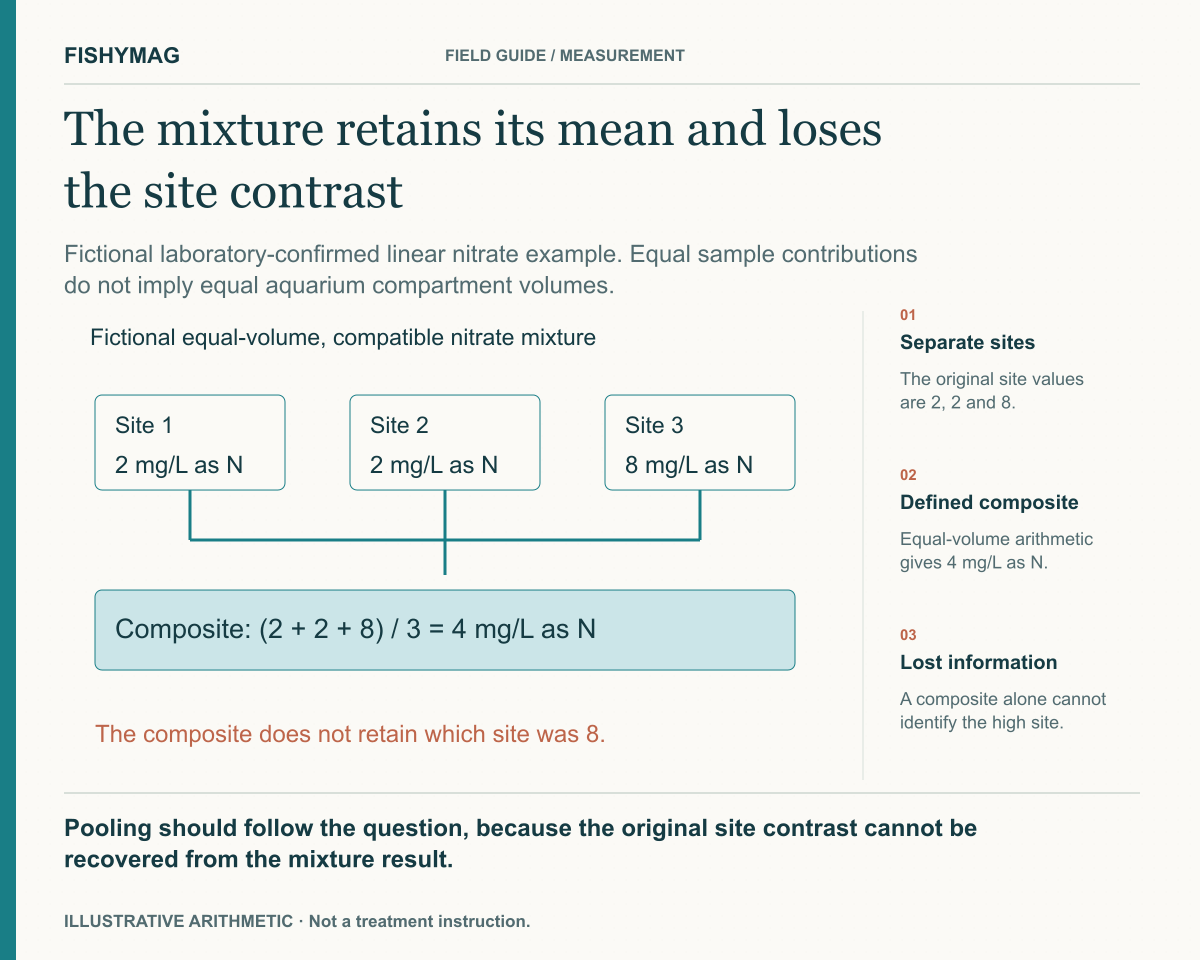
Figure data and explanation
Fictional laboratory-confirmed linear nitrate example. Equal sample contributions do not imply equal aquarium compartment volumes.
- Separate sites
- The original site values are 2, 2 and 8.
- Defined composite
- Equal-volume arithmetic gives 4 mg/L as N.
- Lost information
- A composite alone cannot identify the high site.
Pooling should follow the question, because the original site contrast cannot be recovered from the mixture result.
Choose the question before pooling loses site identity
This invented packet declares a laboratory-approved equal-volume composite of compatible nitrate samples on one nitrogen basis. The applicability of linear mixing is supplied as a condition of the teaching case, not inferred for every aquarium analyte. This is not a sample-mixing procedure. Arithmetic averaging must not be transferred to pH or a reactive mixture without the appropriate model and method evidence.
Complete the site and mixture comparison
Equal contributed volumes give equal weights. The composite is (2 + 2 + 8)/3 = 4 mg/L as N. The separate-site range is 8 − 2 = 6 mg/L as N. These numbers answer different questions.
| Question | Evidence retained separately | Composite-only answer |
|---|---|---|
| Concentration in the defined equal-volume mixture | 2, 2 and 8; contribution conditions supplied | 4 mg/L as N under those conditions |
| Which sampled site was highest? | Site 3 at 8 mg/L as N | Not recoverable from 4 alone |
| Range across the original sites | 6 mg/L as N | Not recoverable from 4 alone |
| System-volume-weighted average | Compartment volumes and representativeness needed | Not established by equal sample contributions |
Keep the weighting basis visible
Equal sample volumes are not automatically proportional to the water held in the original compartments. A large display and a small side vessel can contribute equal laboratory sample volumes while representing very different system volumes. The completed decision in this case is to retain separate samples for a site-contrast question; the defined composite addresses a mixture question only. A composite value of 4 is also compatible with many other original site combinations, so it cannot be inverted into the original map. Ask the analytical provider about actual composite applicability before commissioning the report.
Use your own details
When pooling aquarium samples hides the answer worksheet
Download the editable text file, fill it in on your device and keep it with the relevant record. This blank worksheet records your information; it does not verify entries or approve treatment.
- Question and intended sampled population
- Exact parent samples and pathway identities
- Laboratory-approved method and fraction
- Raw values, units and qualifiers
- Weighting or replication assumptions
- Completed descriptive calculation
- What remains unidentifiable
- Laboratory review and next evidence
Put it into practice
Your checklist
- State whether the question concerns a mixture or individual sites.
- Keep the contribution weights explicit.
- Do not reconstruct local extremes from a composite alone.
Sources and scope
This article distinguishes manufacturer statements from FishyMag’s own workflows and arithmetic examples. Linked formulation records retain their own evidence dates; publishing this article does not refresh those records.
- Australian and New Zealand water-quality field sampling guidance; reviewed November 8, 2026 ↗
- Australian and New Zealand water-quality guidelines: laboratory analysis; reviewed November 8, 2026 ↗
- Australian and New Zealand guidelines: water-quality data analysis; reviewed November 8, 2026 ↗
AI-assisted writing and development. Not hands-on product testing or veterinary review. How we publish →
FishyMag reports what manufacturers say, quoted and linked. It does not diagnose illness or recommend a treatment, and it never infers that a product is safe from the absence of a warning — where no statement exists, it says so.
Formulations change. Always read the label on the bottle in your hand, and contact the manufacturer if your tank contains anything valuable or unusual.