Measurement
Which carbonate form does an aquarium pH imply?
Compare checked carbonate-species distributions at fixed inorganic-carbon total while retaining complexed carbon and the countercharge differences between constructed states.
By FishyMag · Published
Worked arithmetic example · Not a clinical review or treatment recommendation.
Quick answer
Different species distributions do not necessarily mean different total inorganic carbon. Both constructed states contain 2.000 mmol C/L, while their free aqueous CO2, bicarbonate and carbonate differ. The calculation also retains other carbon-bearing species, so the three familiar free species are not silently treated as the entire inventory.
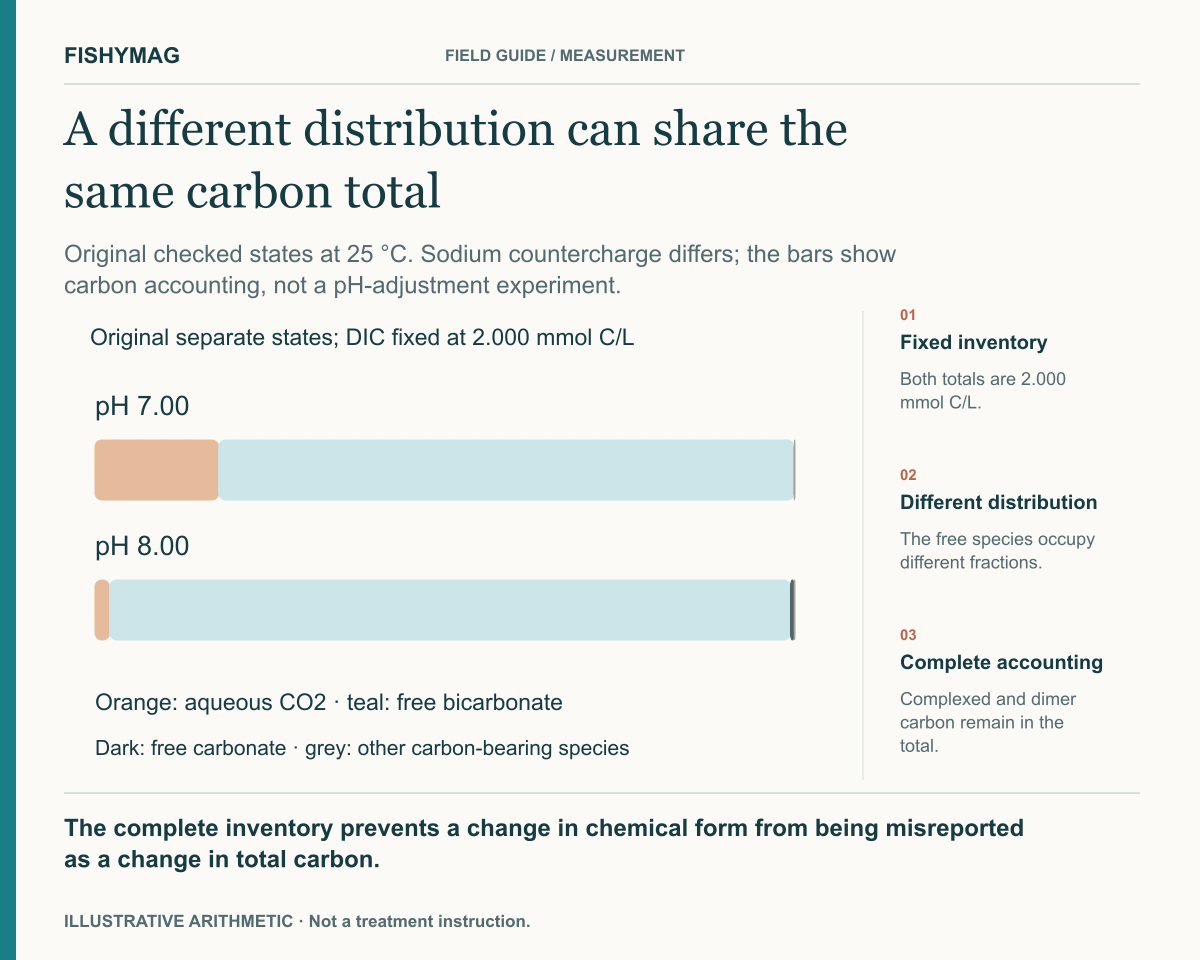
Figure data and explanation
Original checked states at 25 °C. Sodium countercharge differs; the bars show carbon accounting, not a pH-adjustment experiment.
- Fixed inventory
- Both totals are 2.000 mmol C/L.
- Different distribution
- The free species occupy different fractions.
- Complete accounting
- Complexed and dimer carbon remain in the total.
The complete inventory prevents a change in chemical form from being misreported as a change in total carbon.
Compare separate chemical states, not an intervention
The two original calculations use 25 °C, 1 atm and DIC of 2.000 mmol C/L. One specifies pH 7.00 and the other pH 8.00. Sodium countercharge is allowed to differ to maintain electroneutrality, about 1.64743 and 1.97027 mmol/L respectively. These are separately constructed states. They do not describe changing the pH of one aquarium while every other quantity remains fixed, and they are not instructions for doing so.
Account for every carbon term
The table uses mmol C/L. Each listed free species contains one carbon per molecule or ion. The final category counts carbon in modeled complexes and a small CO2-dimer term, including two carbons per dimer. Values are rounded to five decimals.
| Carbon category | pH 7.00 state, mmol C/L | pH 8.00 state, mmol C/L |
|---|---|---|
| Free aqueous CO2 | 0.35347 | 0.04166 |
| Free bicarbonate | 1.64423 | 1.94551 |
| Free carbonate | 0.00088 | 0.01055 |
| Other carbon-bearing species | 0.00142 | 0.00228 |
| Rounded column sum | 2.00000 | 2.00000 |
Close the inventory claim at the calculated boundary
Carbon mass, electrical charge, alkalinity accounting and carbonate mass-action relationships were checked. The two distributions differ while the total remains fixed by construction. That establishes a counterexample to the claim that a larger bicarbonate fraction must mean added total carbon. It does not establish the cause of a real aquarium’s pH change, nor prove that a measured DIC inventory stayed constant. Real comparison records still need composition, temperature, gas exchange, sampling and analytical evidence. Keep the other-species category visible instead of forcing three selected free species to sum to the total.
Use your own details
Which carbonate form does an aquarium pH imply? worksheet
Download the editable text file, fill it in on your device and keep it with the relevant record. This blank worksheet records your information; it does not verify entries or approve treatment.
- DIC total, carbon basis and original source
- pH and temperature for each separate state
- Major ions and countercharge allowed to differ
- Chosen database and activity treatment
- Free aqueous CO2, bicarbonate and carbonate
- Other carbon-bearing species counted as carbon
- Full column sums and rounding convention
- Unproved inference about a real pH change or carbon addition
Worked example files
These files contain the article’s worked example. Read its source and scope notes, and keep your own current records before opening an example in a tool.
Put it into practice
Your checklist
- Distinguish separate constructed states from a physical intervention.
- Sum carbon across free and complexed species.
- Keep a distribution change separate from a total-inventory claim.
Sources and scope
This article distinguishes manufacturer statements from FishyMag’s own workflows and arithmetic examples. Linked formulation records retain their own evidence dates; publishing this article does not refresh those records.
- USGS PHREEQC Version 3 manual: capabilities and computational scope; reviewed November 9, 2026 ↗
- USGS PHREEQC SOLUTION: units, calculated density, pH and alkalinity; reviewed November 9, 2026 ↗
- USGS PHREEQC SELECTED_OUTPUT: alkalinity and concentration output bases; reviewed November 9, 2026 ↗
- Vitens PhreeqPython primary repository and local version 1.6.2; reviewed November 9, 2026 ↗
AI-assisted writing and development. Not hands-on product testing or veterinary review. How we publish →
FishyMag reports what manufacturers say, quoted and linked. It does not diagnose illness or recommend a treatment, and it never infers that a product is safe from the absence of a warning — where no statement exists, it says so.
Formulations change. Always read the label on the bottle in your hand, and contact the manufacturer if your tank contains anything valuable or unusual.