Measurement
What the uncertainty on an aquarium probe certificate means
Read a certificate’s correction, expanded uncertainty and multiplier separately, then record what the arithmetic does and does not establish.
By FishyMag · Published
Worked arithmetic example · Not a clinical review or treatment recommendation.
Quick answer
Standard uncertainty and expanded uncertainty are different quantities. Divide the stated expanded uncertainty U by its stated multiplier k to recover standard uncertainty u. In the fictional example here, U = 0.12 °C and k = 2 give u = 0.06 °C. Adding the explicitly defined correction of +0.06 °C to an indication of 24.98 °C gives 25.04 °C. Neither the correction nor the uncertainty is the display resolution, and this calculation alone does not establish the uncertainty of an actual aquarium measurement.
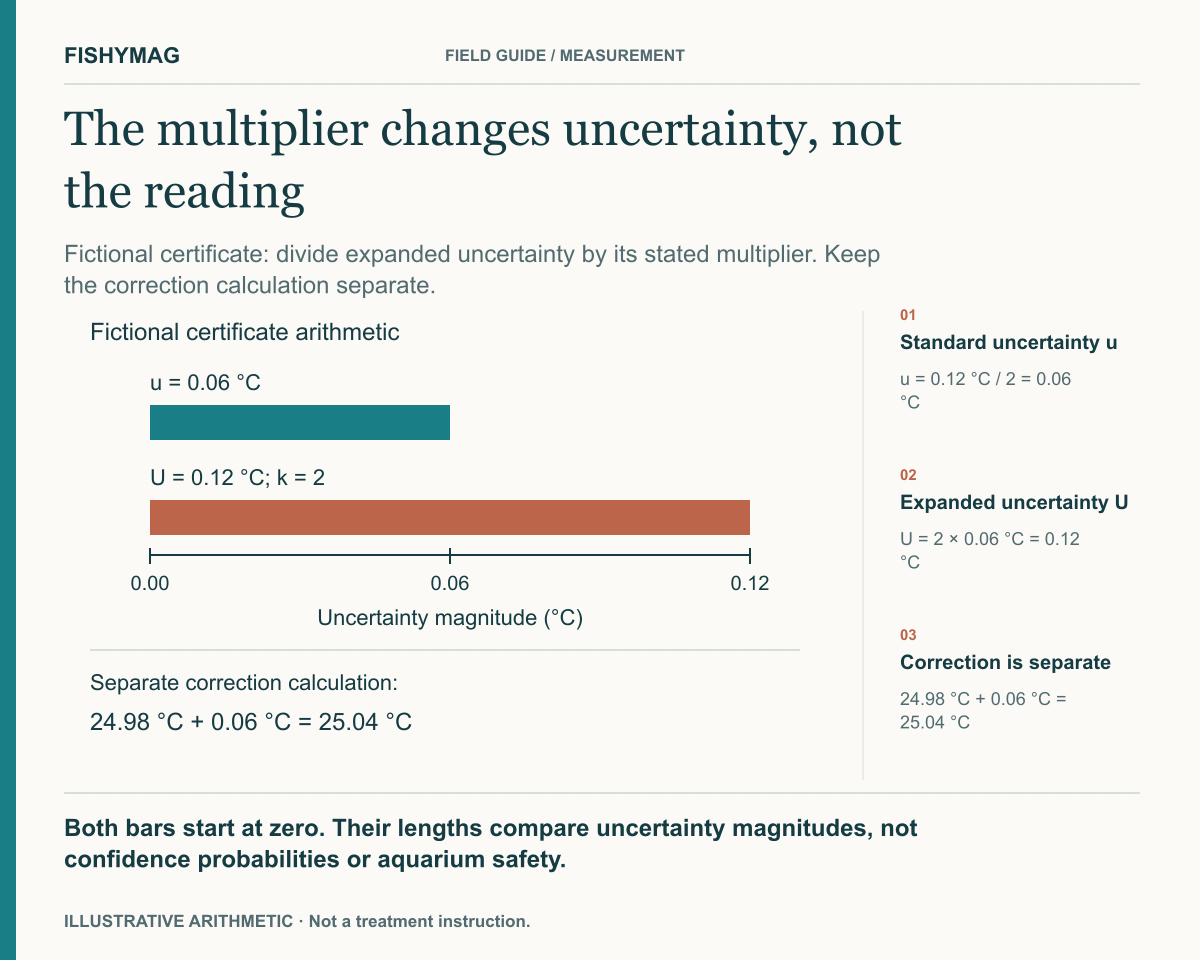
Figure data and explanation
Fictional certificate: divide expanded uncertainty by its stated multiplier. Keep the correction calculation separate.
- Standard uncertainty u
- u = 0.12 °C / 2 = 0.06 °C
- Expanded uncertainty U
- U = 2 × 0.06 °C = 0.12 °C
- Correction is separate
- 24.98 °C + 0.06 °C = 25.04 °C
Both bars start at zero. Their lengths compare uncertainty magnitudes, not confidence probabilities or aquarium safety.
Read four separate things before calculating
A useful certificate record separates the correction, the uncertainty type, the multiplier and applicability. A correction changes the estimated value according to the document’s sign convention. Uncertainty describes uncertainty associated with a result; it is not another correction to add to the reading. NIST’s guidance on Type B uncertainty says that a stated expanded uncertainty is divided by its stated multiplier to obtain standard uncertainty. Its uncertainty approach gives the reverse relationship, U = k × u. Keep the labels U and u attached to their values so that an expanded uncertainty is not accidentally entered as a standard uncertainty. Also retain the coverage statement exactly as reported. A multiplier alone does not establish a coverage interpretation: that depends on the underlying model and degrees of freedom. If the coverage statement is missing, record Unknown rather than supplying a familiar percentage. Display resolution belongs in a separate field. NIST’s terminology guidance makes clear that a display increment is not proof of accuracy or a complete uncertainty estimate. The number of decimal places in the fictional reading below does not establish the instrument’s documented resolution.
Completed fictional certificate-to-result record
This is an original fictional document example, not an actual certificate or evidence about any instrument. Its invented extract states: “Correction: add +0.06 °C to the indication. Expanded uncertainty U = 0.12 °C, multiplier k = 2.” An associated fictional reading is 24.98 °C. The example supplies no coverage statement, degrees of freedom, applicability conditions or interpolation permission. The arithmetic is therefore complete, while real-use applicability remains unresolved. The correction and the recovered standard uncertainty happen to have the same numerical value here. That coincidence does not make them the same quantity.
| Record item | Completed fictional entry | Meaning or calculation |
|---|---|---|
| Evidence identity | Fictional extract A; fictional probe A | Demonstration only; no actual device capability established |
| Indicated value | 24.98 °C | Original fictional indication, retained unchanged |
| Correction and convention | +0.06 °C; add to indication | Convention explicitly supplied by the fictional extract |
| Corrected estimate | 25.04 °C | 24.98 °C + 0.06 °C = 25.04 °C |
| Reported uncertainty type | Expanded uncertainty | Not standard uncertainty and not display resolution |
| Expanded uncertainty U | 0.12 °C | Fictional certificate-related quantity |
| Multiplier k | 2; dimensionless | Stated multiplier, not an inferred coverage probability |
| Recovered standard uncertainty u | 0.06 °C | 0.12 °C / 2 = 0.06 °C |
| Certificate-only result construction | (25.04 ± 0.12) °C | Corrected estimate with the stated expanded uncertainty applied alone |
| Arithmetic endpoints | 24.92 °C to 25.16 °C | 25.04 °C − 0.12 °C and 25.04 °C + 0.12 °C; no coverage probability assigned |
| Coverage statement and degrees of freedom | Unknown | Not provided in the fictional extract |
| Documented display resolution | Unknown | Not established by the written indication |
| Conditions and interpolation permission | Unknown | No supported extension to other conditions or calibration points |
| Actual aquarium applicability | Unknown | No actual certificate, matched instrument or supported measurement configuration supplied |
Keep the finished result narrower than the claim
A finished handover statement for this example is: “Fictional indication 24.98 °C; add correction +0.06 °C; corrected estimate 25.04 °C. Certificate-related expanded uncertainty U = 0.12 °C at k = 2, equivalent to standard uncertainty u = 0.06 °C. The certificate-only construction is (25.04 ± 0.12) °C. Coverage interpretation and aquarium applicability: Unknown.” That statement is usable because it preserves the calculation without presenting it as a complete in-use uncertainty budget. NIST’s uncertainty approach ties uncertainty to a particular result and measurement configuration. A certificate-related quantity alone does not establish every contribution relevant to the aquarium measurement. Repeated readings would not, by themselves, remove shared error or settle applicability. For an actual record, attach the complete certificate and identify the instrument and probe it covers. Copy its correction convention, relevant calibration point, conditions, coverage wording and any interpolation restrictions. Keep the original indication beside the calculated estimate rather than overwriting it. These are FishyMag editorial record practices, not a calibration procedure. reason for stopping: An actual corrected aquarium result with a defensible in-use uncertainty cannot be established here because the actual certificate, instrument match, correction convention and evidence supporting application to the measurement configuration are missing. If an actual document gives U without k, conversion to u is also blocked until the multiplier is established. Do not guess the missing value.
Use your own details
Certificate-to-result worksheet
Download the editable text file, fill it in on your device and keep it with the relevant record. This blank worksheet records your information; it does not verify entries or approve treatment.
- Instrument and probe identifiers: ____________________
- Certificate reference and attached file: ____________________
- Indication, unit and measurement context: ____________________
- Relevant certificate point and applicability conditions: ____________________
- Correction, unit and exact sign convention: ____________________
- Corrected estimate and arithmetic: ____________________
- Reported uncertainty value, unit and type: ____________________
- Multiplier, coverage wording and degrees of freedom: ____________________
- Recovered standard uncertainty calculation, or reason for stopping: ____________________
- Resolution evidence, interpolation restrictions and unresolved applicability: ____________________
Put it into practice
Your checklist
- Match the certificate to the instrument and probe, and retain the original indication separately from the corrected estimate.
- Copy the uncertainty type and stated multiplier before calculating u = U / k; leave the conversion blocked if k is unknown.
- Record the exact coverage wording and applicability limits, and label any certificate-only result so it cannot be mistaken for a complete in-use uncertainty statement.
Sources and scope
This article distinguishes manufacturer statements from FishyMag’s own workflows and arithmetic examples. Linked formulation records retain their own evidence dates; publishing this article does not refresh those records.
- NIST: evaluating Type B uncertainty components; reviewed November 8, 2026 ↗
- NIST/SEMATECH handbook: uncertainty approach; reviewed November 8, 2026 ↗
- NIST TN1297 Appendix D1: measurement terminology; reviewed November 8, 2026 ↗
AI-assisted writing and development. Not hands-on product testing or veterinary review. How we publish →
FishyMag reports what manufacturers say, quoted and linked. It does not diagnose illness or recommend a treatment, and it never infers that a product is safe from the absence of a warning — where no statement exists, it says so.
Formulations change. Always read the label on the bottle in your hand, and contact the manufacturer if your tank contains anything valuable or unusual.