Measurement
Which aquarium reading drives the ammonia estimate?
Calculate all four pH-temperature corners of a fictional ammonia-fraction estimate and separate the pH contribution from the temperature contribution.
By FishyMag · Published
Worked arithmetic example · Not a clinical review or treatment recommendation.
Quick answer
For the specified freshwater equation, pH 7.8 to 8.2 and 24 to 26 °C produce a modeled fraction from 3.225% to 8.795%. At the central temperature, the pH span changes the result by 4.792 percentage points; the temperature span at central pH changes it by 0.718 points. These are conditional input bounds, without an assigned probability.
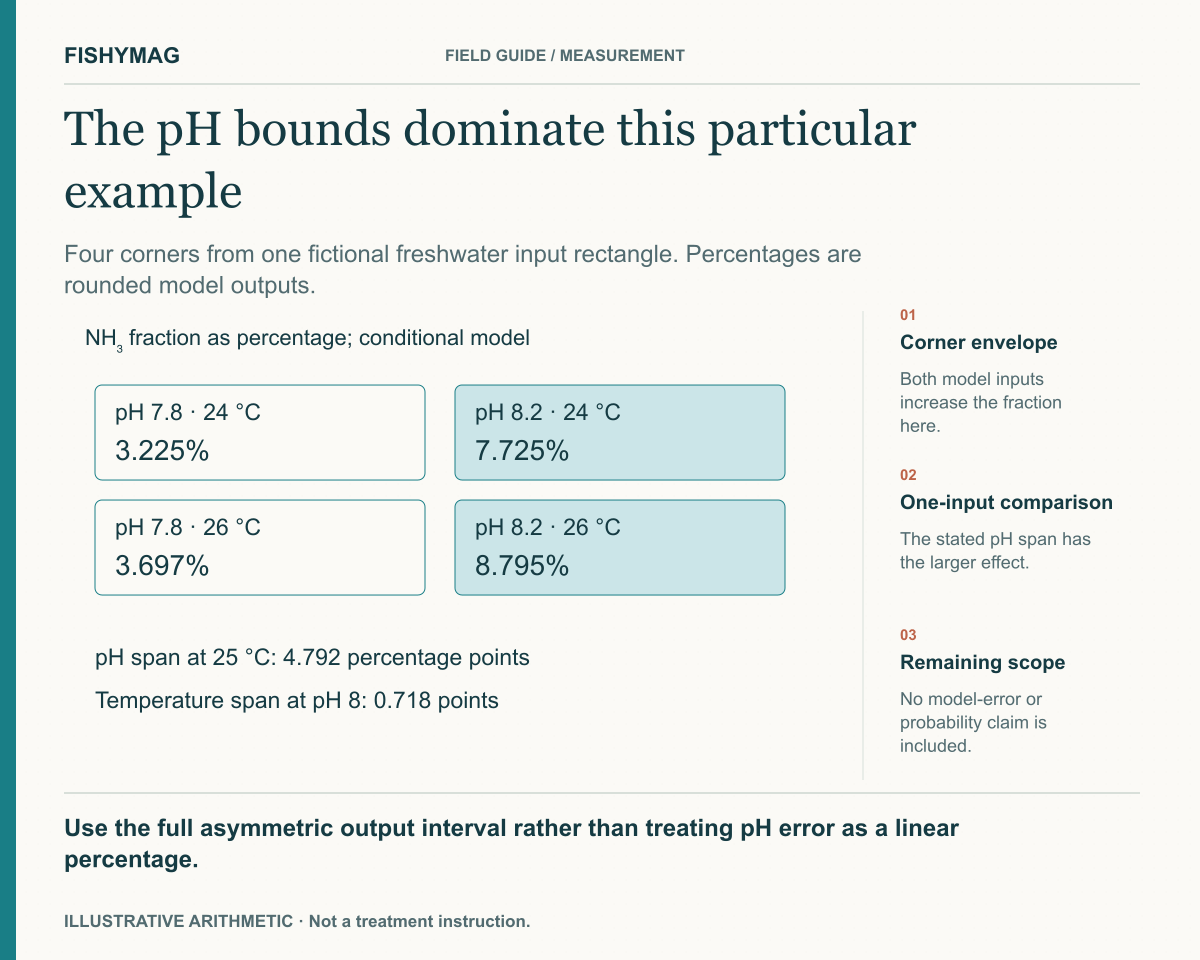
Figure data and explanation
Four corners from one fictional freshwater input rectangle. Percentages are rounded model outputs.
- Corner envelope
- Both model inputs increase the fraction here.
- One-input comparison
- The stated pH span has the larger effect.
- Remaining scope
- No model-error or probability claim is included.
Use the full asymmetric output interval rather than treating pH error as a linear percentage.
Define the input rectangle
This fictional case uses the same conventional freshwater equation shown in the linked model calculation: pKa = 0.09018 + 2729.92/(273.15 + t), and f = 1/(1 + 10^(pKa − pH)). The pH interval is 7.8 to 8.2, and temperature t is 24 to 26 °C. The central record is pH 8.00 at 25 °C. All temperatures are within the source’s stated range. The bounds do not include model error, salinity effects or an unrecognized reporting-basis mismatch.
Calculate the corners and check the direction
Within this rectangle, increasing pH reduces the exponent and increases f. Increasing temperature reduces pKa and also increases f. Both changes are monotonic in the stated equations, so the smallest corner is pH 7.8 at 24 °C and the largest is pH 8.2 at 26 °C. There is no interior extremum for this model over these inputs.
| pH | Temperature, °C | NH₃ fraction | Percentage |
|---|---|---|---|
| 7.8 | 24 | 0.03225313 | 3.2253% |
| 7.8 | 26 | 0.03697174 | 3.6972% |
| 8.2 | 24 | 0.07724928 | 7.7249% |
| 8.2 | 26 | 0.08795252 | 8.7953% |
Compare one input at a time
At 25 °C, changing only pH from 7.8 to 8.2 spans 4.7918 percentage points. At pH 8.00, changing only temperature from 24 to 26 °C spans 0.7185 percentage points. Thus the specified pH range contributes a larger one-at-a-time span in this particular case. This is not a universal ranking for every uncertainty range. The central output is 5.3662%, while the combined envelope is 3.2253% to 8.7953%. Its asymmetry means “central value plus or minus half the full width” would not preserve the computed endpoints.
Keep bounds distinct from confidence
The completed record reports the input limits, model and output envelope together. No distribution was assigned to either input, and no confidence level follows from checking four corners. If the real water falls outside the freshwater model’s applicability, more precise pH inputs will not repair the model mismatch. Preserve the unresolved model contribution separately. This is an interpretation exercise, without an ammonia safety threshold or instruction to change aquarium conditions.
Use your own details
Which aquarium reading drives the ammonia estimate? worksheet
Download the editable text file, fill it in on your device and keep it with the relevant record. This blank worksheet records your information; it does not verify entries or approve treatment.
- Aquarium and sample identity
- Exact analyte wording
- Reporting unit and chemical basis
- Sample fraction and method revision
- Original values and qualifiers
- Permitted comparison or calculation
- Remaining scope or evidence gap
- Completed interpretation and source
Put it into practice
Your checklist
- Verify the equation is monotonic over the full input range.
- Compare each input using its own stated bounds.
- Report the combined endpoints without inventing a confidence level.
Sources and scope
This article distinguishes manufacturer statements from FishyMag’s own workflows and arithmetic examples. Linked formulation records retain their own evidence dates; publishing this article does not refresh those records.
- IPCS Environmental Health Criteria 54, section 2.1.2; reviewed November 8, 2026 ↗
- Australian and New Zealand Guidelines, ammonia freshwater technical brief; reviewed November 8, 2026 ↗
- NIST/SEMATECH: propagation of measurement uncertainty; reviewed November 8, 2026 ↗
AI-assisted writing and development. Not hands-on product testing or veterinary review. How we publish →
FishyMag reports what manufacturers say, quoted and linked. It does not diagnose illness or recommend a treatment, and it never infers that a product is safe from the absence of a warning — where no statement exists, it says so.
Formulations change. Always read the label on the bottle in your hand, and contact the manufacturer if your tank contains anything valuable or unusual.