Measurement
Does aquarium alkalinity mean carbonate alone?
Partition a checked alkalinity example into carbonate, borate and water contributions, then show why a total alone cannot supply that partition.
By FishyMag · Published
Worked arithmetic example · Not a clinical review or treatment recommendation.
Quick answer
A total alkalinity result does not automatically equal carbonate-system alkalinity. In this constructed calculation, 2.000 meq/L consists of 1.600 carbonate terms and 0.400 other terms. Assigning the entire total to carbonate misattributes 20% of the total and overstates the carbonate contribution by 25% relative to its actual modeled value.
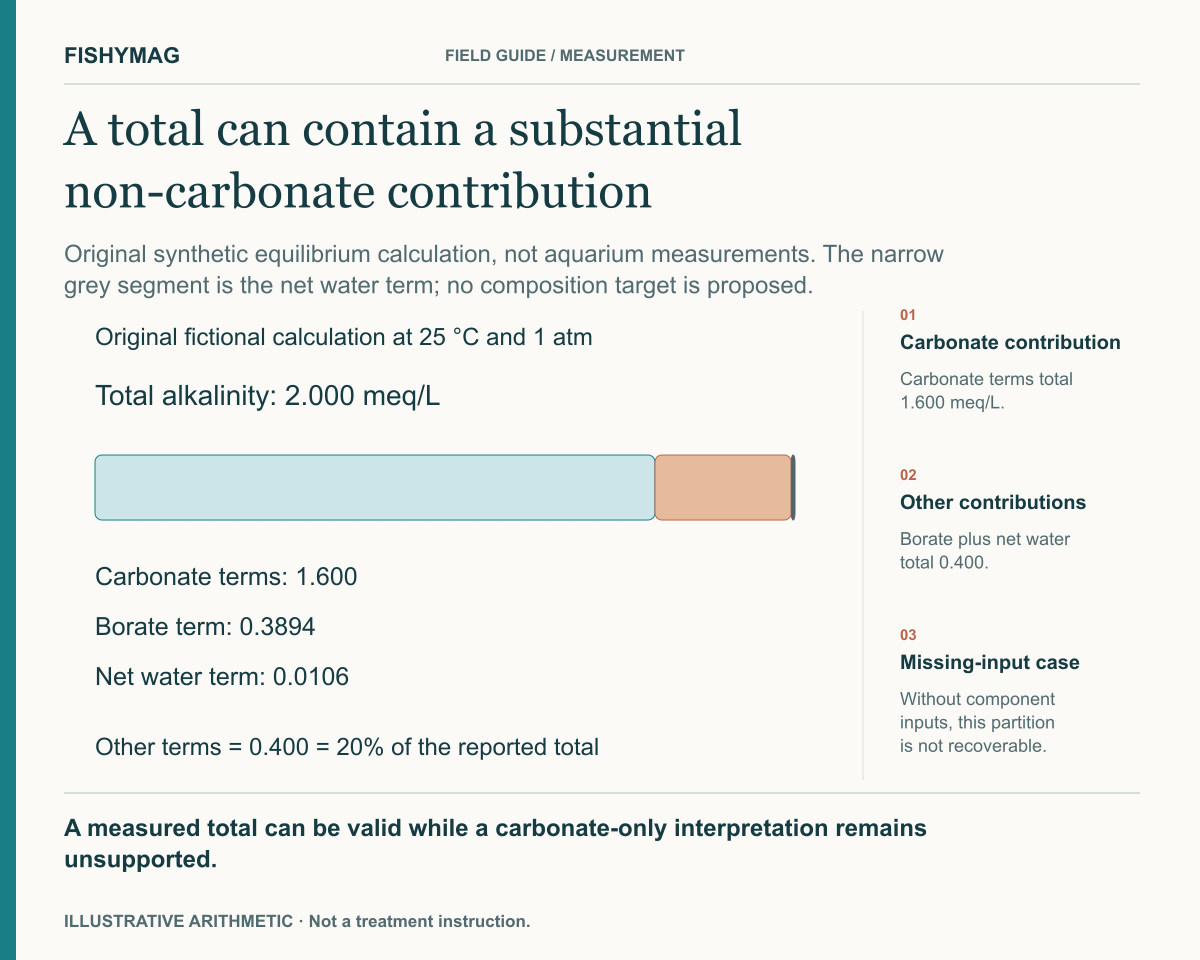
Figure data and explanation
Original synthetic equilibrium calculation, not aquarium measurements. The narrow grey segment is the net water term; no composition target is proposed.
- Carbonate contribution
- Carbonate terms total 1.600 meq/L.
- Other contributions
- Borate plus net water total 0.400.
- Missing-input case
- Without component inputs, this partition is not recoverable.
A measured total can be valid while a carbonate-only interpretation remains unsupported.
Work from a declared composition, not a typical-water assumption
FishyMag computed this synthetic state locally using PhreeqPython 1.6.2 with its explicitly selected phreeqc.dat database. It is at pH 9.00, 25 °C and 1 atm, with total alkalinity specified as 2.000 meq/L. Its constructed boron total is about 1.03243 mmol/L and sodium about 2.000 mmol/L. These are model inputs and outputs, not aquarium targets, usual tank composition or preparation instructions. No animal or formulation was tested.
Complete the component and percentage accounting
The calculation retains free and complexed carbonate species. The water term is the net acid-base contribution, not simply the hydroxide concentration. Carbon mass, electrical charge, total alkalinity and carbonate mass-action relationships were checked separately from the reported totals.
| Contribution or comparison | Checked result | Meaning |
|---|---|---|
| Carbonate-system terms | 1.6000 meq/L | Carbonate and bicarbonate contributions, including modeled complexes |
| Borate term | 0.3894 meq/L | Constructed non-carbonate component |
| Net water term | 0.0106 meq/L | Net water-related acid-base contribution |
| All other terms combined | 0.4000 meq/L | 20% of 2.000 total |
| Overstatement relative to carbonate | 0.4000 ÷ 1.6000 × 100 = 25% | Different denominator from the 20% attribution fraction |
Remove the component evidence and the partition becomes unknown
A second dossier supplies only the same 2.000 meq/L total, without the non-carbonate inputs. That total can remain in the record, but the 1.600/0.400 partition cannot be copied into it. A successful titration does not identify every contributor. The synthetic example demonstrates the missing assumption rather than estimating the makeup of an undocumented aquarium sample. If a later calculation needs carbonate alkalinity specifically, retain the relevant composition, temperature, fraction and method evidence instead of relabelling a total result as carbonate-only.
Use your own details
Does aquarium alkalinity mean carbonate alone? worksheet
Download the editable text file, fill it in on your device and keep it with the relevant record. This blank worksheet records your information; it does not verify entries or approve treatment.
- Original total alkalinity and reporting basis
- pH, temperature and applicable sample composition
- Carbonate-system inputs or missing fields
- Known non-carbonate components and source of evidence
- Water and complexed-species terms retained
- Calculated partition with its model and units
- Correct denominator for any percentage claim
- Finding when component evidence is withheld
Worked example files
These files contain the article’s worked example. Read its source and scope notes, and keep your own current records before opening an example in a tool.
Put it into practice
Your checklist
- Distinguish total alkalinity from the carbonate contribution.
- Keep non-carbonate and net water terms in the accounting.
- State the denominator when describing an attribution percentage.
Sources and scope
This article distinguishes manufacturer statements from FishyMag’s own workflows and arithmetic examples. Linked formulation records retain their own evidence dates; publishing this article does not refresh those records.
- USGS PHREEQC Version 3 manual: capabilities and computational scope; reviewed November 9, 2026 ↗
- USGS PHREEQC SOLUTION: units, calculated density, pH and alkalinity; reviewed November 9, 2026 ↗
- USGS PHREEQC SELECTED_OUTPUT: alkalinity and concentration output bases; reviewed November 9, 2026 ↗
- Vitens PhreeqPython primary repository and local version 1.6.2; reviewed November 9, 2026 ↗
AI-assisted writing and development. Not hands-on product testing or veterinary review. How we publish →
FishyMag reports what manufacturers say, quoted and linked. It does not diagnose illness or recommend a treatment, and it never infers that a product is safe from the absence of a warning — where no statement exists, it says so.
Formulations change. Always read the label on the bottle in your hand, and contact the manufacturer if your tank contains anything valuable or unusual.