Measurement
When aquarium acid-base tests use different endpoints
Audit three real endpoint definitions and complete a fictional report-pair comparison without treating acidity as negative alkalinity or assigning a pH to a colour endpoint.
By FishyMag · Published
Worked arithmetic example · Not a clinical review or treatment recommendation.
Quick answer
Acidity and alkalinity results are not automatically opposite signed numbers. EPA 310.1, EPA 305.1 and API KH instructions define different endpoints or preparation conditions. The completed packet below leaves every conversion or subtraction unsupported unless the applicable method evidence supplies a real bridge.

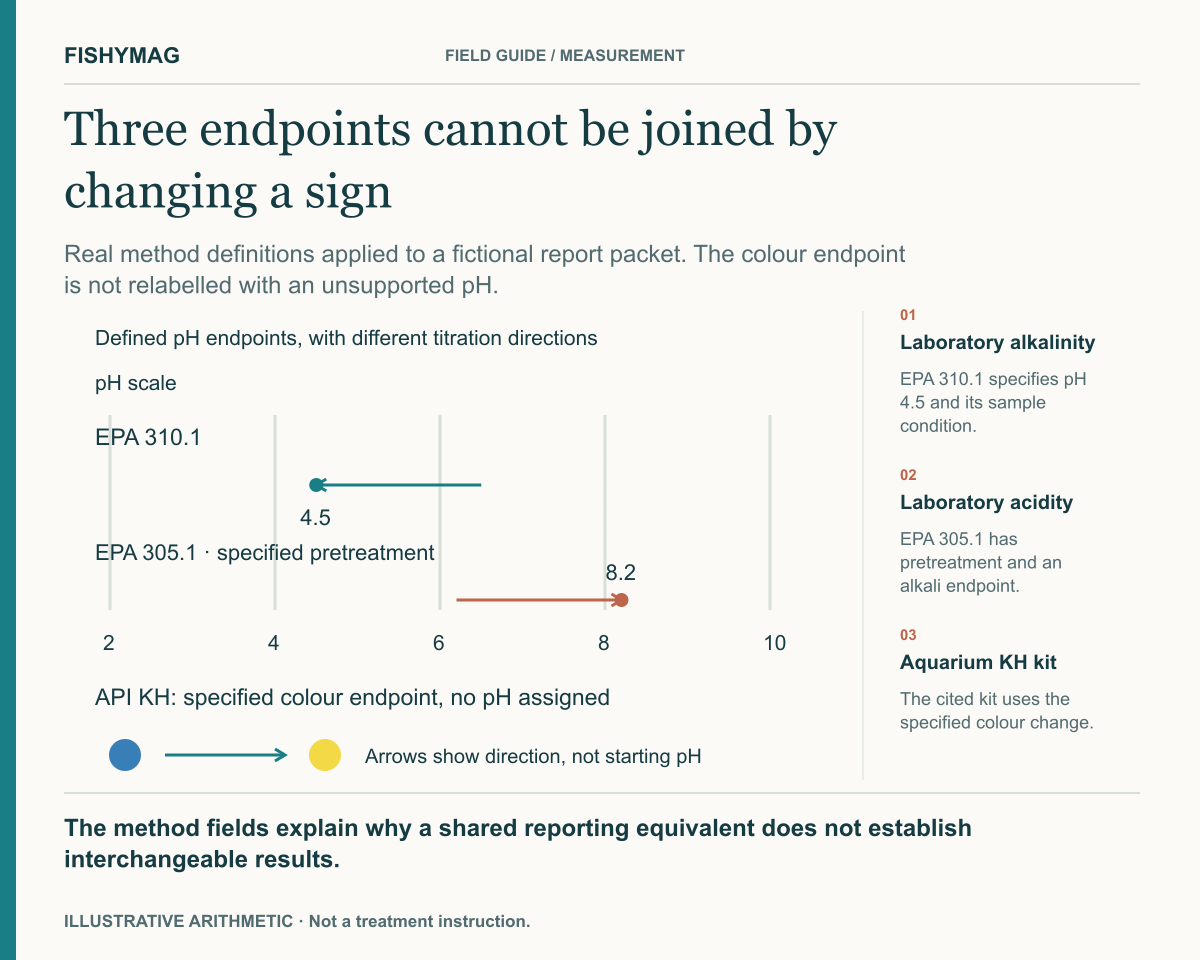
Figure data and explanation
Real method definitions applied to a fictional report packet. The colour endpoint is not relabelled with an unsupported pH.
- Laboratory alkalinity
- EPA 310.1 specifies pH 4.5 and its sample condition.
- Laboratory acidity
- EPA 305.1 has pretreatment and an alkali endpoint.
- Aquarium KH kit
- The cited kit uses the specified colour change.
The method fields explain why a shared reporting equivalent does not establish interchangeable results.
Start with the actual endpoint records
EPA 310.1 describes an unaltered, unfiltered sample titrated with acid to an electrometric pH 4.5 endpoint. EPA 305.1 uses specified pretreatment and an alkali titration to pH 8.2 for its acidity determination. Its scope and preparation are material to the result, not optional details. API KH instructions specify a blue-to-bright-yellow colour endpoint after mixing; that wording does not independently identify pH 4.5. These source distinctions are not home laboratory instructions.
Complete the fictional three-report comparison
The constructed packet names these three methods but lacks a cross-method study for its particular sample. Its report identifiers A, B and C are fictional. No invented numerical results are needed to finish the comparability decision.
| Pair | Shared feature | Material gap | Completed decision |
|---|---|---|---|
| A: EPA 310.1 vs B: EPA 305.1 | Both use acid-base titration | Different direction, pretreatment and endpoint definition | Do not negate or subtract one into the other |
| A: EPA 310.1 vs C: API KH | Both concern a capacity called alkalinity or KH | No demonstrated equivalence of endpoint, fraction and conversion for this sample | Potential comparison question, no justified numerical conversion |
| B: EPA 305.1 vs C: API KH | Both appear in the same packet | Acidity determination is not the kit’s KH result | No direct subtraction or sign reversal supported |
Ask for the missing bridge rather than inventing it
A useful request to the issuing laboratory identifies the original sample, the two methods, the preparation differences and the exact comparison needed. A matching CaCO3 reporting basis alone does not solve those differences. Keep both original results, method identities and endpoint definitions in separate fields. Do not import the filtered-alkalinity definition from another method family into EPA 310.1, whose own sample requirements are different. The finished decision is that this packet does not support numerical equivalence, not that all acid-base methods are forever incomparable.
Use your own details
When aquarium acid-base tests use different endpoints worksheet
Download the editable text file, fill it in on your device and keep it with the relevant record. This blank worksheet records your information; it does not verify entries or approve treatment.
- Exact method, revision and issuer
- Original measured quantity and reporting basis
- Sample fraction and pretreatment
- Titration direction
- Actual endpoint wording
- Calibration or kit conversion basis
- Completed pairwise comparison
- Missing bridge needed before any numerical comparison
Put it into practice
Your checklist
- Preserve endpoint wording and pretreatment.
- Do not assign an unstated pH to a colour change.
- Require an applicable bridge before comparing or subtracting method results.
Sources and scope
This article distinguishes manufacturer statements from FishyMag’s own workflows and arithmetic examples. Linked formulation records retain their own evidence dates; publishing this article does not refresh those records.
- EPA 310.1 alkalinity, official NEMI method record and indexed method text; reviewed November 9, 2026 ↗
- EPA 305.1 acidity, official NEMI method record; reviewed November 9, 2026 ↗
- API GH & KH instructions linked from manufacturer KH page; reviewed November 8, 2026 ↗
AI-assisted writing and development. Not hands-on product testing or veterinary review. How we publish →
FishyMag reports what manufacturers say, quoted and linked. It does not diagnose illness or recommend a treatment, and it never infers that a product is safe from the absence of a warning — where no statement exists, it says so.
Formulations change. Always read the label on the bottle in your hand, and contact the manufacturer if your tank contains anything valuable or unusual.