Evidence literacy
Does the untreated aquarium support the claimed effect?
Correct an additive-only claim when a fictional aquarium study changes both the additive and the light schedule.
By FishyMag · Published
Original research-appraisal case · Not a clinical review or treatment recommendation.
Quick answer
The fictional comparison observes an additive plus a changed light schedule against neither change. It describes that package contrast. It does not isolate the additive’s contribution, even if the reported endpoint differs between groups.

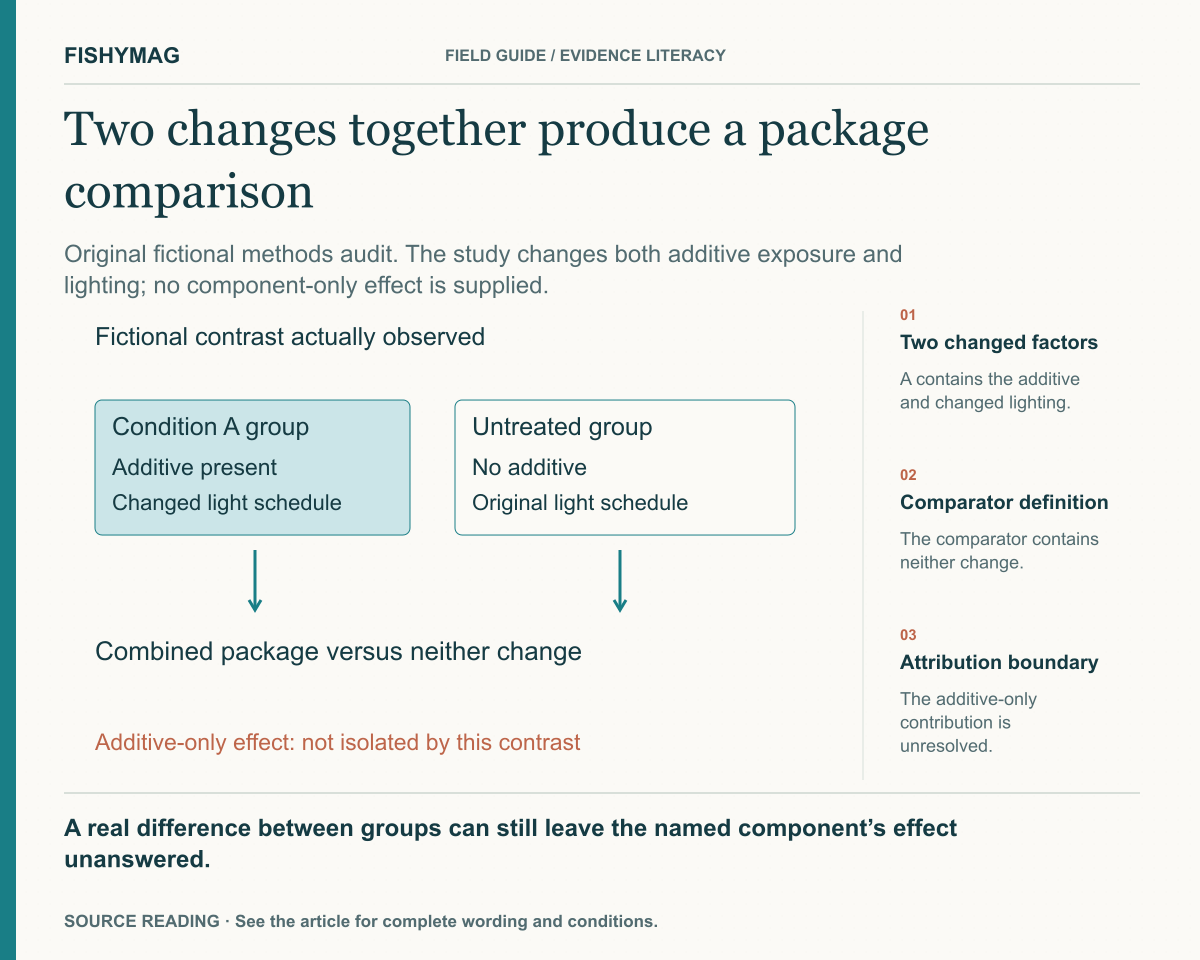
Figure data and explanation
Original fictional methods audit. The study changes both additive exposure and lighting; no component-only effect is supplied.
- Two changed factors
- A contains the additive and changed lighting.
- Comparator definition
- The comparator contains neither change.
- Attribution boundary
- The additive-only contribution is unresolved.
A real difference between groups can still leave the named component’s effect unanswered.
Write down every condition that changes between groups
The fictional extract calls one group treated and the other untreated. In its methods, however, the A group both receives an additive and uses a changed light schedule. The comparator receives no additive and retains the original schedule. ARRIVE’s study-design reporting framework is useful because it asks what groups and controls actually exist. The reasoning here is a completed contrast audit, not a reanalysis of a real experiment.
Translate the design into an answerable question
The endpoint difference is reported but no numerical effect is supplied in this teaching case. There is no need to invent one to identify what the design compares.
| Feature | A group | Comparator | Consequence for the claim |
|---|---|---|---|
| Additive | Present | Absent | Differs between groups |
| Light schedule | Changed | Original | Also differs between groups |
| Observed contrast | Additive plus changed light | Neither change | Package comparison |
| Additive alone under matched light | No matching group supplied | No matching group supplied | Contribution unresolved |
| Which component caused the difference? | Not separated | Not separated | Do not allocate the observed difference |
Correct the sentence rather than guess the mechanism
A defensible summary is: “The reported endpoint differed between groups that also differed in both additive exposure and light schedule.” It can then state that the additive-only contribution is unresolved. Do not conclude that lighting explains everything, that the additive has no effect, or that the two components interact. Each is a stronger proposition than this record establishes. The useful follow-up is to request the full group definitions, co-intervention records and any comparison that holds the light schedule constant. This is evidence appraisal for existing studies; it supplies no exposure procedure and no aquarium compatibility clearance.
Use your own details
Does the untreated aquarium support the claimed effect? worksheet
Download the editable text file, fill it in on your device and keep it with the relevant record. This blank worksheet records your information; it does not verify entries or approve treatment.
- Group definitions from the methods
- Ingredient or additive difference
- Light-schedule difference
- Other documented co-interventions
- Endpoint and observation window
- Contrast actually observed
- Component-only claim in the summary
- Missing comparison needed to assess that claim
Put it into practice
Your checklist
- List every documented difference between the groups.
- Name the package contrast the record actually observes.
- Leave component attribution unresolved when it is not isolated.
Sources and scope
This article distinguishes manufacturer statements from FishyMag’s own workflows and arithmetic examples. Linked formulation records retain their own evidence dates; publishing this article does not refresh those records.
AI-assisted writing and development. Not hands-on product testing or veterinary review. How we publish →
FishyMag reports what manufacturers say, quoted and linked. It does not diagnose illness or recommend a treatment, and it never infers that a product is safe from the absence of a warning — where no statement exists, it says so.
Formulations change. Always read the label on the bottle in your hand, and contact the manufacturer if your tank contains anything valuable or unusual.