Evidence literacy
Six fish in one aquarium: what was actually replicated?
Audit an aquarium study’s allocation unit with a completed six-tank example, including a shared-reservoir branch that cannot be counted as independent tanks.
By FishyMag · Published
Original research-appraisal case · Not a clinical review or treatment recommendation.
Quick answer
In the fictional six-tank study, exposure is assigned independently to hydraulically separate tanks. There are 36 observed fish but three independently assigned tanks per condition. A revised drawing with one shared reservoir for the three A tanks changes the independence question; animal count alone cannot settle it.
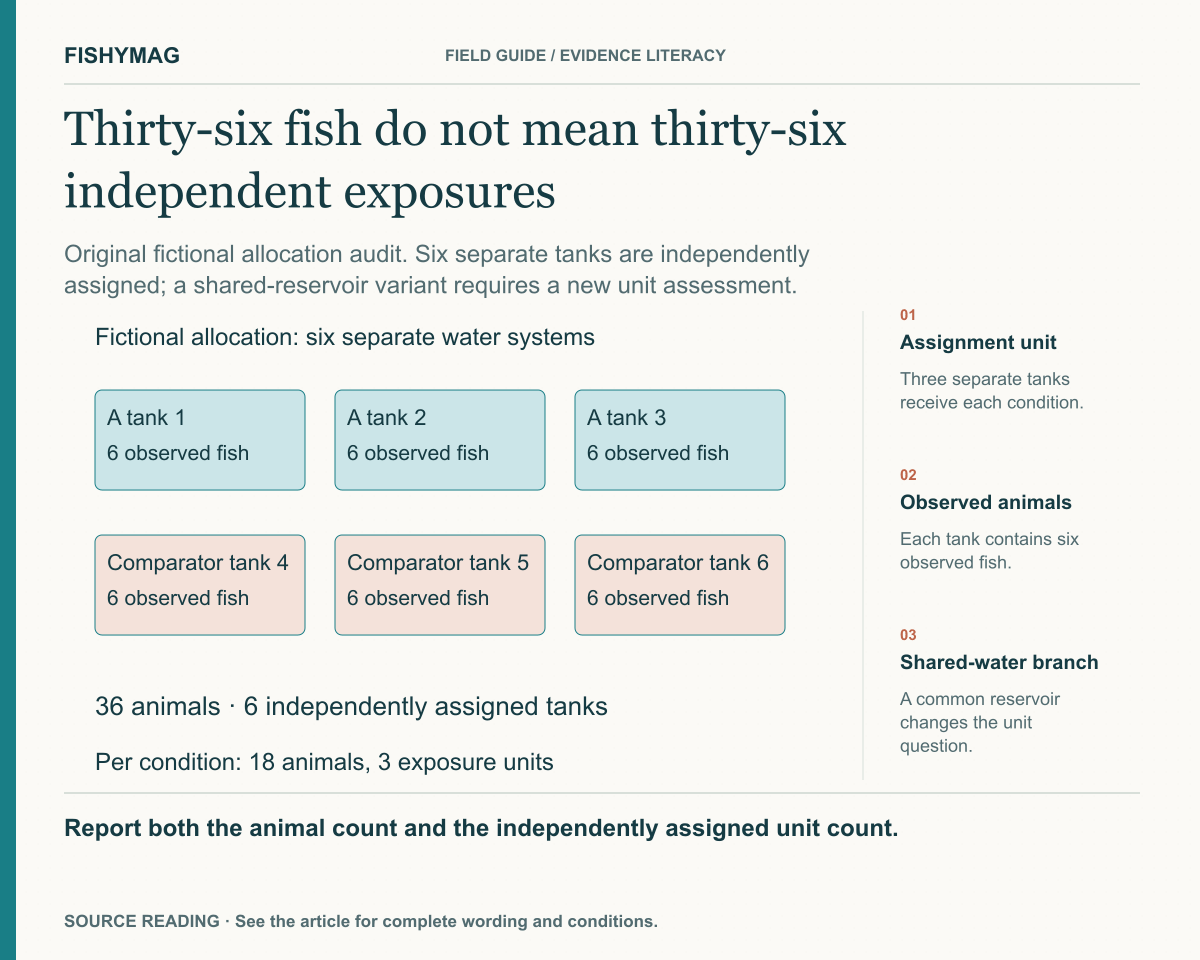
Figure data and explanation
Original fictional allocation audit. Six separate tanks are independently assigned; a shared-reservoir variant requires a new unit assessment.
- Assignment unit
- Three separate tanks receive each condition.
- Observed animals
- Each tank contains six observed fish.
- Shared-water branch
- A common reservoir changes the unit question.
Report both the animal count and the independently assigned unit count.
Count at the point where conditions can differ independently
ARRIVE 2.0 distinguishes the experimental unit from animals or measurements nested within it. The original case here fixes the assignment rule: each of six separate aquariums can receive its own condition, and no tank shares water with another. Tanks 1 to 3 receive A; tanks 4 to 6 receive the comparator. Each contains six fish. These are invented study records for reading a paper, not a proposed keeper experiment.
Complete both levels of the count
The animal count describes what was observed. The assignment count describes the independent exposure replication stipulated in this case. One count cannot silently replace the other in a summary.
| Record | Condition A | Comparator | Interpretation |
|---|---|---|---|
| Separate aquariums | 3 | 3 | Three assigned exposure units per condition |
| Fish observed | 18 | 18 | Six animals nested within each tank |
| Combined animal count | 18 + 18 = 36 | Same study total | Not 36 independent exposure assignments |
| Alternative drawing: A tanks share one reservoir | Three connected tanks | Connection evidence separate | Reservoir-level assignment and dependencies must be recovered |
| Independent replication in the alternative | Unresolved | Do not assume unchanged | No replacement sample size invented |
Do not repair a shared-water design by recounting fish
In the alternative drawing, water from all three A tanks passes through one reservoir. Ask which entity actually received an independently assignable exposure and how outcomes could influence one another through the common system. Until that record is available, retain “three connected A tanks” as a physical count and leave independent exposure replication unresolved. This does not mean the study is worthless or that a particular statistical model is automatically invalid. It means the headline animal count cannot establish the claimed independence. Preserve both the allocation diagram and the authors’ actual analysis before judging the inference.
Use your own details
Six fish in one aquarium: what was actually replicated? worksheet
Download the editable text file, fill it in on your device and keep it with the relevant record. This blank worksheet records your information; it does not verify entries or approve treatment.
- Study and allocation record version
- Entity receiving independent exposure assignment
- Animals observed within each entity
- Water connections and shared reservoirs
- Conditions assigned per independent unit
- Repeated observations or subsamples
- Independent unit counts by condition
- Unresolved reservoir-level assignment evidence
Put it into practice
Your checklist
- Separate animals observed from independent exposure assignments.
- Trace water connections before accepting tank independence.
- Request the allocation record instead of inventing an effective sample size.
Sources and scope
This article distinguishes manufacturer statements from FishyMag’s own workflows and arithmetic examples. Linked formulation records retain their own evidence dates; publishing this article does not refresh those records.
AI-assisted writing and development. Not hands-on product testing or veterinary review. How we publish →
FishyMag reports what manufacturers say, quoted and linked. It does not diagnose illness or recommend a treatment, and it never infers that a product is safe from the absence of a warning — where no statement exists, it says so.
Formulations change. Always read the label on the bottle in your hand, and contact the manufacturer if your tank contains anything valuable or unusual.