Evidence literacy
No observed harm in an aquarium study: how much remains uncertain?
Calculate an exact one-sided bound for a fictional zero-event study while preserving independent-unit, endpoint and follow-up assumptions.
By FishyMag · Published
Worked arithmetic example · Not a clinical review or treatment recommendation.
Quick answer
Zero specified adverse events in 30 independent units gives a one-sided 95% binomial upper bound of about 9.5% under the stated model. The observed count is zero; the model does not establish zero event probability, cover unmeasured endpoints or extend follow-up.

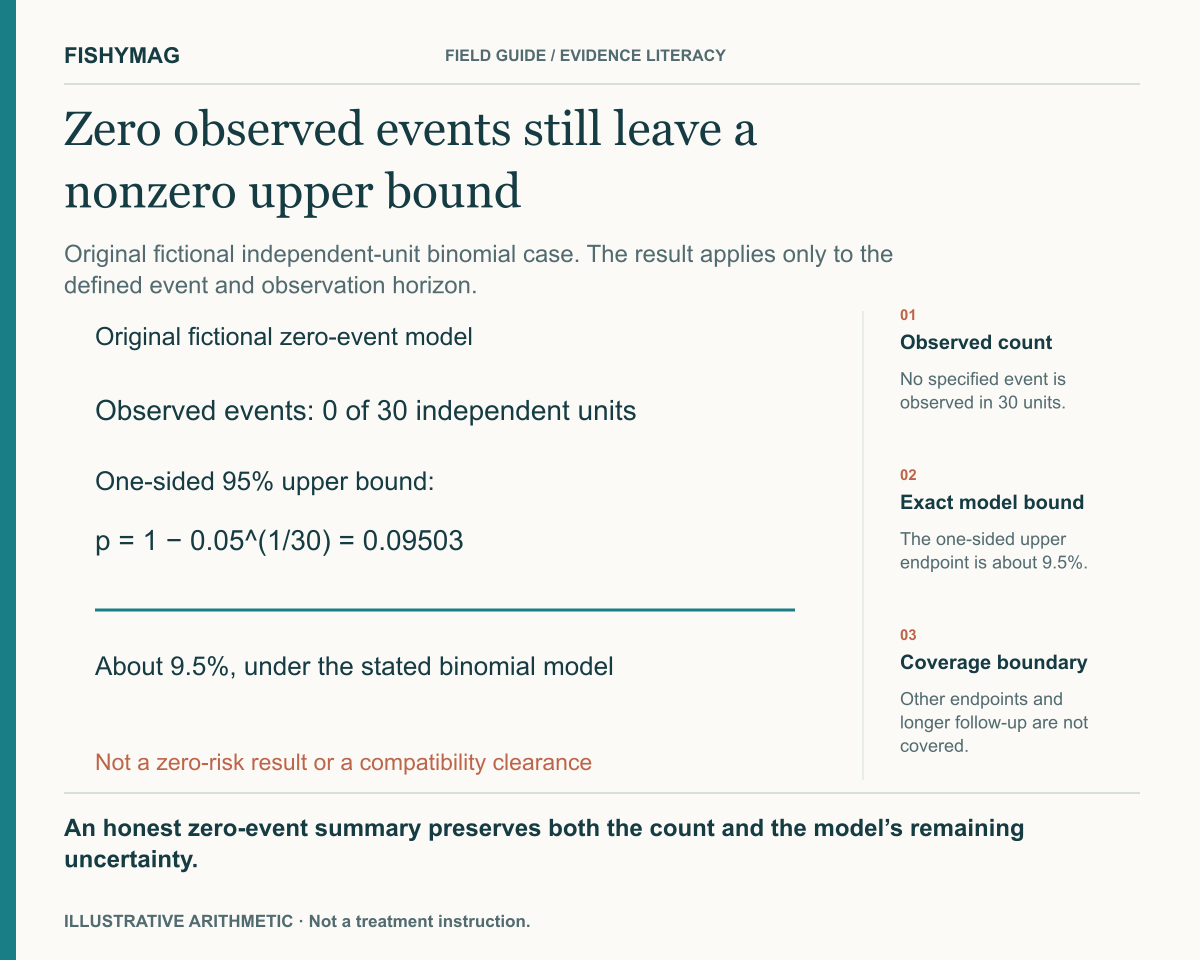
Figure data and explanation
Original fictional independent-unit binomial case. The result applies only to the defined event and observation horizon.
- Observed count
- No specified event is observed in 30 units.
- Exact model bound
- The one-sided upper endpoint is about 9.5%.
- Coverage boundary
- Other endpoints and longer follow-up are not covered.
An honest zero-event summary preserves both the count and the model’s remaining uncertainty.
Define the event before counting zero
This original fictional case follows 30 independently assigned and independent units through the same day-14 observation horizon. Each contributes one yes-or-no result for the predefined event “any recorded loss of equilibrium during the observation window.” No event is observed, and no outcome is missing. These are teaching assumptions, not animal-test data or a recommended observation period. Thirty animals in one shared tank would not automatically satisfy the independent-unit assumption.
Invert the probability of observing no events
NIST documents exact binomial limits. For this zero-event case, the probability of zero events is (1 − p)^30. Set that probability to 0.05 and solve for p. This is the one-sided calculation, not a two-sided 95% interval calculation.
| Step | Expression or value | Interpretation |
|---|---|---|
| Observed count | 0/30 = 0% | Sample event proportion only |
| Model probability of zero | (1 − p)^30 | Independent equal-probability Bernoulli outcomes |
| Boundary equation | (1 − p)^30 = 0.05 | One-sided 95% construction |
| Exact upper endpoint | 1 − 0.05^(1/30) = 0.09503385 | About 9.5% |
| Coverage statement | Specified event through day 14 | No reproductive, later or other-endpoint conclusion |
Report the count and the uncertainty together
A useful sentence is: “No specified events were observed among 30 independent units through day 14; the exact one-sided 95% upper bound for the event probability is about 9.5% under the binomial assumptions.” It does not assign a 95% probability that a product is safe. The confidence level belongs to the procedure across repeated studies under its model. Request the unit definition, endpoint, missing-outcome record and follow-up before applying the calculation to a real paper. No manufacturer compatibility statement is created by this mathematical example.
Use your own details
No observed harm in an aquarium study: how much remains uncertain? worksheet
Download the editable text file, fill it in on your device and keep it with the relevant record. This blank worksheet records your information; it does not verify entries or approve treatment.
- Precisely defined adverse event
- Observation horizon and completeness
- Independent experimental unit
- Number observed and event count
- Equal-probability binomial assumptions
- Confidence level and one-sided method
- Calculated bound and rounding
- Endpoints, periods and settings not represented
Put it into practice
Your checklist
- Verify independence and complete endpoint follow-up before using the model.
- Keep a one-sided bound distinct from the observed zero count.
- Do not extend the bound to other outcomes, periods or formulations.
Sources and scope
This article distinguishes manufacturer statements from FishyMag’s own workflows and arithmetic examples. Linked formulation records retain their own evidence dates; publishing this article does not refresh those records.
- NIST Dataplot: exact binomial confidence limits; reviewed November 9, 2026 ↗
- Percie du Sert etal., ARRIVE2.0 explanationandelaboration,2020; reviewed November 9, 2026 ↗
AI-assisted writing and development. Not hands-on product testing or veterinary review. How we publish →
FishyMag reports what manufacturers say, quoted and linked. It does not diagnose illness or recommend a treatment, and it never infers that a product is safe from the absence of a warning — where no statement exists, it says so.
Formulations change. Always read the label on the bottle in your hand, and contact the manufacturer if your tank contains anything valuable or unusual.