Keeper workflows
A two-source blend for one documented constituent
Reconcile one conservative-constituent result for an already documented two-source batch, without treating the calculation as a pH blending rule.
By FishyMag · Published
Original evidence-and-batch case · Not a clinical review or treatment recommendation.
Quick answer
The fictional completed batch contains 10 L at 20 mg/L chloride and 30 L at 4 mg/L. Under the explicit conserved-chloride and 40 L final-volume assumptions, 320 mg in 40 L gives 8 mg/L. This is a batch-record calculation, not a recipe or a formula for averaging pH.
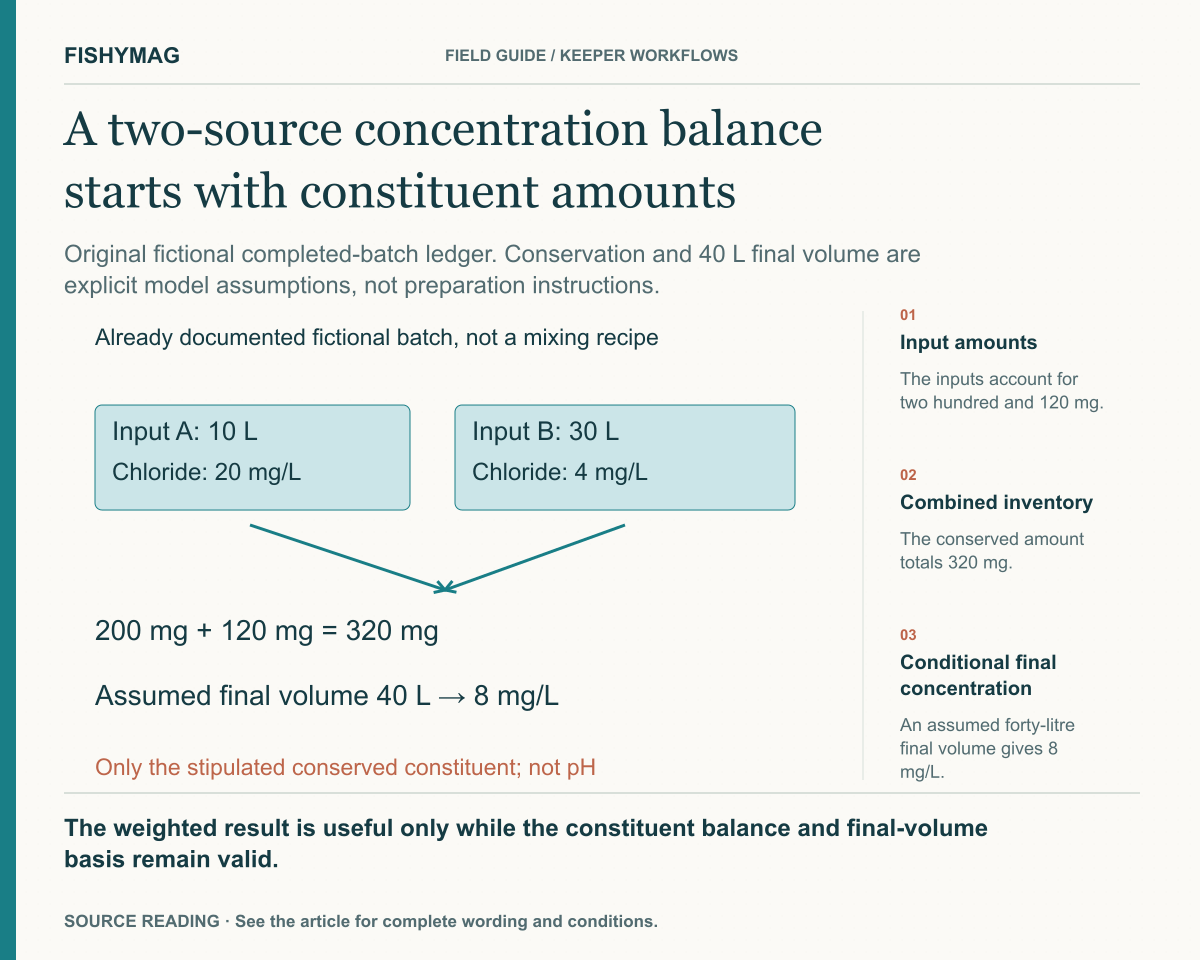
Figure data and explanation
Original fictional completed-batch ledger. Conservation and 40 L final volume are explicit model assumptions, not preparation instructions.
- Input amounts
- The inputs account for two hundred and 120 mg.
- Combined inventory
- The conserved amount totals 320 mg.
- Conditional final concentration
- An assumed forty-litre final volume gives 8 mg/L.
The weighted result is useful only while the constituent balance and final-volume basis remain valid.
State the conservation model before combining numbers
This original fictional example records an already completed two-source batch. It stipulates chloride as conserved during the recorded interval: no unrecorded chloride input, export, precipitation or partitioning is included, and the final volume is explicitly assumed to be 40 L. These are limited teaching assumptions, not a claim that every constituent is conservative in every aquarium. USGS PHREEQC documentation distinguishes chemical input quantities and bases; an actual equilibrium model would require its own complete inputs.
Complete the amount ledger first
The input records are evidence in the invented batch packet, not instructions for preparing replacement water. Concentration is calculated only after the constituent amounts and final volume are defined.
| Existing record | Amount calculation | Chloride amount |
|---|---|---|
| Input A: 10 L at 20 mg/L | 10 L × 20 mg/L | 200 mg |
| Input B: 30 L at 4 mg/L | 30 L × 4 mg/L | 120 mg |
| Combined accounted input | 200 + 120 | 320 mg |
| Assumed final volume | 40 L | Volume assumption kept explicit |
| Modeled final concentration | 320 mg / 40 L | 8 mg/L |
| Unweighted concentration average | (20 + 4)/2 = 12 mg/L | Does not use the unequal input volumes |
Keep the result inside its amount-and-volume assumptions
If the actual final volume differs, substitute its supported value rather than retaining 40 L automatically. If chloride is not conserved over the chosen boundary, the input-only ledger cannot establish the final measured concentration. The result is also not an average of pH: pH has a different chemical definition and cannot be blended by this mass-concentration shortcut. Other constituent balances, biological suitability and the complete composition of the batch remain separate questions. Retain assumptions beside the result so a later keeper does not mistake this worked ledger for a measured certificate or a preparation target.
Use your own details
A two-source blend for one documented constituent worksheet
Download the editable text file, fill it in on your device and keep it with the relevant record. This blank worksheet records your information; it does not verify entries or approve treatment.
- Existing batch identity and input records
- Constituent selected and chemical basis
- Evidence or explicit model assumptions for conservation
- Input volumes and concentrations
- Final volume measured or assumed
- Unaccounted transfers, reaction or partitioning
- Computed total amount and final concentration
- Quantities outside the model such as pH
Put it into practice
Your checklist
- Name the conserved constituent and the limits of that assumption.
- Sum amounts before dividing by the supported final volume.
- Do not reuse a concentration balance as a pH blending formula.
Sources and scope
This article distinguishes manufacturer statements from FishyMag’s own workflows and arithmetic examples. Linked formulation records retain their own evidence dates; publishing this article does not refresh those records.
- USGS PHREEQC SOLUTION: units, calculated density, pH and alkalinity; reviewed November 9, 2026 ↗
- FishyMag evidence methodology; reviewed November 8, 2026 ↗
AI-assisted writing and development. Not hands-on product testing or veterinary review. How we publish →
FishyMag reports what manufacturers say, quoted and linked. It does not diagnose illness or recommend a treatment, and it never infers that a product is safe from the absence of a warning — where no statement exists, it says so.
Formulations change. Always read the label on the bottle in your hand, and contact the manufacturer if your tank contains anything valuable or unusual.