Keeper workflows
Read an aquarium pump curve as a range
Read a defensible operating flow estimate from EHEIM’s compactON 5000 curve and a documented head interval.
By FishyMag · Published
Worked hydraulic example · Not a clinical review or treatment recommendation.
Quick answer
On EHEIM’s published 1032 curve, about 2 m corresponds to roughly 33 L/min and about 1 m to roughly 50 L/min. For a matching installation with total operating head between those levels, report an approximate flow interval of 33 to 50 L/min, subject to the graph’s resolution and conditions.
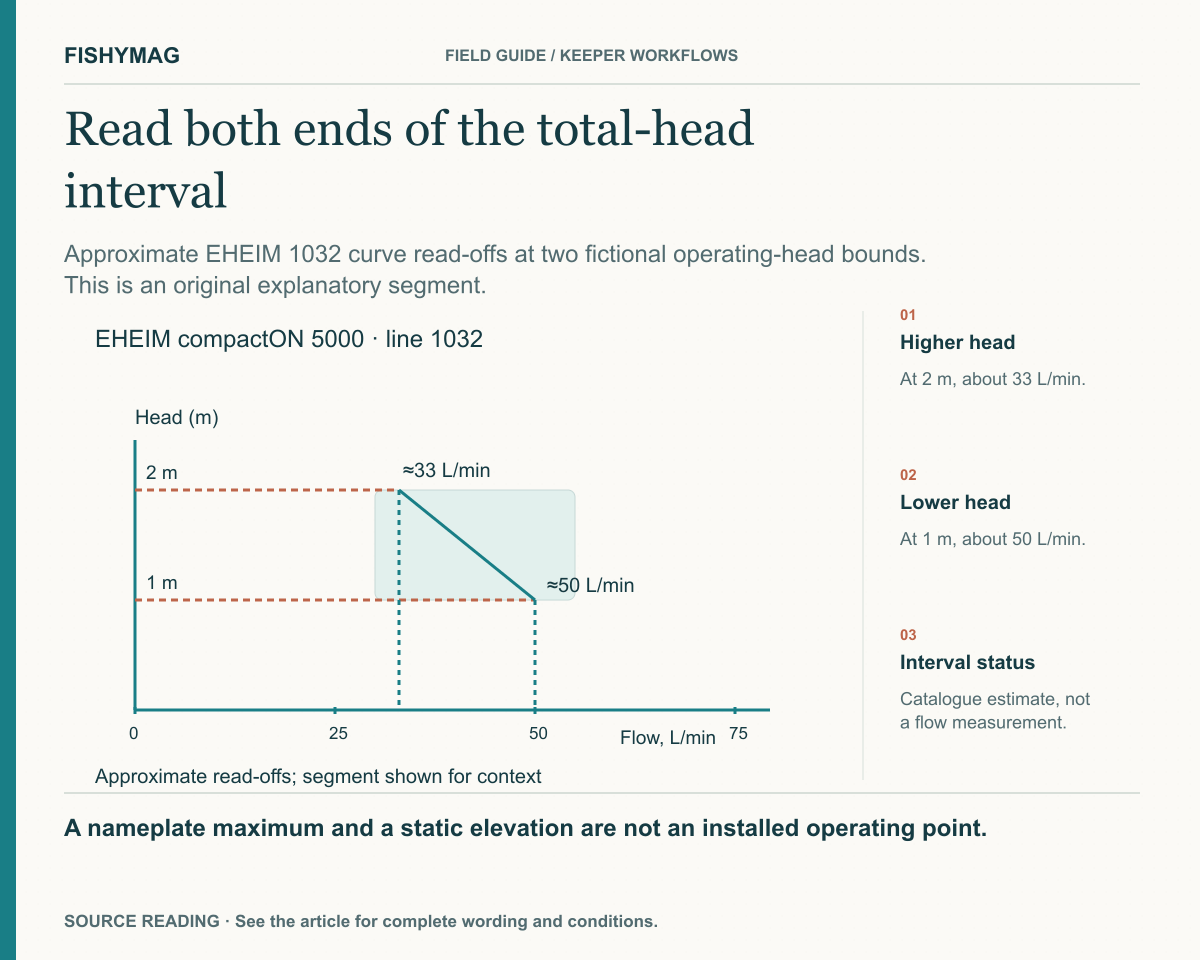
Figure data and explanation
Approximate EHEIM 1032 curve read-offs at two fictional operating-head bounds. This is an original explanatory segment.
- Higher head
- At 2 m, about 33 L/min.
- Lower head
- At 1 m, about 50 L/min.
- Interval status
- Catalogue estimate, not a flow measurement.
A nameplate maximum and a static elevation are not an installed operating point.
Use the correct curve and the correct kind of head
EHEIM’s UK dealer catalogue page 137 identifies line 1032 and lists the fixed-output compactON 5000, UK code 1032340. In our fictional packet an engineering record estimates total head at the pump between 1 and 2 m of water at its operating point. The packet accounts for elevation, pressure and velocity head at the selected sections, and states an equivalent static lift of 0.75 m in its system balance. That static lift alone does not reproduce the operating head. No real equipment was tested for this guide.
Read both ends and preserve the precision
Read the intersections with line 1032 on the left plot. The major flow marks are 25 L/min apart; the chart cannot support a decimal-place reading. Only the approximate portion relevant to the two marks is illustrated here.
| Total head | Graph read-off | Approximate unit conversion |
|---|---|---|
| 2 m | About 33 L/min | About 2,000 L/h |
| 1 m | About 50 L/min | About 3,000 L/h |
| Between those heads | About 33 to 50 L/min | About 2,000 to 3,000 L/h |
| Only 0.75 m static lift known | Full head unresolved | No comparable operating interval |
Keep the curve estimate distinct from an observed flow
The interval is conditional on the matching curve and the head record. It is neither a calibrated flow reading nor a statistical confidence interval. The source does not establish the installation-specific uncertainty. In a different case where head itself depends on the unmeasured flow, match the system curve to the pump curve instead of assuming one fixed loss. Keep the exact item, supply conditions, measured or estimated head basis, and plot resolution with any reported interval.
Use your own details
Read an aquarium pump curve as a range worksheet
Download the editable text file, fill it in on your device and keep it with the relevant record. This blank worksheet records your information; it does not verify entries or approve treatment.
- Full pump code and supply conditions
- Applicable manufacturer curve and page
- Adjustable or fixed setting
- Total head interval and its evidence
- Flow at upper head
- Flow at lower head
- Graph resolution and conversion
- Separate measured operating result if available
Put it into practice
Your checklist
- Match the exact pump to the line legend.
- Use total operating head or a system curve, with documented assumptions.
- Report the range at the precision the graph supports.
Sources and scope
This article distinguishes manufacturer statements from FishyMag’s own workflows and arithmetic examples. Linked formulation records retain their own evidence dates; publishing this article does not refresh those records.
- EHEIM UK dealer catalogue, compactON performance curves, page 137; reviewed November 9, 2026 ↗
- San Diego State University pump-pipe system calculator method; reviewed November 9, 2026 ↗
AI-assisted writing and development. Not hands-on product testing or veterinary review. How we publish →
FishyMag reports what manufacturers say, quoted and linked. It does not diagnose illness or recommend a treatment, and it never infers that a product is safe from the absence of a warning — where no statement exists, it says so.
Formulations change. Always read the label on the bottle in your hand, and contact the manufacturer if your tank contains anything valuable or unusual.