Keeper workflows
Could your aquarium logger miss a brief event?
Test whether three stored timestamps cover a known short event, then separate point sampling from interval summaries and retained extrema.
By FishyMag · Published
Worked arithmetic example · Not a clinical review or treatment recommendation.
Quick answer
None of the fictional stored times 12:00, 12:05 and 12:10 lies inside the independently documented 12:01 to 12:03 event. That does not prove a logger recorded nothing about it: an interval maximum or summary could have different coverage. The channel’s actual storage semantics decide the interpretation.
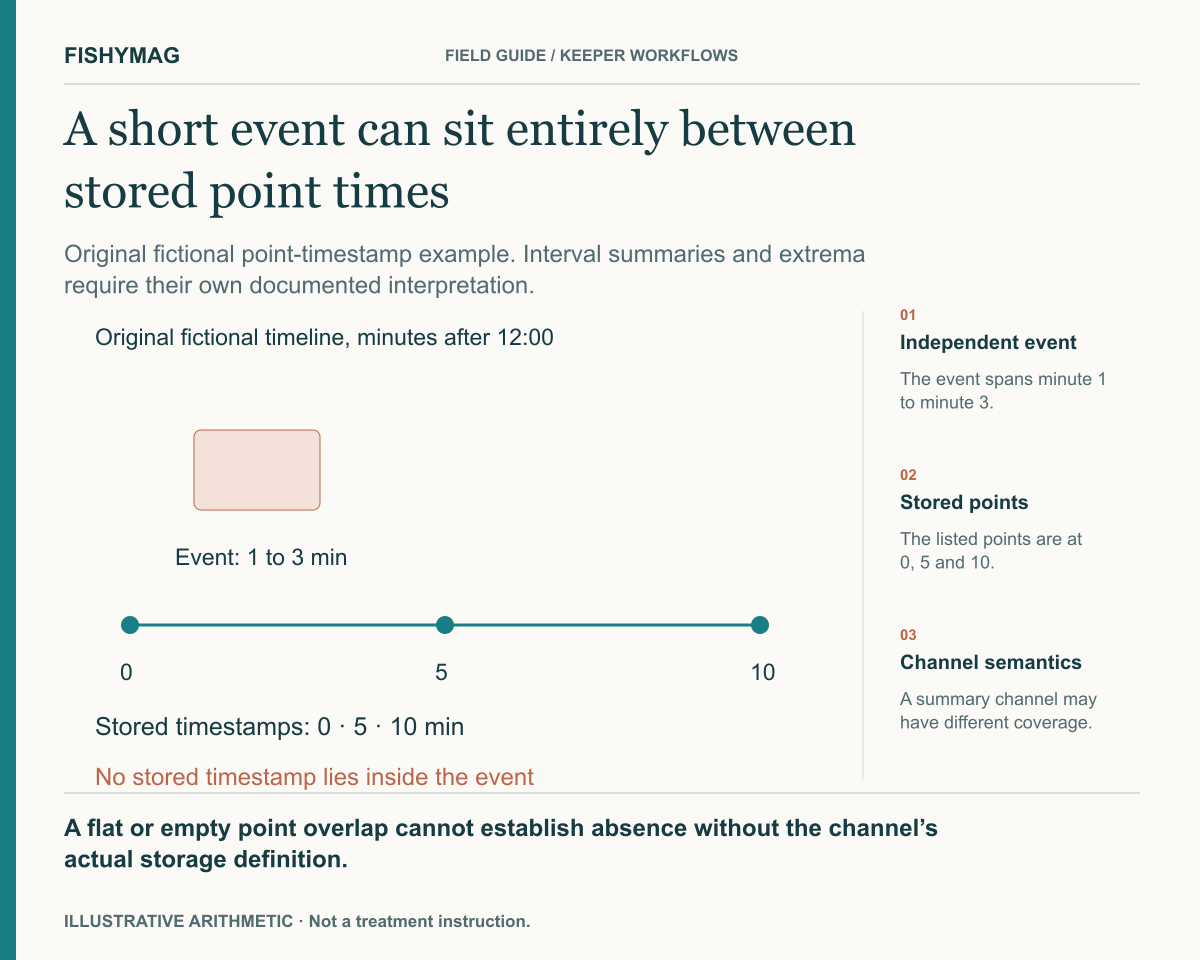
Figure data and explanation
Original fictional point-timestamp example. Interval summaries and extrema require their own documented interpretation.
- Independent event
- The event spans minute 1 to minute 3.
- Stored points
- The listed points are at 0, 5 and 10.
- Channel semantics
- A summary channel may have different coverage.
A flat or empty point overlap cannot establish absence without the channel’s actual storage definition.
Finish the timestamp-overlap calculation
This constructed event lasts two minutes and falls between adjacent stored points. Counting points inside its interval gives zero. That is a statement about those timestamps, not an inference that the event never happened or that all logger channels missed it.
Complete the channel-coverage decision
The ProfiLux resource guide documents enabled per-probe recording at a selected interval. The reviewed guide does not establish every interval-summary or retained-extrema behavior for an unspecified firmware configuration.
| Stored-channel type | What the fictional timestamps establish | Event coverage finding |
|---|---|---|
| Instantaneous values at the three listed times | No point lies inside 12:01 to 12:03 | No direct point observation of the event |
| Interval mean | Needs exact interval membership and processing | Coverage cannot be decided from timestamps alone |
| Interval maximum or minimum | Needs documented retention and time basis | May address a different question; not assumed present |
| Unspecified ProfiLux export | Interval setting is documented, semantics incomplete | Retain the method gap before claiming absence |
Do not replace a data gap with a preferred story
Obtain the channel’s stored quantity, interval boundaries and any averaging or extrema definitions. Sensor response time is a separate limit, so a frequent storage rate alone is not full event detection evidence either. The completed packet retains the known event and the limited sampled coverage, without diagnosing a missed alarm or recommending a new logging interval.
Use your own details
Could your aquarium logger miss a brief event? worksheet
Download the editable text file, fill it in on your device and keep it with the relevant record. This blank worksheet records your information; it does not verify entries or approve treatment.
- Independent event start and end evidence
- Stored timestamps and common clock basis
- Instantaneous point versus interval definition
- Averaging or smoothing before storage
- Retained minima/maxima if documented
- Actual logging interval and enabled channel
- Coverage conclusion for each data type
- Unsupported absence claim
Put it into practice
Your checklist
- Compare stored times with the actual event interval.
- Identify the stored quantity before claiming a missed event.
- Keep sensor response and storage interval as separate limits.
Sources and scope
This article distinguishes manufacturer statements from FishyMag’s own workflows and arithmetic examples. Linked formulation records retain their own evidence dates; publishing this article does not refresh those records.
- GHL ProfiLux4/4e GHL Connect resource guide, June2020; reviewed November 9, 2026 ↗
- Hanna HI98194/HI98195/HI98196 instruction manual; reviewed November 9, 2026 ↗
AI-assisted writing and development. Not hands-on product testing or veterinary review. How we publish →
FishyMag reports what manufacturers say, quoted and linked. It does not diagnose illness or recommend a treatment, and it never infers that a product is safe from the absence of a warning — where no statement exists, it says so.
Formulations change. Always read the label on the bottle in your hand, and contact the manufacturer if your tank contains anything valuable or unusual.