Label case studies
A scaleless-fish instruction does not create a shrimp exception
Read the scope of API’s conditional instruction before carrying it across to another animal group.
By FishyMag · Published
Manufacturer-source commentary · Not a clinical review or treatment recommendation.
Quick answer
API’s Liquid Super Ick Cure page gives a reduced-dose instruction for some scaleless fish and separately advises against use in aquariums with invertebrates. The fish instruction does not establish a shrimp or snail dose.
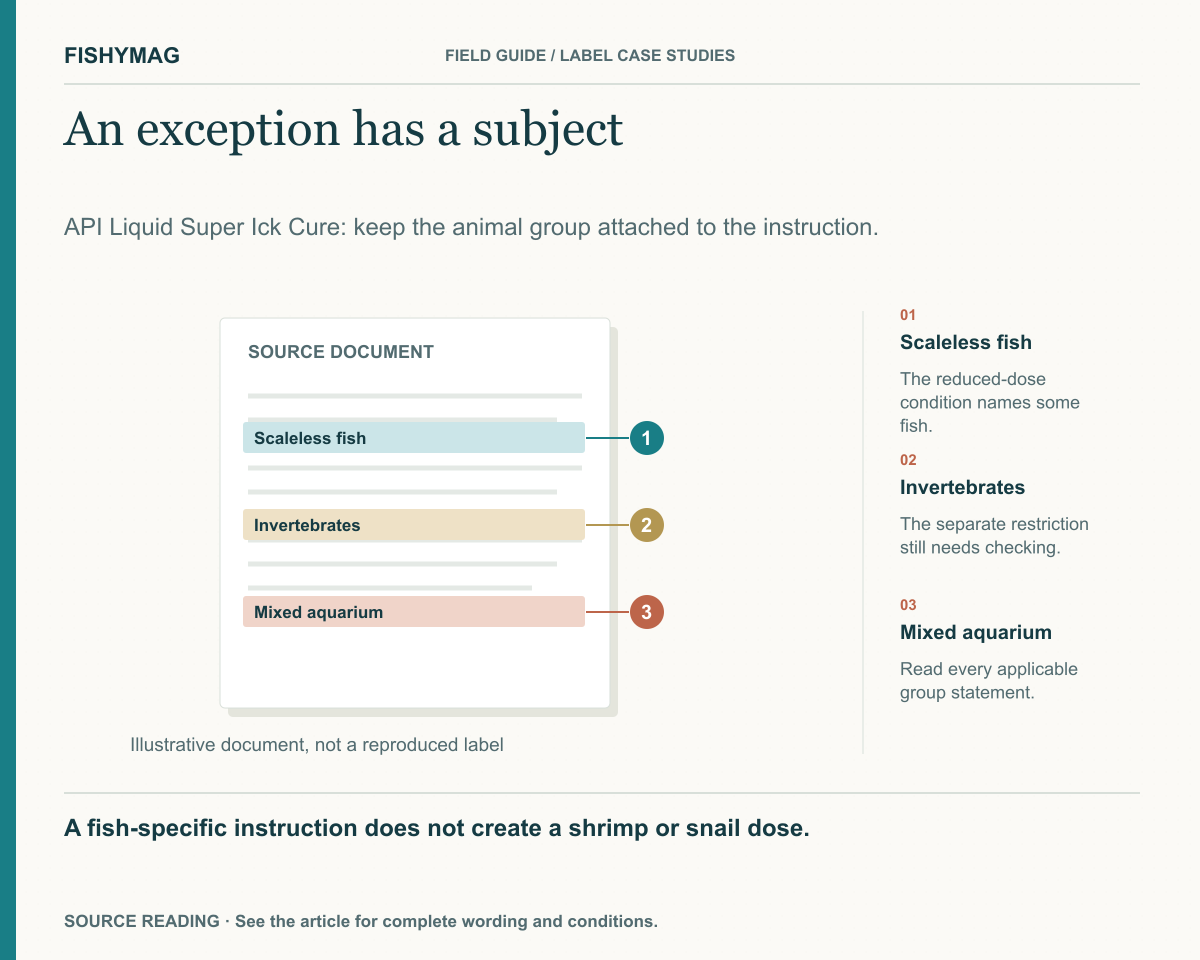
Figure data and explanation
API Liquid Super Ick Cure: keep the animal group attached to the instruction.
- Scaleless fish
- The reduced-dose condition names some fish.
- Invertebrates
- The separate restriction still needs checking.
- Mixed aquarium
- Read every applicable group statement.
A fish-specific instruction does not create a shrimp or snail dose.
Find the subject of each sentence
The manufacturer’s description identifies sensitivity in some scaleless fish. Its instructions and FAQ separately address corals, shrimp, snails and other invertebrates. These are different subjects. A keeper cannot replace the group named in one instruction with a different group and preserve the meaning. Keep the complete conditional sentence with its heading, rather than copying only a fraction from the dose.
Build a two-row scope check
In your own record, give each instruction a row with four fields: named group, stated condition, manufacturer action and source location. In the worked reading below, the reduced-dose wording belongs to the fish row. The invertebrate row retains the separate restriction. This is a reading aid, not a recommendation to treat a scaleless fish or a clearance for any species.
| Source subject | Instruction type | Boundary |
|---|---|---|
| Some scaleless fish | Reduced-dose condition | Does not name shrimp or snails |
| Invertebrates | Separate restriction and FAQ qualification | Not cancelled by the fish condition |
Handle a mixed aquarium explicitly
Suppose an aquarium contains a fish someone calls scaleless and a snail. Even if the fish description is correct, that does not remove the snail from the compatibility check. Record both groups. Do not select the most permissive sentence as the answer for the entire tank, and do not average restrictions across groups. If a group or species identity is uncertain, make that uncertainty part of the question.
Keep the veterinary qualification intact
API’s invertebrate FAQ includes a qualification concerning an aquatics veterinarian. A general internet answer or an instruction for another animal does not satisfy that qualification. Preserve its exact scope when you seek advice. The FishyMag formulation page continues to report its existing manufacturer position; this article does not introduce a reduced-dose verdict or species-specific treatment rule.
A useful question to send
A draft might read: “My bottle is [form, market and label version]. The page gives one instruction for scaleless fish and a separate invertebrate restriction. My aquarium contains [actual groups]. Which statement applies to this mixed system?” Attach the full label, not just the reassuring sentence. Keep any reply with the exact question and date so another keeper can see what was actually assessed.
Put it into practice
Your checklist
- Record the named animal group beside every conditional instruction.
- Keep the invertebrate restriction visible in a mixed-tank check.
- Do not invent a shrimp or snail dose from a fish-specific instruction.
Sources and scope
This article distinguishes manufacturer statements from FishyMag’s own workflows and arithmetic examples. Linked formulation records retain their own evidence dates; publishing this article does not refresh those records.
- API Liquid Super Ick Cure: instructions and invertebrate FAQ, read November 8, 2026 ↗
- FishyMag evidence methodology ↗
AI-assisted writing and development. Not hands-on product testing or veterinary review. How we publish →
Read the formulation evidence
These links provide context, not product recommendations.
FishyMag reports what manufacturers say, quoted and linked. It does not diagnose illness or recommend a treatment, and it never infers that a product is safe from the absence of a warning — where no statement exists, it says so.
Formulations change. Always read the label on the bottle in your hand, and contact the manufacturer if your tank contains anything valuable or unusual.