Label case studies
General Cure packets and bulk powder: catch an instruction mismatch
A current manufacturer page and an older packet record can describe different packs under the same trade name.
By FishyMag · Published
Manufacturer-source commentary · Not a clinical review or treatment recommendation.
Quick answer
The API General Cure page checked for this article displays a 30 oz pack and scoop-based instructions. FishyMag’s existing record contains packet-based wording. Match the physical pack before using either set of numbers; this article establishes no packet-to-scoop conversion.
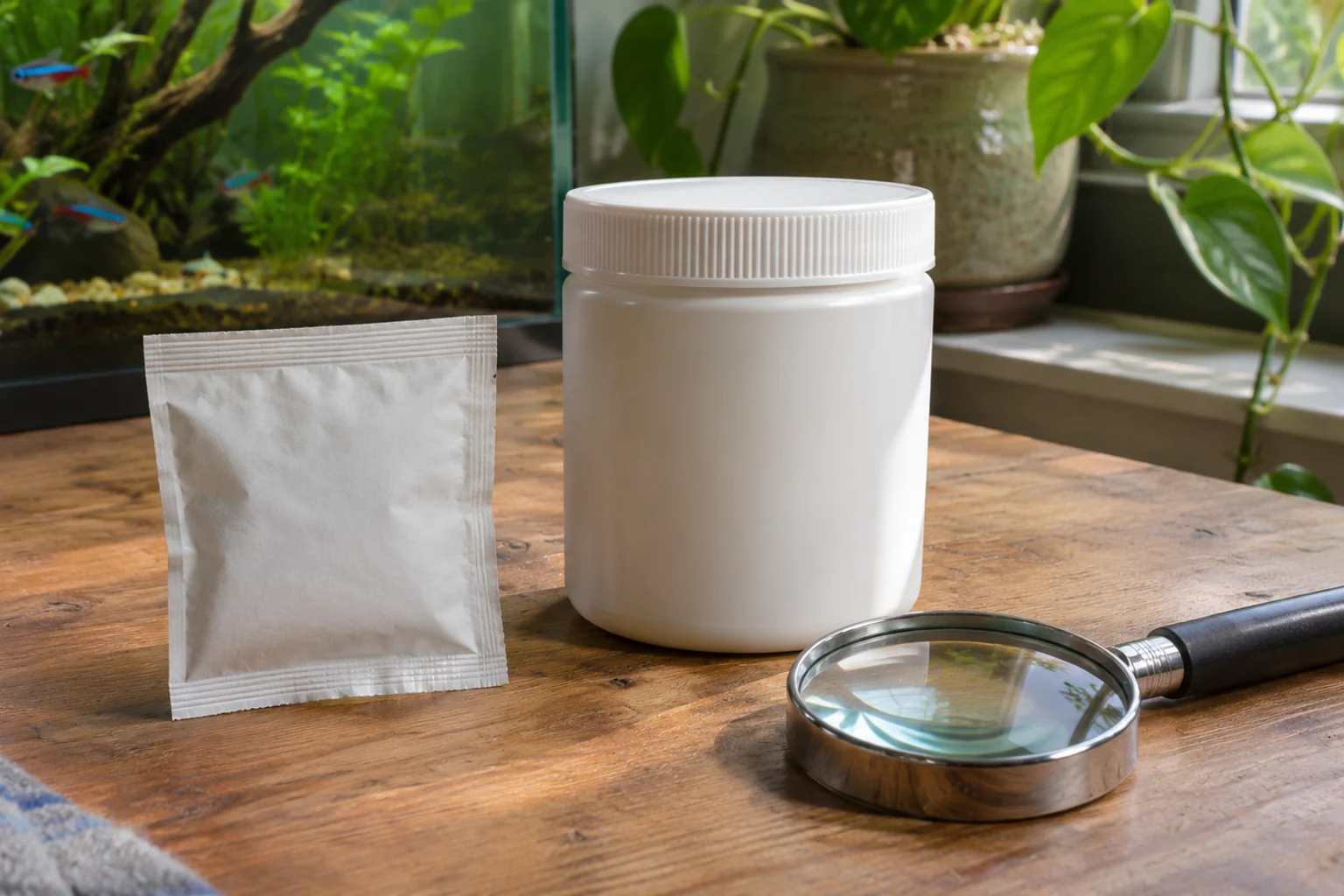
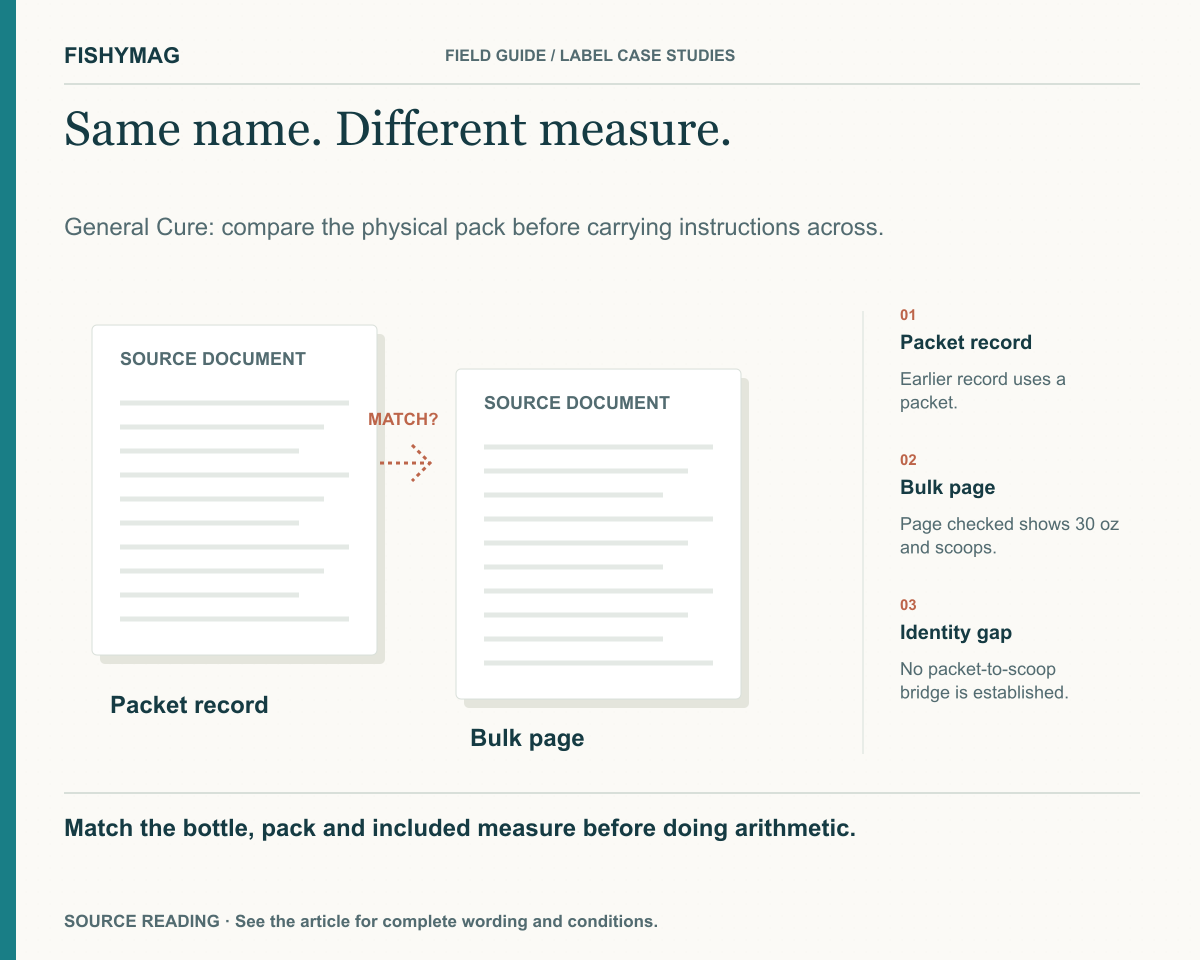
Figure data and explanation
General Cure: compare the physical pack before carrying instructions across.
- Packet record
- Earlier record uses a packet.
- Bulk page
- Page checked shows 30 oz and scoops.
- Identity gap
- No packet-to-scoop bridge is established.
Match the bottle, pack and included measure before doing arithmetic.
What the current page actually shows
On the manufacturer page read on November 8, 2026, the displayed pack is 30 oz and the instructions use scoops, teaspoons, tablespoons and cups for stated system volumes. The existing FishyMag record preserves an earlier packet instruction. The shared name does not establish that a packet, scoop and teaspoon contain equivalent amounts or apply to the same pack.
Compare identity before arithmetic
Make two columns: the container you own and the document you found. Record physical form, pack size, included measuring device, market if established, ingredient statement and instruction denominator. A packet count in one column and a scoop in the other is a visible mismatch. A blank ingredient field is also a gap, not permission to assume sameness. Photograph the actual directions and preserve the document URL.
| Field | Earlier recorded wording | Current page checked |
|---|---|---|
| Measure | Packet | Scoop and household-volume units |
| Identity task | Match the actual packet pack | Match the actual 30 oz pack |
| Unresolved bridge | No packet-to-scoop conversion established | No equivalence inferred |
Do not create a conversion from package capacity
A 30 oz pack size does not tell you the mass of a separate packet or the amount delivered by an included scoop. Powder volume, mass and bulk density are different quantities. Even a measured mass match would not by itself prove formulation equivalence. This guide deliberately gives no conversion that could be mistaken for a treatment instruction.
Keep older evidence without disguising its age
An older source can still explain why a packet record exists. Its existence does not authenticate a newer bulk container, and loading a current page does not refresh the old record’s date. Save the old wording and the present mismatch together. If an evidence record needs changing, that goes through human review rather than silently substituting a new number in the calculator.
Resolve the mismatch with the manufacturer
Ask which current directions apply to your exact pack and included measure. Include readable label photos and the product identifier. If you cannot identify the pack, leave the instruction match unresolved. FishyMag’s bottle worksheet is useful for organising the comparison, but it cannot authenticate packaging, establish ingredient equivalence or decide that a treatment is appropriate.
Put it into practice
Your checklist
- Match pack size and measuring device before using a rule.
- Do not treat a packet, scoop and teaspoon as interchangeable units.
- Keep old and current documents separate until identity is resolved.
Sources and scope
This article distinguishes manufacturer statements from FishyMag’s own workflows and arithmetic examples. Linked formulation records retain their own evidence dates; publishing this article does not refresh those records.
- API General Cure: 30 oz pack and scoop instructions, read November 8, 2026 ↗
- FishyMag evidence methodology ↗
AI-assisted writing and development. Not hands-on product testing or veterinary review. How we publish →
Read the formulation evidence
These links provide context, not product recommendations.
FishyMag reports what manufacturers say, quoted and linked. It does not diagnose illness or recommend a treatment, and it never infers that a product is safe from the absence of a warning — where no statement exists, it says so.
Formulations change. Always read the label on the bottle in your hand, and contact the manufacturer if your tank contains anything valuable or unusual.