Evidence literacy
Does the study's water-exchange design match your aquarium?
Distinguish external medium renewal from internal aquarium recirculation before transferring a study’s exposure history.
By FishyMag · Published
Original research-appraisal case · Not a clinical review or treatment recommendation.
Quick answer
Scheduled replacement of the test medium makes the fictional study a renewal design under the inspected OECD terminology. The reader’s aquarium only has documented internal recirculation. That is a water-exchange mismatch, not evidence that either system had a higher concentration.
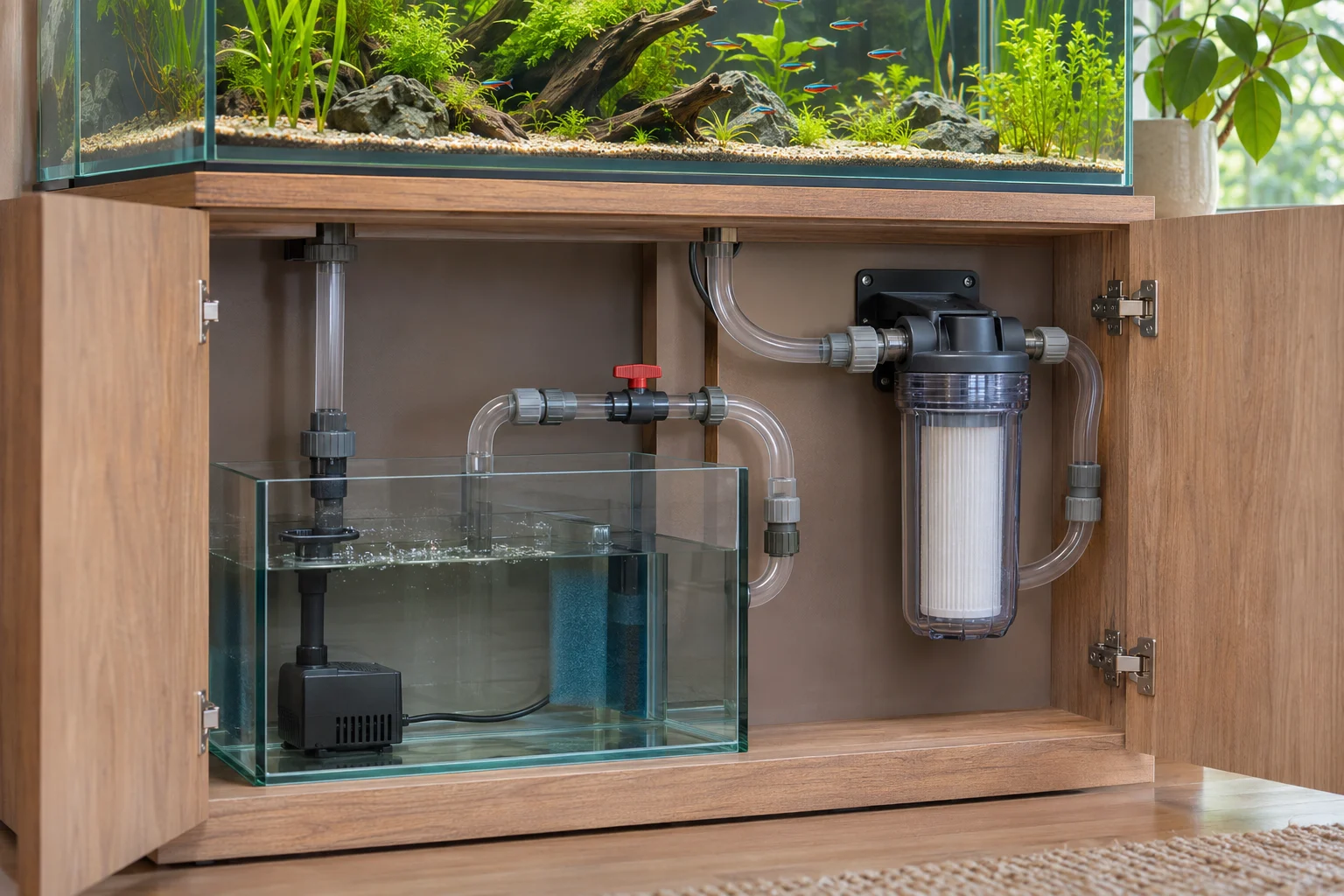
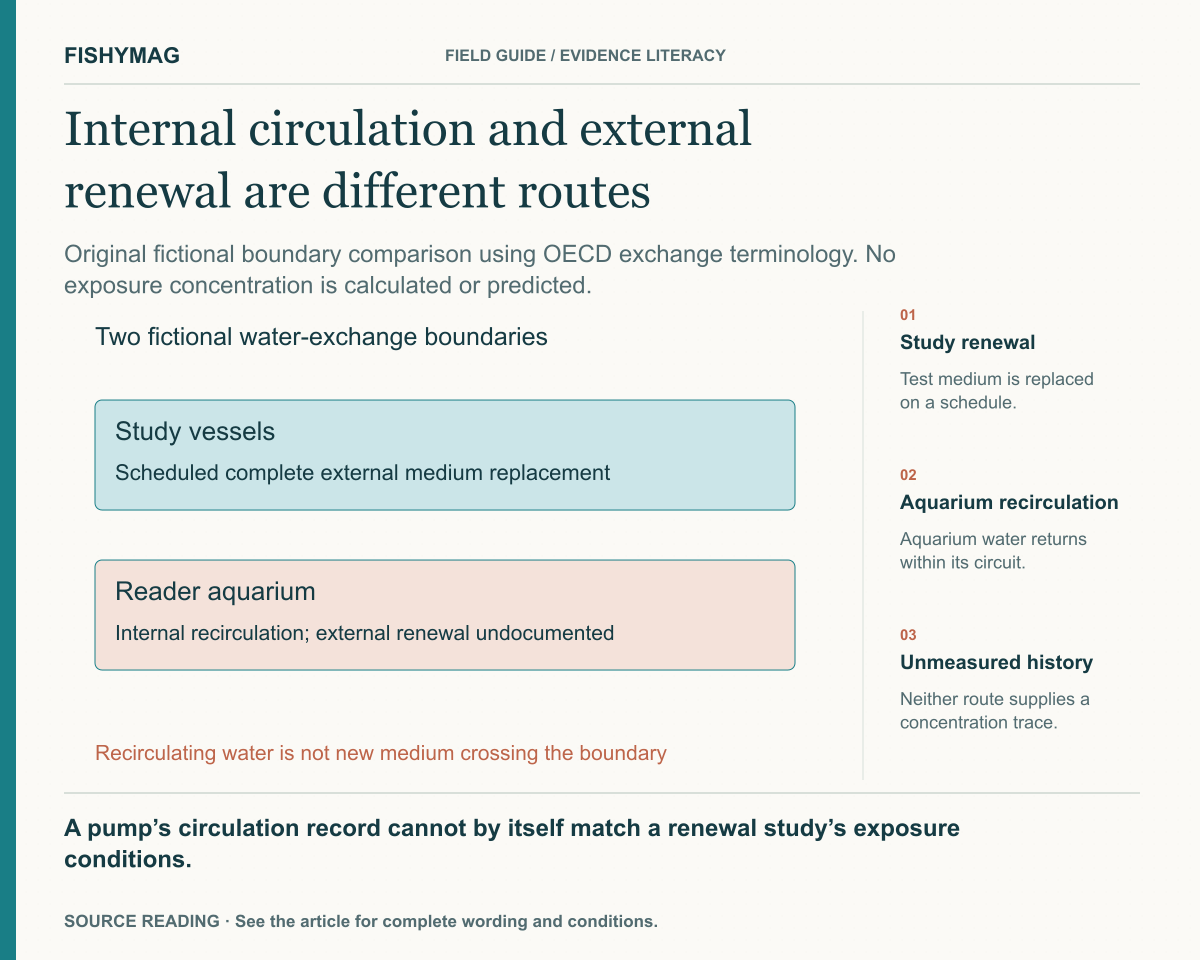
Figure data and explanation
Original fictional boundary comparison using OECD exchange terminology. No exposure concentration is calculated or predicted.
- Study renewal
- Test medium is replaced on a schedule.
- Aquarium recirculation
- Aquarium water returns within its circuit.
- Unmeasured history
- Neither route supplies a concentration trace.
A pump’s circulation record cannot by itself match a renewal study’s exposure conditions.
Draw the boundary before naming the flow
In the fictional study, the medium is completely replaced on a stated schedule. In the reader’s aquarium, a pump circulates water through internal equipment and returns it to the same water circuit. No external replacement is documented for the relevant window. OECD TG 203, corrected September 2025, distinguishes semi-static renewal from static and flow-through designs. Its renewal terminology concerns replacement of test solution, not merely motion inside a vessel.
Compare the two documented routes
The case does not supply an exchange interval, pump-setting recommendation or measured concentration. It is a completed interpretation of existing route descriptions.
| Feature | Fictional study | Reader aquarium | Interpretation |
|---|---|---|---|
| External medium replacement | Scheduled complete replacement documented | Not documented in the window | Exchange designs do not match |
| Internal recirculation | Not needed to classify the stated renewal | Documented | Does not itself establish external renewal |
| Terminology | Semi-static renewal fits the description | Internal recirculation documented | Do not call recirculation flow-through by itself |
| External continuous supply | Not the stated study route | Not documented | No continuous through-flow established |
| Concentration over time | No numerical trace supplied here | Unmeasured | Direction or size of exposure difference unknown |
Keep geometry separate from concentration
External renewal can change the inputs and outputs that matter to exposure, but the route alone does not provide the resulting concentration history. Stability, partitioning, other flows and measurement timing still require evidence. A useful summary therefore identifies the renewal-versus-recirculation mismatch and asks for the measured history in the relevant systems. Do not infer that the aquarium accumulates more target, that renewal necessarily lowers every result, or that equal nominal labels establish equal exposures. This appraisal requires no interruption of a live aquarium and supplies no water-change procedure.
Use your own details
Does the study's water-exchange design match your aquarium? worksheet
Download the editable text file, fill it in on your device and keep it with the relevant record. This blank worksheet records your information; it does not verify entries or approve treatment.
- Study vessel and external boundary
- Reported external renewal or through-flow
- Internal circulation route
- Reader aquarium boundary
- Reader external replacement evidence
- Measured concentration history in each system
- Exchange terminology and document version
- Unresolved transfer question
Put it into practice
Your checklist
- Distinguish water moving inside a circuit from water crossing its boundary.
- Use the study’s documented exchange design.
- Leave concentration differences unquantified without measurements.
Sources and scope
This article distinguishes manufacturer statements from FishyMag’s own workflows and arithmetic examples. Linked formulation records retain their own evidence dates; publishing this article does not refresh those records.
- OECD Test Guideline 203, adopted June 2025 and corrected September 2025; reviewed November 9, 2026 ↗
- Percie du Sert etal., ARRIVE2.0 explanationandelaboration,2020; reviewed November 9, 2026 ↗
AI-assisted writing and development. Not hands-on product testing or veterinary review. How we publish →
FishyMag reports what manufacturers say, quoted and linked. It does not diagnose illness or recommend a treatment, and it never infers that a product is safe from the absence of a warning — where no statement exists, it says so.
Formulations change. Always read the label on the bottle in your hand, and contact the manufacturer if your tank contains anything valuable or unusual.