Keeper workflows
Two keepers, one aquarium task: keep claiming and completion separate
A worked coordination record for shared aquarium tasks, with one declared coordinator, explicit acknowledgements and a separate completion entry.
By FishyMag · Published
FishyMag editorial workflow · Not a clinical review or treatment recommendation.
Quick answer
Use one declared coordination record. A keeper first requests the task, the coordinator acknowledges who holds it, and the keeper later records completion separately. A claim, an alert and a completed action are three different records. This manual workflow cannot provide a software lock or independently prove that an action occurred.
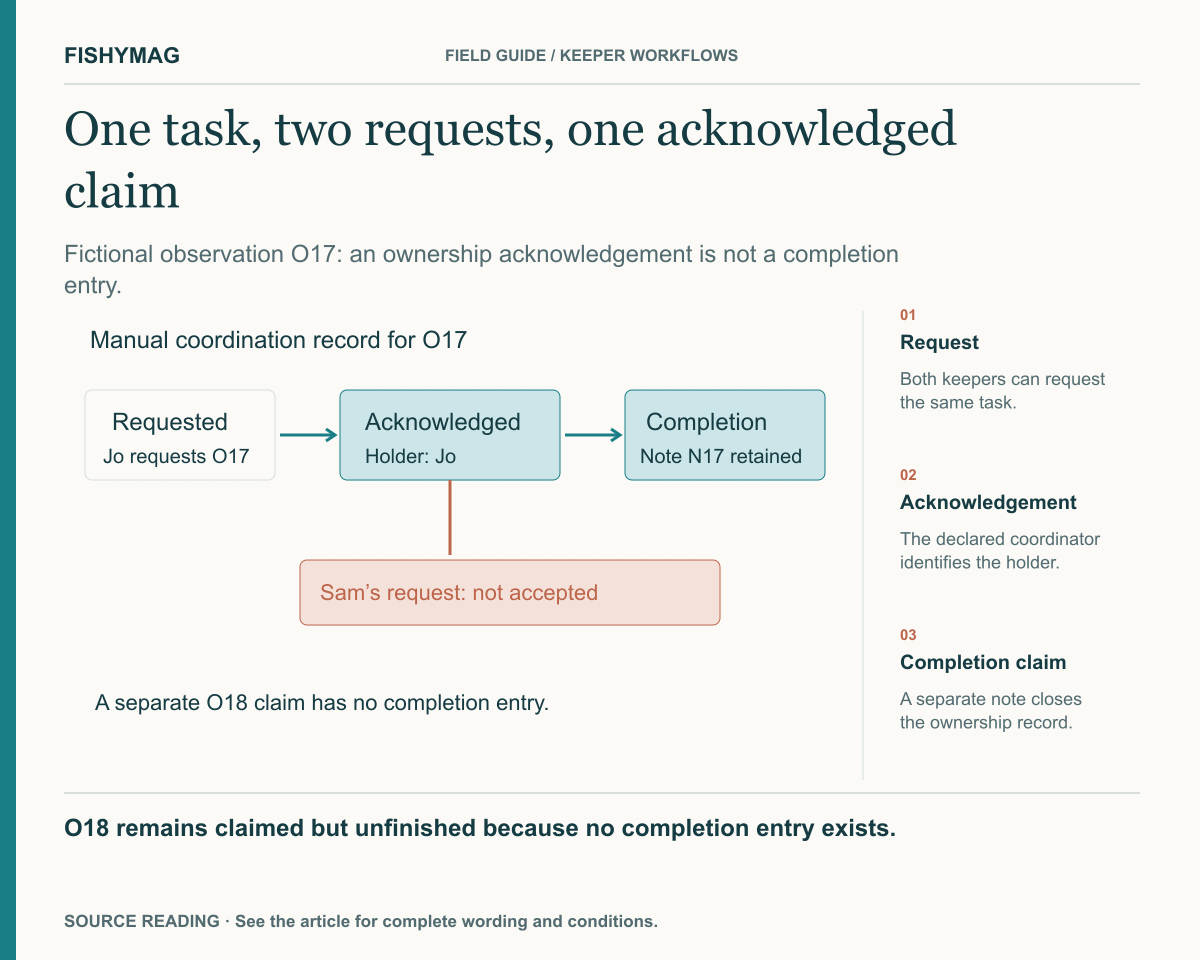
Figure data and explanation
Fictional observation O17: an ownership acknowledgement is not a completion entry.
- Request
- Both keepers can request the same task.
- Acknowledgement
- The declared coordinator identifies the holder.
- Completion claim
- A separate note closes the ownership record.
O18 remains claimed but unfinished because no completion entry exists.
Declare who can acknowledge ownership
This is an original FishyMag coordination workflow. Before relying on it, the keepers agree which record and coordinator they will check. A message sent to one person is not automatically visible to another. If a keeper cannot obtain a current acknowledgement, the record stays unresolved; the workflow supplies no treatment decision. FishyMag’s local tools do not synchronise between keepers and do not implement a shared lock.
Worked case: one request is acknowledged
All names, task identifiers and events in this example are fictional. The task is an agreed aquarium observation, not a proposed treatment action. Mira maintains coordination record R1. Jo and Sam both see a reminder for observation O17. The following entries preserve what each message means.
| Entry | Message or record | Result in R1 |
|---|---|---|
| 1 | Jo requests ownership of O17 | Requested; not acknowledged |
| 2 | Mira acknowledges Jo for O17 | Claim held by Jo; no completion recorded |
| 3 | Sam requests the same O17 | Second claim not accepted; Sam receives current status |
| 4 | Jo reports observation O17 completed, with note N17 | Completion claim linked to N17; ownership closed |
| 5 | Jo requests O18 and receives acknowledgement | O18 claimed; no completion entry exists |
Keep the two terminal states different
O17 ends with a documented completion claim. O18 ends with a claim only. Do not convert O18 to completed because Jo normally finishes tasks or because an acknowledgement was received. Equally, closing ownership is not proof of the physical observation: it records the communication and its supporting note. A later correction should cite the original entry and explain what changed. If conflicting completion reports arrive, retain both while the coordinator resolves the record.
Make the handover usable offline
At handover, export the current record and identify its revision, coordinator and time of issue. The receiving keeper should acknowledge which copy was received. Keep later changes in a new revision rather than silently editing the issued copy. FishyMag’s treatment log distinguishes plans from completed actions, but its saved files are local records, not a shared coordination service. The worksheet provides a manual state trail that can accompany those files.
Use your own details
Two keepers, one aquarium task: keep claiming and completion separate worksheet
Download the editable text file, fill it in on your device and keep it with the relevant record. This blank worksheet records your information; it does not verify entries or approve treatment.
- System and task ID
- Declared coordination record and revision
- Coordinator and contact route
- Claim requester and request time
- Acknowledgement and assigned keeper
- Completion claim and supporting note
- Conflicting or unresolved entries
- Issued handover copy and receiver acknowledgement
Put it into practice
Your checklist
- Agree the current coordinator and record before using a claim.
- Require a separate completion entry with its supporting note.
- Leave acknowledged but unfinished tasks visibly open.
Sources and scope
This article distinguishes manufacturer statements from FishyMag’s own workflows and arithmetic examples. Linked formulation records retain their own evidence dates; publishing this article does not refresh those records.
- FishyMag evidence methodology; reviewed November 8, 2026 ↗
- FishyMag local treatment log; reviewed November 8, 2026 ↗
- FishyMag keeper handover and editable backup; reviewed November 8, 2026 ↗
AI-assisted writing and development. Not hands-on product testing or veterinary review. How we publish →
FishyMag reports what manufacturers say, quoted and linked. It does not diagnose illness or recommend a treatment, and it never infers that a product is safe from the absence of a warning — where no statement exists, it says so.
Formulations change. Always read the label on the bottle in your hand, and contact the manufacturer if your tank contains anything valuable or unusual.