Evidence literacy
Does the laboratory's accreditation cover your aquarium sample?
Match three fictional aquarium analysis services to an accreditation scope and keep matrix and activity gaps explicit.
By FishyMag · Published
Original laboratory-report case · Not a clinical review or treatment recommendation.
Quick answer
In the fictional quotation, freshwater copper at the named site matches the supplied scope. The marine copper matrix remains unresolved. The organic screen is not demonstrated within the inspected scope. This is a line-by-line documentation finding, not a real laboratory accreditation judgment.
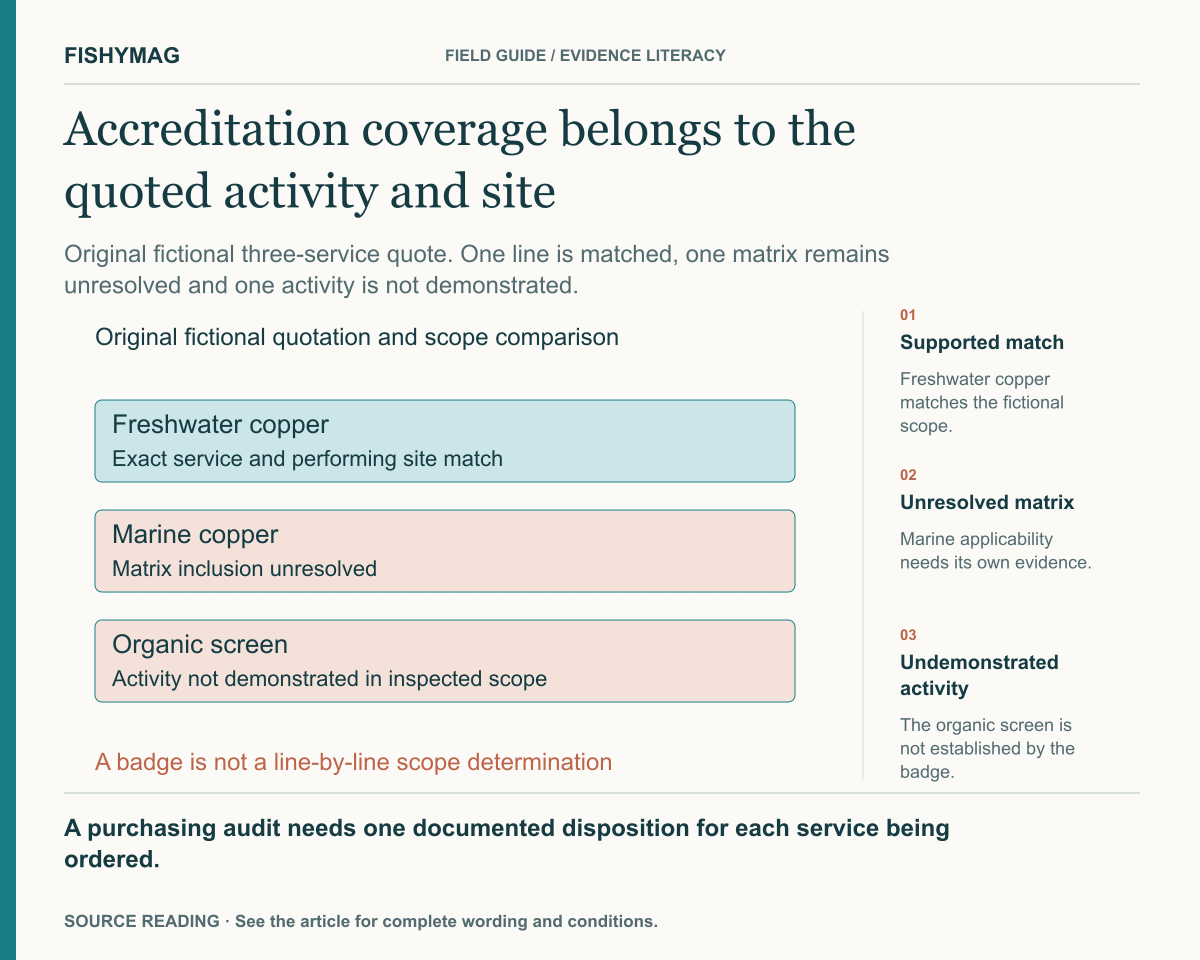
Figure data and explanation
Original fictional three-service quote. One line is matched, one matrix remains unresolved and one activity is not demonstrated.
- Supported match
- Freshwater copper matches the fictional scope.
- Unresolved matrix
- Marine applicability needs its own evidence.
- Undemonstrated activity
- The organic screen is not established by the badge.
A purchasing audit needs one documented disposition for each service being ordered.
Match the quoted work to its performing site and scope
ILAC G18 treats accreditation scope as a statement of specific activities and describes bounded flexibility for testing laboratories. The original fictional quote here offers freshwater copper, marine copper and an organic screen. Its supplied scope clearly lists the performing site and freshwater copper activity. It supplies no resolved marine-matrix entry and no demonstrated organic-screen activity. No real laboratory is being rated.
Complete a separate disposition for every quote line
The matrix question is distinct from the capability to measure a low concentration. A scope match does not by itself supply every reporting limit or validate a different sample.
| Quoted service | Inspected fictional scope evidence | Disposition | Exact follow-up |
|---|---|---|---|
| Freshwater copper | Correct site, method, analyte and freshwater activity | Supported scope match | Confirm requested fraction and reporting capability |
| Marine copper | Copper activity listed; marine coverage not established | Matrix match unresolved | Ask for applicable scope entry or documented flexible coverage |
| Organic screen | No corresponding activity demonstrated | Inspected scope does not demonstrate coverage | Ask for performing site and current specific scope |
| General accreditation badge | Laboratory advertises accreditation | Insufficient by itself | Use the formal scope and actual performer |
Do not confuse unresolved coverage with a negative accreditation finding
A flexible scope may cover a change only within its documented permissions. Do not assume a missing exact word means exclusion, or that the word “water” settles every marine matrix. Ask for the current scope, applicable activity list and performing site, then record what actually matches. Keep service accreditation, technical method applicability and reporting capability as distinct questions. A matched line can still be a poor fit for the intended reporting limit. The two unresolved lines remain unresolved until their own documentation is available; no blanket judgment about laboratory competence follows.
Use your own details
Does the laboratory's accreditation cover your aquarium sample? worksheet
Download the editable text file, fill it in on your device and keep it with the relevant record. This blank worksheet records your information; it does not verify entries or approve treatment.
- Accreditation body and current scope document
- Performing legal entity and site
- Exact quoted service and method
- Analyte or activity named in scope
- Material or matrix named in scope
- Flexible scope evidence and limits
- Separate accreditation and analytical-fit determinations
- Purchasing clarification for each unmatched row
Put it into practice
Your checklist
- Match the actual performing site, activity, analyte and matrix.
- Ask for documented scope flexibility instead of guessing its boundaries.
- Keep accreditation coverage separate from the requested analytical performance.
Sources and scope
This article distinguishes manufacturer statements from FishyMag’s own workflows and arithmetic examples. Linked formulation records retain their own evidence dates; publishing this article does not refresh those records.
- ILAC G18:01/2024, describing scopes of accreditation; reviewed November 9, 2026 ↗
- US EPA Method 200.8 revision 5.4 (1994); reviewed November 9, 2026 ↗
AI-assisted writing and development. Not hands-on product testing or veterinary review. How we publish →
FishyMag reports what manufacturers say, quoted and linked. It does not diagnose illness or recommend a treatment, and it never infers that a product is safe from the absence of a warning — where no statement exists, it says so.
Formulations change. Always read the label on the bottle in your hand, and contact the manufacturer if your tank contains anything valuable or unusual.