Keeper workflows
What subdivision loses from an aquarium supply's identity
Trace a seller-repacked aquarium supply through its subdivision event instead of treating a bulk-container photo as proof of the received portion’s lot.
By FishyMag · Published
Worked evidence example · Not a clinical review or treatment recommendation.
Quick answer
A bulk-container photograph and a portion invoice do not necessarily connect the portion to that lot. In this fictional purchase, the seller shows lot L9 and invoices portion P7 as 100 g, but supplies no subdivision record linking them. Portion-to-lot continuity remains unresolved; that is not a finding of counterfeiting or chemical equivalence.
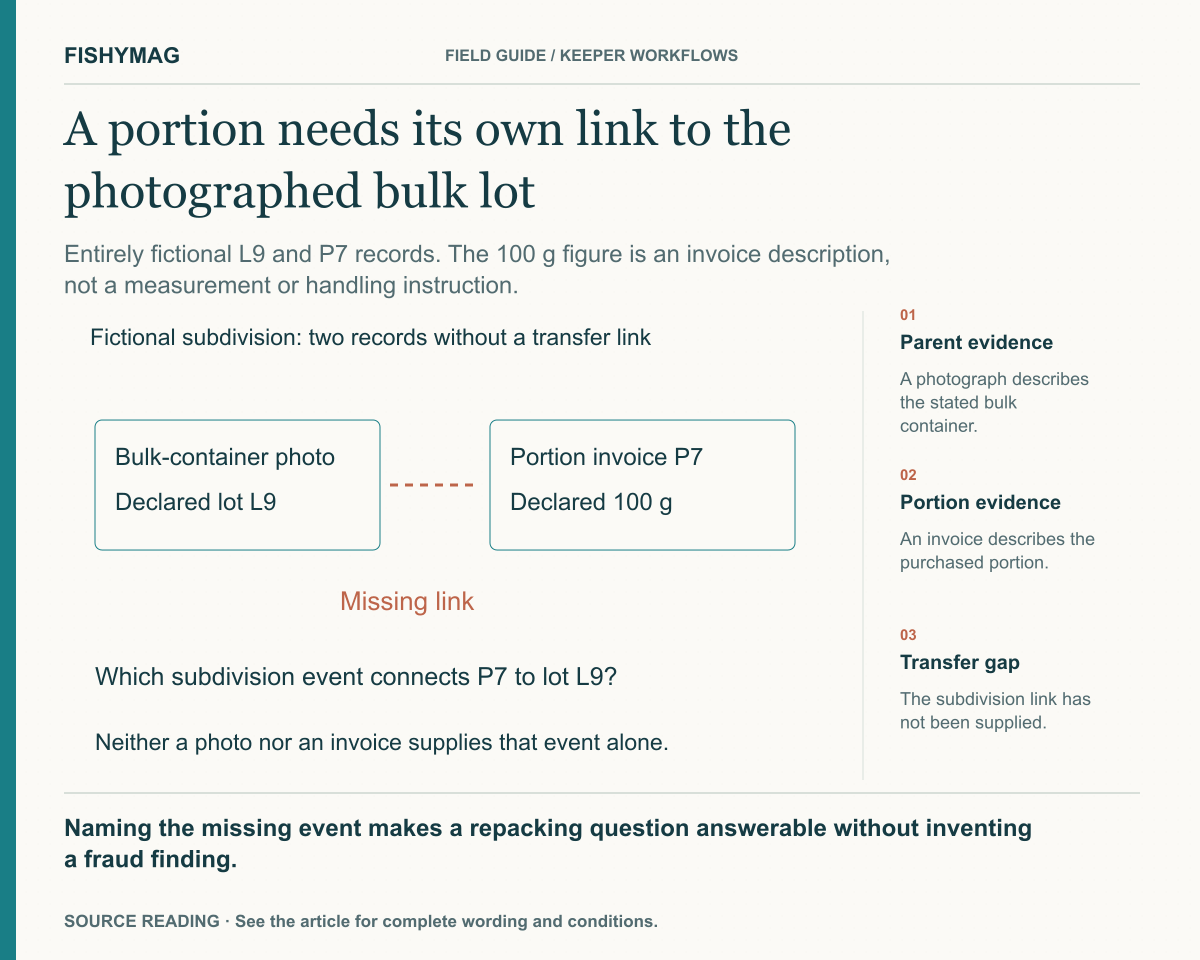
Figure data and explanation
Entirely fictional L9 and P7 records. The 100 g figure is an invoice description, not a measurement or handling instruction.
- Parent evidence
- A photograph describes the stated bulk container.
- Portion evidence
- An invoice describes the purchased portion.
- Transfer gap
- The subdivision link has not been supplied.
Naming the missing event makes a repacking question answerable without inventing a fraud finding.
Find the event that changed the packaging
The case concerns a fictional repacked aquarium filter medium. The seller supplies a photograph of a bulk container marked L9 and an invoice for portion P7, described as 100 g. The quantity is an invoice statement, not a FishyMag weighing result. The missing evidence is the event connecting that bulk container to this portion. A photograph of some L9 stock does not identify every small pack later sold under its family name.
Complete the transfer-chain worksheet
Keep the purchase record even when the lot link is absent. The point is to identify the gap accurately, not discard documented facts or accuse the seller.
| Link | Evidence supplied | Completed finding |
|---|---|---|
| Bulk item description | Container photograph marked L9 | Description and photographed identifier retained |
| Portion purchase | Invoice for P7, described as 100 g | Transaction description retained |
| L9 subdivided into P7 | No event record connecting identifiers | Continuity unresolved |
| P7 contents chemically equivalent to parent | No applicable content or homogeneity evidence | Not established by purchase or packaging records |
Ask for continuity, then assess what it does not prove
Request a subdivision or repacking record naming the parent lot, portion identifier, date and relevant transfers. Ask for the original applicable label and document revision as well. A record that supplies that connection would improve traceability, but it would not independently establish the portion’s composition, uniformity, storage suitability or compatibility with an aquarium treatment. Those are separate evidence questions. Do not assume that dividing a powder preserves the proportion of every ingredient, or that a handwritten lot copied onto a bag authenticates its contents. The useful output is a specific unresolved link and a focused document request.
Use your own details
What subdivision loses from an aquarium supply's identity worksheet
Download the editable text file, fill it in on your device and keep it with the relevant record. This blank worksheet records your information; it does not verify entries or approve treatment.
- Received portion identifier and original packaging
- Invoice description and declared quantity
- Bulk-container identity, lot and source of photograph
- Subdivision-event date and responsible record
- Parent lot to portion identifier link
- Subsequent transfers or relabelling
- Completed continuity finding
- Evidence requested and remaining content questions
Put it into practice
Your checklist
- Identify the subdivision event, not only the parent container.
- Keep purchase evidence separate from portion-to-lot continuity.
- Do not turn traceability into a chemical-equivalence or authenticity claim.
Sources and scope
This article distinguishes manufacturer statements from FishyMag’s own workflows and arithmetic examples. Linked formulation records retain their own evidence dates; publishing this article does not refresh those records.
- FishyMag evidence methodology; reviewed November 8, 2026 ↗
- FishyMag bottle identity worksheet; reviewed November 8, 2026 ↗
- FishyMag manufacturer question brief; reviewed November 8, 2026 ↗
AI-assisted writing and development. Not hands-on product testing or veterinary review. How we publish →
FishyMag reports what manufacturers say, quoted and linked. It does not diagnose illness or recommend a treatment, and it never infers that a product is safe from the absence of a warning — where no statement exists, it says so.
Formulations change. Always read the label on the bottle in your hand, and contact the manufacturer if your tank contains anything valuable or unusual.