Keeper workflows
Zero, not detected and not measured belong in different fields
A result-handling guide prevents blank cells from becoming reassuring zeroes.
By FishyMag · Published
FishyMag editorial workflow · Not a clinical review or treatment recommendation.
Quick answer
A zero display, a reported less-than limit and a missing test are different records. Preserve the report’s qualifier and method information. Do not replace an unmeasured or censored result with zero to complete a chart.

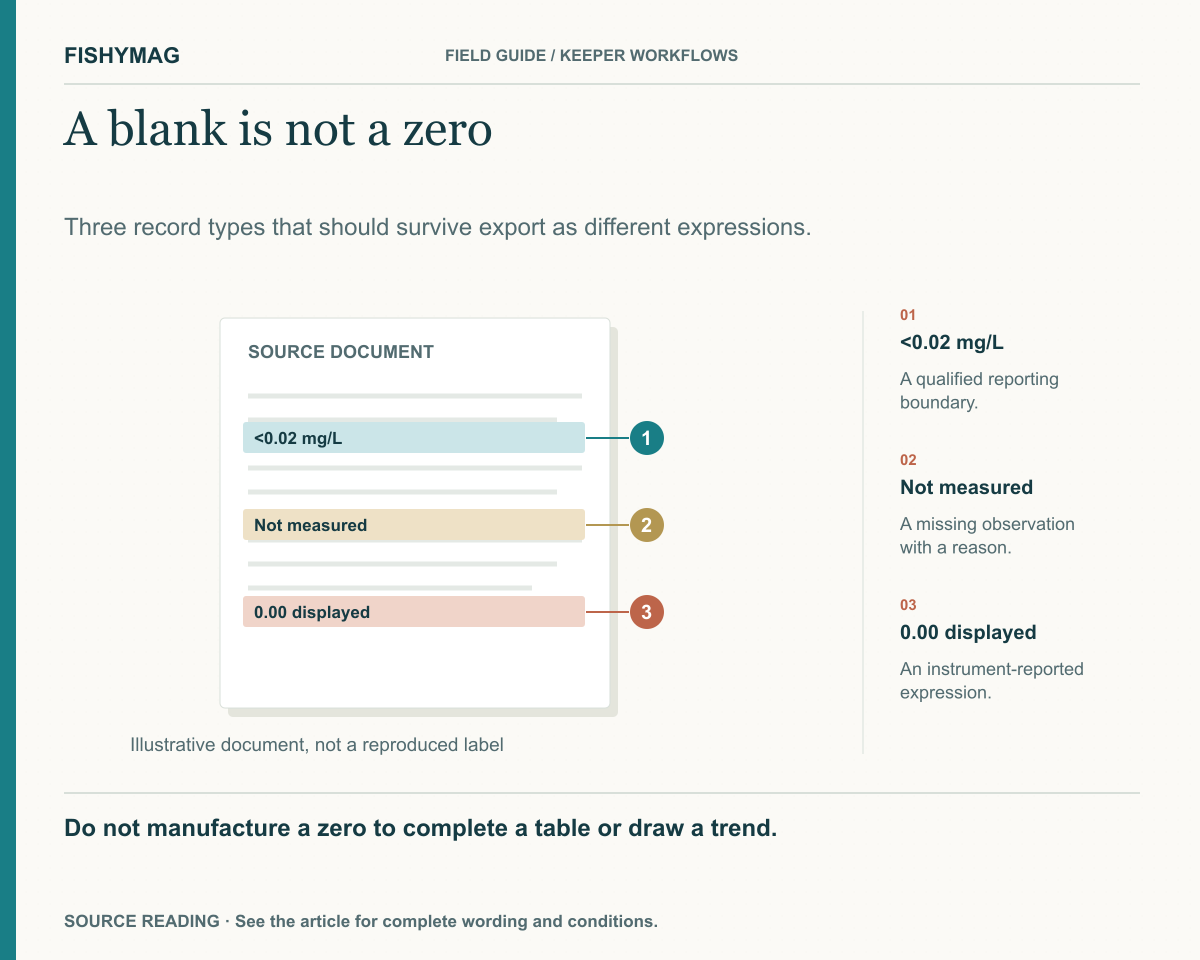
Figure data and explanation
Three record types that should survive export as different expressions.
- <0.02 mg/L
- A qualified reporting boundary.
- Not measured
- A missing observation with a reason.
- 0.00 displayed
- An instrument-reported expression.
Do not manufacture a zero to complete a table or draw a trend.
Keep the original expression intact
A report written “less than 0.02 mg/L” carries a boundary. A blank field may mean the test was not performed, the result was lost or a value has not been entered. “Not detected” is meaningful only with the method and its reporting convention. These expressions should not all be stored as the same numeric zero.
Use a result plus qualifier model
For a fictional reading below 0.02 mg/L, use a qualifier such as “less than” and a reporting-bound field of 0.02 with its unit. If the test was not performed, use a missing-reason field. The table illustrates record design; it does not define the detection capability of any kit or certify the absence of a substance.
| Reported expression | Record type | Do not replace it with |
|---|---|---|
| <0.02 mg/L | Qualified limit | Exact zero |
| Not measured | Missing observation | A measured concentration |
| 0.00 on display | Instrument-reported value | A claim that no substance exists |
Do not draw an invented point on a trend
Plotting a missing result at zero creates a decline that was never measured. Plotting a less-than value at exactly its boundary also changes its meaning unless the chart clearly marks it as a limit. Keep qualifiers visible in exported tables and annotate gaps rather than connecting a precise-looking line through invented values.
Treat a zero display as a method report
An instrument may round, truncate or use its own threshold for a zero display. Check the applicable instructions and retain the device’s actual expression. Do not relabel it “nothing remains” or use it as universal evidence that livestock can return. That would extend a method result beyond its documented scope.
A record another keeper can use
Include analyte, method, sample time, reported expression, unit, qualifier and any applicable reporting limit. If an export format has only one numeric column, add a text qualifier column instead of forcing everything into numbers. This preserves information for a later adviser without pretending the record provides clinical interpretation.
Put it into practice
Your checklist
- Keep qualifiers such as “less than” with the value and unit.
- Store “not measured” as a reason, not a numerical zero.
- Leave missing points and reporting limits visible in trends.
Sources and scope
This article distinguishes manufacturer statements from FishyMag’s own workflows and arithmetic examples. Linked formulation records retain their own evidence dates; publishing this article does not refresh those records.
AI-assisted writing and development. Not hands-on product testing or veterinary review. How we publish →
FishyMag reports what manufacturers say, quoted and linked. It does not diagnose illness or recommend a treatment, and it never infers that a product is safe from the absence of a warning — where no statement exists, it says so.
Formulations change. Always read the label on the bottle in your hand, and contact the manufacturer if your tank contains anything valuable or unusual.