Evidence literacy
A planned aquarium exposure is not a measured one
Separate assigned conditions, completed addition records and analytical exposure verification in a fictional six-tank study.
By FishyMag · Published
Original research-appraisal case · Not a clinical review or treatment recommendation.
Quick answer
All six fictional tanks have assignment records, five have completed addition records, and none has an analytical water result. The packet documents intended conditions and most completion records. It does not establish actual water concentrations, and it does not prove that the sixth addition was omitted.

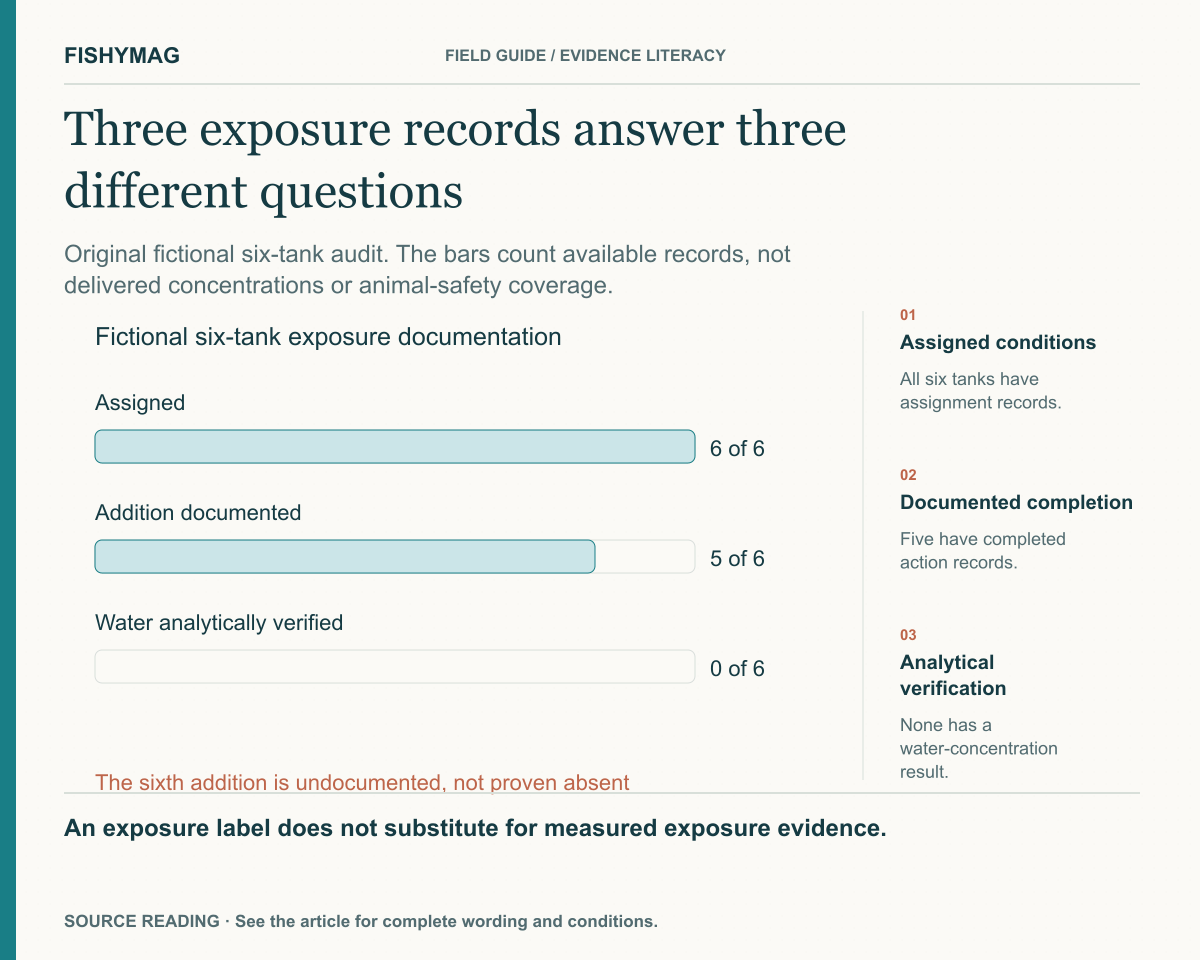
Figure data and explanation
Original fictional six-tank audit. The bars count available records, not delivered concentrations or animal-safety coverage.
- Assigned conditions
- All six tanks have assignment records.
- Documented completion
- Five have completed action records.
- Analytical verification
- None has a water-concentration result.
An exposure label does not substitute for measured exposure evidence.
Keep intention, documented action and measurement separate
The fictional study has six exposure tanks. Every tank appears on the condition-assignment list. Five have a signed completion record; the sixth has no completion entry. No tank has an analytical water result. These records answer different questions. OECD TG 203’s inspected 2025 text explicitly distinguishes analytical test-concentration evidence from nominal exposure. This case uses that distinction to read existing documentation, not to prescribe a test.
Complete the three-layer coverage audit
Each denominator below is the same six-tank roster. The counts measure documentation coverage, not the probability that an action occurred or the percentage of a target concentration attained.
| Evidence layer | Documented coverage | What it establishes | What it leaves open |
|---|---|---|---|
| Assignment | 6/6 tanks | Intended nominal conditions recorded | Whether each action was completed |
| Completed addition record | 5/6 tanks | Completion documented for those five | Sixth tank’s action remains undocumented |
| Analytical water verification | 0/6 tanks | No analytical concentration supplied | Actual concentrations and their time course |
| Sixth tank | Assignment present; completion missing | Gap in documentation | Not proof that no addition occurred |
| Whole exposure summary | Nominal design described | Records can be reported as such | Measured exposure not established |
Use an evidence-bounded exposure sentence
Write: “Six tanks were assigned the nominal exposure; completion was documented for five, and no analytical water concentrations were supplied.” That statement preserves useful information without upgrading assignment to measurement. To close the gaps, request the missing completion record and any existing analytical results with sampling times, chemical identity, fraction and method scope. Do not calculate a concentration from undocumented actions or assume all tanks had equal exposure because the assignment label matched. There is no target concentration, preparation amount or administration procedure in this article.
Use your own details
A planned aquarium exposure is not a measured one worksheet
Download the editable text file, fill it in on your device and keep it with the relevant record. This blank worksheet records your information; it does not verify entries or approve treatment.
- Tank roster and assignment record
- Nominal condition definition
- Completed addition record per tank
- Missing records versus explicit noncompletion
- Analytical identity and water fraction
- Sampling times and measurement coverage
- Assay applicability and reporting limits
- Allowed exposure statement and missing evidence
Put it into practice
Your checklist
- Track assignment, action documentation and analytical verification separately.
- Keep an undocumented action distinct from a confirmed omission.
- Describe nominal exposure as nominal when measured concentrations are absent.
Sources and scope
This article distinguishes manufacturer statements from FishyMag’s own workflows and arithmetic examples. Linked formulation records retain their own evidence dates; publishing this article does not refresh those records.
- Percie du Sert etal., ARRIVE2.0 explanationandelaboration,2020; reviewed November 9, 2026 ↗
- OECD Test Guideline 203, adopted June 2025 and corrected September 2025; reviewed November 9, 2026 ↗
AI-assisted writing and development. Not hands-on product testing or veterinary review. How we publish →
FishyMag reports what manufacturers say, quoted and linked. It does not diagnose illness or recommend a treatment, and it never infers that a product is safe from the absence of a warning — where no statement exists, it says so.
Formulations change. Always read the label on the bottle in your hand, and contact the manufacturer if your tank contains anything valuable or unusual.