Keeper workflows
No aquarium evidence found: what that means
Reconcile a small search ledger and distinguish an unavailable report, an out-of-scope report and a negative observation.
By FishyMag · Published
Original evidence audit · Not a clinical review or treatment recommendation.
Quick answer
The fictional search finds eight records, six after deduplication. Two studies are eligible, one report is unavailable and three are out of scope. Only one eligible study measures the requested endpoint. Its negative finding applies to its own conditions.

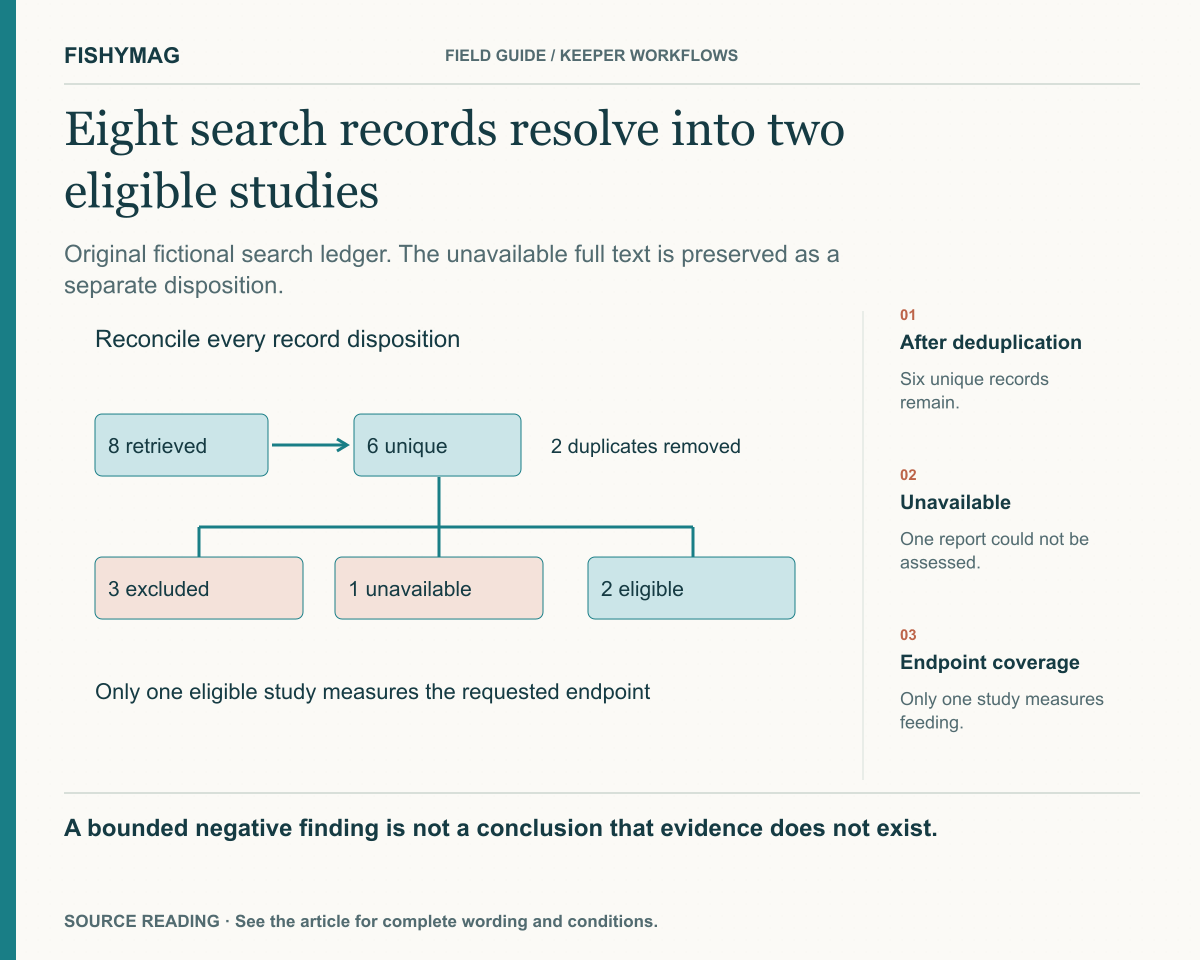
Figure data and explanation
Original fictional search ledger. The unavailable full text is preserved as a separate disposition.
- After deduplication
- Six unique records remain.
- Unavailable
- One report could not be assessed.
- Endpoint coverage
- Only one study measures feeding.
A bounded negative finding is not a conclusion that evidence does not exist.
Start with the search that was actually done
The fictional log searches two specified databases through October 20, 2026 for a defined formulation and freshwater exposure. It retrieves R1 to R8. R2 duplicates R1 and R8 duplicates R7. Three unique records fail route, matrix or formulation eligibility. One potentially relevant report could not be retrieved.
Reconcile each disposition
The unavailable report remains a separate candidate. It is neither an eligible finding nor a known irrelevant study.
| Step | Count | What remains |
|---|---|---|
| Retrieved | 8 | Two duplicates |
| Unique | 6 | Three excluded, one unavailable, two eligible |
| Eligible | 2 | One feeding record, one growth record |
| Requested feeding endpoint | 1 | No prespecified effect detected under its stated conditions |
Report the limits instead of “nothing exists”
The second study is eligible for the broader review but does not measure feeding. The one negative result does not establish equivalence or general compatibility, and the unavailable text could not be assessed. A defensible sentence names the search boundary and says exactly what was found within it. The downloadable ledger lets a reader reconcile the counts.
Use your own details
No aquarium evidence found: what that means worksheet
Download the editable text file, fill it in on your device and keep it with the relevant record. This blank worksheet records your information; it does not verify entries or approve treatment.
- Question and searched sources
- Last search date and exact query
- Retrieved and unique records
- Duplicate mapping
- Exclusion reasons
- Reports not retrieved
- Eligible studies and requested endpoint coverage
Worked example files
These files contain the article’s worked example. Read its source and scope notes, and keep your own current records before opening an example in a tool.
Put it into practice
Your checklist
- Deduplicate records without deleting their links.
- Keep unavailable reports distinct from exclusions.
- Count endpoint-relevant results separately from eligible studies.
Sources and scope
This article distinguishes manufacturer statements from FishyMag’s own workflows and arithmetic examples. Linked formulation records retain their own evidence dates; publishing this article does not refresh those records.
- PRISMA 2020 flow diagram guidance; reviewed November 9, 2026 ↗
- Cochrane Handbook Chapter 4, searching and selecting studies; reviewed November 9, 2026 ↗
- FishyMag evidence methodology; reviewed November 8, 2026 ↗
AI-assisted writing and development. Not hands-on product testing or veterinary review. How we publish →
FishyMag reports what manufacturers say, quoted and linked. It does not diagnose illness or recommend a treatment, and it never infers that a product is safe from the absence of a warning — where no statement exists, it says so.
Formulations change. Always read the label on the bottle in your hand, and contact the manufacturer if your tank contains anything valuable or unusual.