Keeper workflows
One product, several tanks: keep calculations attached to tank identities
A fleet worksheet shows how to audit totals without turning a combined number into a mixing plan.
By FishyMag · Published
Worked arithmetic example · Not a clinical review or treatment recommendation.
Quick answer
Calculate each identified tank separately under the applicable rule, then sum only comparable quantities for bookkeeping. A fleet total is not permission to pool preparations, combine treatments or allocate a dose by eye.

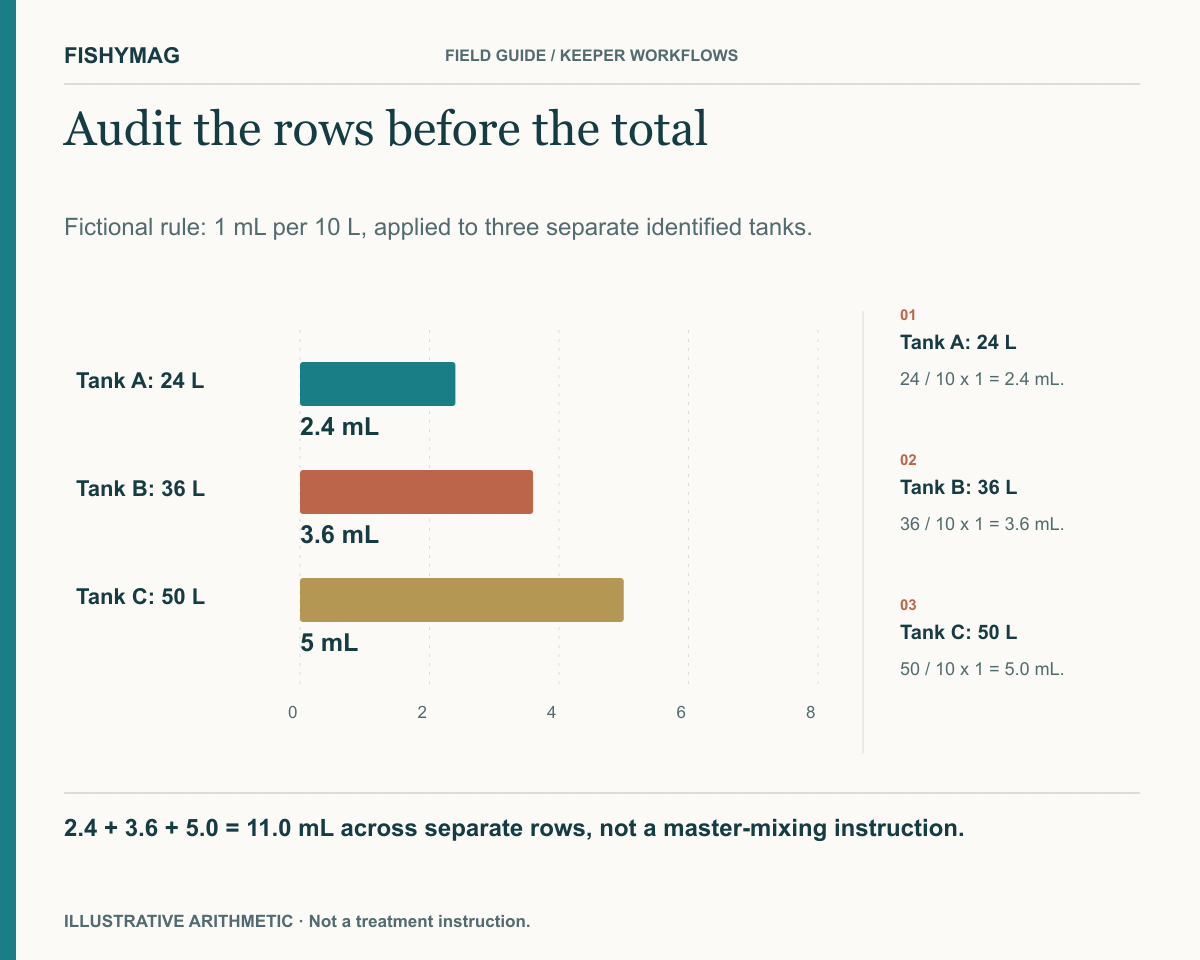
Figure data and explanation
Fictional rule: 1 mL per 10 L, applied to three separate identified tanks.
- Tank A: 24 L
- 2.4 mL. 24 / 10 x 1 = 2.4 mL.
- Tank B: 36 L
- 3.6 mL. 36 / 10 x 1 = 3.6 mL.
- Tank C: 50 L
- 5 mL. 50 / 10 x 1 = 5.0 mL.
2.4 + 3.6 + 5.0 = 11.0 mL across separate rows, not a master-mixing instruction.
Match the rule before adding the rows
A total makes sense only when the rows concern the same defined quantity. Record product identity, route and instruction version with each tank. If different formulations or routes are involved, keep separate subtotals. Adding amounts from unlike rules can hide exactly the mismatch a keeper needs to see.
Use an invented rule for the worked ledger
For an explicitly fictional scaling rule of 1 mL per 10 L, tank A at 24 L gives 2.4 mL, B at 36 L gives 3.6 mL and C at 50 L gives 5.0 mL. The sum is 11.0 mL. These are illustrative quantities, not a real product’s directions or a recommendation for any aquarium.
| Fictional tank | Volume | At 1 mL per 10 L |
|---|---|---|
| A | 24 L | 2.4 mL |
| B | 36 L | 3.6 mL |
| C | 50 L | 5.0 mL |
| Bookkeeping total | 110 L across separate tanks | 11.0 mL across separate rows |
Do not confuse a total with an allocation method
The 11.0 mL total tells you what the three arithmetic rows sum to. It does not instruct you to make a master mixture, select a diluent, assume homogeneity or split material between containers. Such procedures introduce additional conditions that the arithmetic did not address. Keep each row’s identity and quantity available even when a summary total is shown.
Add completion fields without overwriting the calculation
Use separate columns for calculated quantity, actual recorded action, keeper and time. A row can have valid arithmetic while no action has happened. If a tank volume changes or a rule match becomes uncertain, mark that row for review and recalculate its subtotal; do not silently redistribute the old total across the remaining tanks.
Audit from both directions
Check that every included tank appears once, that units are identical and that the sum agrees with the rows. Also work backward from the summary to confirm that no extra tank or unmatched product has been included. The treatment log and handover tools can preserve the records, but neither authenticates tank volume or decides treatment suitability.
Put it into practice
Your checklist
- Keep product, rule and tank identity on every row.
- Sum only like quantities and retain individual calculations.
- Separate a bookkeeping total from preparation and completed-action records.
Sources and scope
This article distinguishes manufacturer statements from FishyMag’s own workflows and arithmetic examples. Linked formulation records retain their own evidence dates; publishing this article does not refresh those records.
AI-assisted writing and development. Not hands-on product testing or veterinary review. How we publish →
FishyMag reports what manufacturers say, quoted and linked. It does not diagnose illness or recommend a treatment, and it never infers that a product is safe from the absence of a warning — where no statement exists, it says so.
Formulations change. Always read the label on the bottle in your hand, and contact the manufacturer if your tank contains anything valuable or unusual.