Keeper workflows
Low conductivity is not a contaminant report
Audit a low-conductivity aquarium source-water result without converting it into a contaminant-absence report.
By FishyMag · Published
Original evidence-and-batch case · Not a clinical review or treatment recommendation.
Quick answer
The fictional 2 µS/cm result at 25 °C establishes the recorded conductivity measurement. It does not establish absence of constituent X because no X assay, reporting limit or validated relationship is supplied. The unsupported absence claim also does not prove X is present.
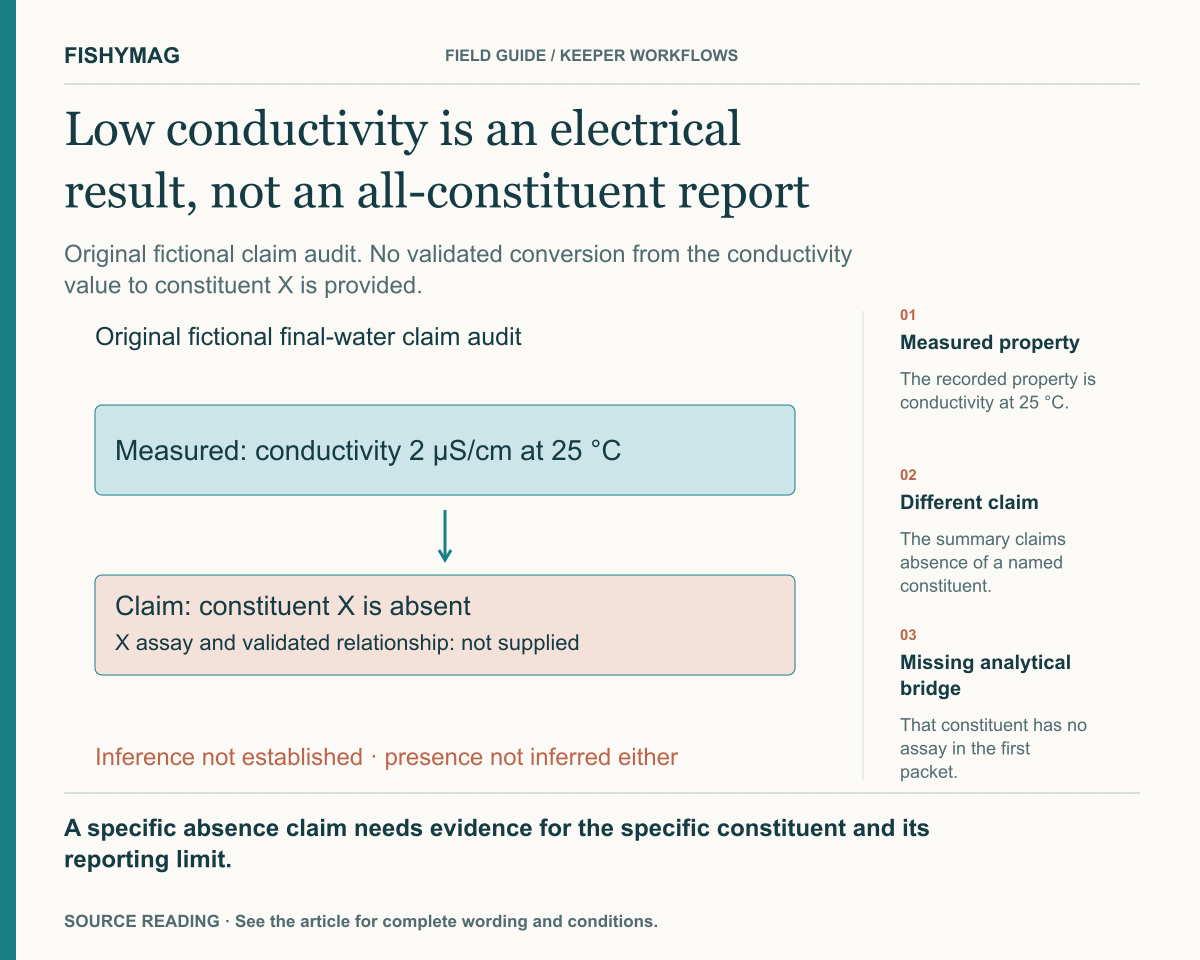
Figure data and explanation
Original fictional claim audit. No validated conversion from the conductivity value to constituent X is provided.
- Measured property
- The recorded property is conductivity at 25 °C.
- Different claim
- The summary claims absence of a named constituent.
- Missing analytical bridge
- That constituent has no assay in the first packet.
A specific absence claim needs evidence for the specific constituent and its reporting limit.
Keep the measured property in the sentence
The original fictional final-water packet reports conductivity of 2 µS/cm referenced to 25 °C. A summary then says “X is absent.” Nothing in the packet identifies an X-specific assay or a validated relationship from that conductivity value to X concentration. The Hanna multiparameter manual distinguishes conductivity and related calculated displays; EPA’s purification discussion does not claim complete removal of every contaminant by a single technology.
Complete the absence-claim audit
The alternative packet adds one expressly fictional target-specific report for the same batch and final point. It does not replace the original conductivity record.
| Claim or evidence | Original packet | Alternative with an X report |
|---|---|---|
| Conductivity recorded | 2 µS/cm at 25 °C | Same measurement retained |
| Named constituent X measured | No | Applicable assay reports X <0.5 µg/L |
| X reporting capability | Not supplied | Limit 0.5 µg/L retained |
| X exactly absent | Not established | Still not established by a qualified nondetection |
| X present | Not established | No quantified detection supplied |
| Final conclusion | Conductivity result only; X unresolved | Qualified X result at the stated point and time |
Ask for the assay that matches the claim
A useful request names X, the relevant water matrix, operational fraction, final collection point and required reporting capability. It does not commission a broad panel on the assumption that every possible compound will be included. Keep a qualified target result as qualified rather than replacing it with zero or a generic “pure water” badge. The conductivity observation can remain useful for its intended electrical question without becoming a universal contaminant screen. This article establishes no water-quality threshold for livestock and no replacement or remineralization procedure.
Use your own details
Low conductivity is not a contaminant report worksheet
Download the editable text file, fill it in on your device and keep it with the relevant record. This blank worksheet records your information; it does not verify entries or approve treatment.
- Final-water sample point and batch
- Electrical quantity and unit
- Actual versus reference temperature
- Instrument and applicable method
- Exact constituent named in the absence claim
- Validated relationship if one is proposed
- Target-specific result and reporting limit
- Bounded claim and unresolved evidence
Put it into practice
Your checklist
- Name conductivity as the property actually measured.
- Require constituent-specific evidence for a constituent-specific absence claim.
- Reject the unsupported inference without inventing a detection.
Sources and scope
This article distinguishes manufacturer statements from FishyMag’s own workflows and arithmetic examples. Linked formulation records retain their own evidence dates; publishing this article does not refresh those records.
- Hanna HI98194/HI98195/HI98196 instruction manual; reviewed November 9, 2026 ↗
- EPA WaterSense at Work, Water Purification, March 2024; reviewed November 9, 2026 ↗
AI-assisted writing and development. Not hands-on product testing or veterinary review. How we publish →
FishyMag reports what manufacturers say, quoted and linked. It does not diagnose illness or recommend a treatment, and it never infers that a product is safe from the absence of a warning — where no statement exists, it says so.
Formulations change. Always read the label on the bottle in your hand, and contact the manufacturer if your tank contains anything valuable or unusual.