Keeper workflows
An event-triggered aquarium record needs a coverage statement
Distinguish a controller command from observed return-flow loss and record which part of an intermittent event was actually captured.
By FishyMag · Published
FishyMag editorial workflow · Not a clinical review or treatment recommendation.
Quick answer
Define the trigger by the evidence the question needs. In this fictional timeline, return-flow loss is seen at 14:03 and the first feasible observation begins at 14:06, before normal flow is documented at 14:08. The event was captured while ongoing, but the first three minutes and onset chemistry were not observed by that response.
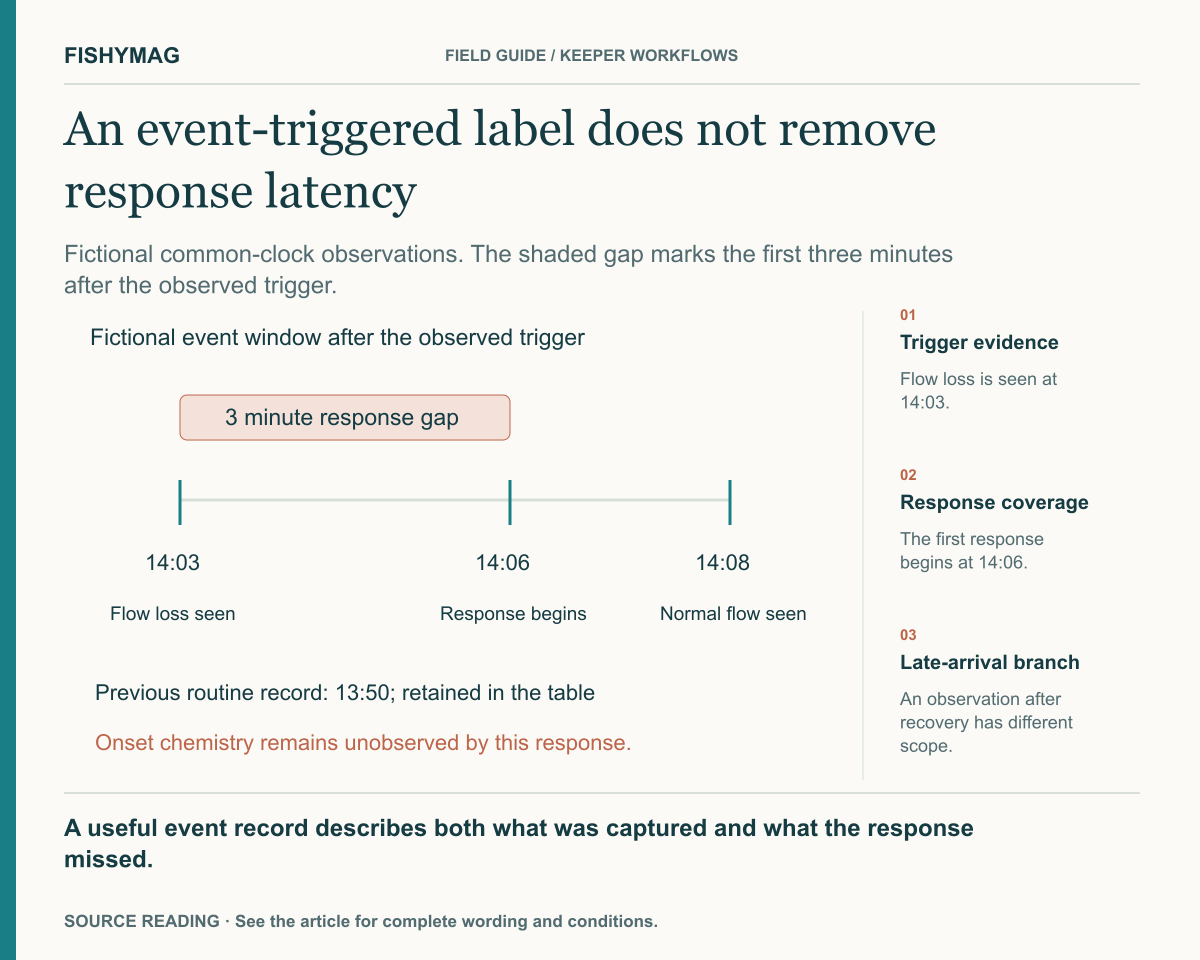
Figure data and explanation
Fictional common-clock observations. The shaded gap marks the first three minutes after the observed trigger.
- Trigger evidence
- Flow loss is seen at 14:03.
- Response coverage
- The first response begins at 14:06.
- Late-arrival branch
- An observation after recovery has different scope.
A useful event record describes both what was captured and what the response missed.
Define the observed event before designing the response
The invented case concerns an intermittent return-flow interruption that already occurs, without anyone deliberately stopping equipment. Its trigger is a timestamped observation of lost discharge, not merely an OFF command or a controller icon. An equipment command and actual water movement are different evidence. Any real sampling response must fit the applicable method, access and operator safety requirements.
Complete the captured and missed intervals
The previous routine observation was 13:50. Loss of return flow is then seen at 14:03. A feasible observation response begins at 14:06, and normal flow is documented at 14:08. Times are fictional and share a declared clock basis.
| Record | Time | Coverage meaning |
|---|---|---|
| Previous routine observation | 13:50 | Does not establish conditions until the later event |
| Return-flow loss observed | 14:03 | Trigger evidence exists at this time |
| First feasible event observation | 14:06 | Captured while the interruption remains ongoing |
| Normal return flow observed | 14:08 | Recovery is observed at this time |
| Late-arrival branch | First observation after 14:08 | Cannot represent the interruption state merely by being labelled event-triggered |
Keep the missing onset information explicit
The 14:06 response misses the first three minutes after the trigger observation. It cannot supply chemistry at 14:03 or prove that flow loss began exactly when it was first seen. A later sample also does not become an event-state sample merely because the request was triggered during the event. The completed response plan records the physical trigger, feasible response, clock basis, actual observation times and the gaps. Choose further monitoring for the specific unresolved question; the example supplies no universal response cadence, chemical-effect claim or instruction to recreate a failure.
Use your own details
An event-triggered aquarium record needs a coverage statement worksheet
Download the editable text file, fill it in on your device and keep it with the relevant record. This blank worksheet records your information; it does not verify entries or approve treatment.
- Declared comparison or event question
- Parent sample or system identity
- Pathway and observation method
- Exact times or matched block conditions
- Original values and qualifiers
- Completed calculation or coverage finding
- Unresolved mechanism or unobserved interval
- Next evidence and responsible reviewer
Put it into practice
Your checklist
- Define the trigger using the physical evidence required.
- Retain actual response times rather than intended times.
- Report which event intervals and variables were not observed.
Sources and scope
This article distinguishes manufacturer statements from FishyMag’s own workflows and arithmetic examples. Linked formulation records retain their own evidence dates; publishing this article does not refresh those records.
- Australian and New Zealand water-quality field sampling guidance; reviewed November 8, 2026 ↗
- Australian and New Zealand guidelines: water-quality data analysis; reviewed November 8, 2026 ↗
AI-assisted writing and development. Not hands-on product testing or veterinary review. How we publish →
FishyMag reports what manufacturers say, quoted and linked. It does not diagnose illness or recommend a treatment, and it never infers that a product is safe from the absence of a warning — where no statement exists, it says so.
Formulations change. Always read the label on the bottle in your hand, and contact the manufacturer if your tank contains anything valuable or unusual.