Keeper workflows
A damaged aquarium shipment: what the evidence establishes
Build a useful aquarium-supply damage report that separates visible carton condition, unobserved packaging boundaries and unsupported content claims.
By FishyMag · Published
Worked evidence example · Not a clinical review or treatment recommendation.
Quick answer
Describe the visible damage and keep the unobserved boundaries open. In the fictional D6 record, a photograph shows a wet carton corner, but does not establish the inner seal’s condition, the liquid’s source or the product’s suitability. A clean-looking bottle in another photograph would not resolve those gaps automatically.
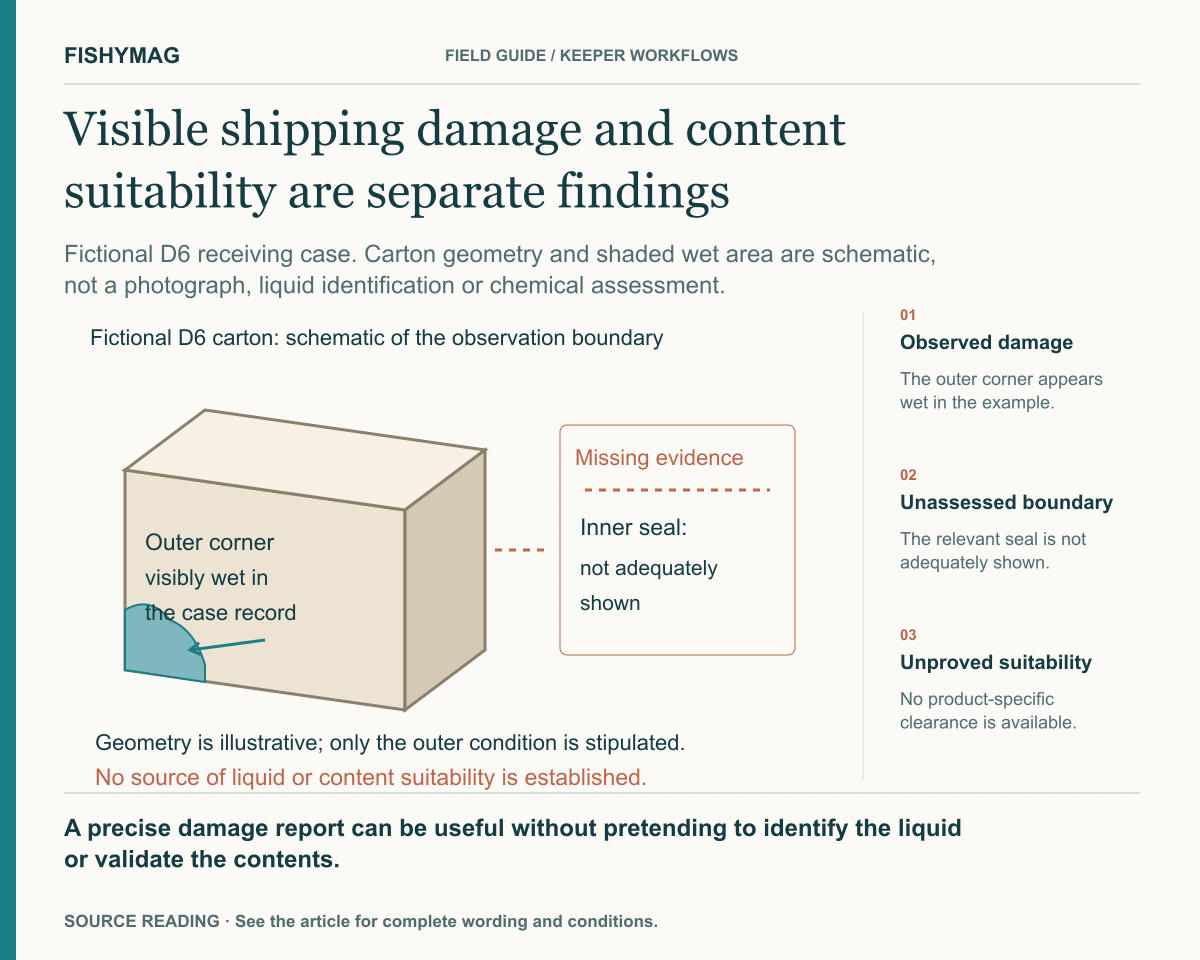
Figure data and explanation
Fictional D6 receiving case. Carton geometry and shaded wet area are schematic, not a photograph, liquid identification or chemical assessment.
- Observed damage
- The outer corner appears wet in the example.
- Unassessed boundary
- The relevant seal is not adequately shown.
- Unproved suitability
- No product-specific clearance is available.
A precise damage report can be useful without pretending to identify the liquid or validate the contents.
Write observations that another reviewer can locate
The invented D6 file records one visibly wet carton corner at receipt. It contains an outer-carton photograph, an invoice and a distant view of a bottle. It does not contain an adequate view of the inner seal or a product-specific assessment of the exposure. No real shipment was inspected. A useful report names the evidence file and visible region instead of beginning with “the contents are contaminated” or “only the box was affected.”
Complete the condition-versus-inference table
Keep the report limited to the evidence supplied. Do not smell, taste, open, mix or otherwise investigate an unknown material to fill the worksheet.
| Statement | Evidence in D6 | Report treatment |
|---|---|---|
| Carton corner appears wet | Visible in original receipt photograph | Retain as observed condition |
| Wetness came from this bottle | Source not established | Do not assert |
| Inner seal remained intact | Relevant boundary not adequately shown | Record as unassessed |
| Contents remain suitable | No product-specific assessment supplied | No clearance issued |
| Item and lot belong to this shipment | Invoice plus retained pack identifiers needed | Preserve the identity chain for review |
Prepare the report without settling the claim yourself
Keep the original files, receipt time, shipment identifiers and any safe observations already available together. Ask the seller or responsible manufacturer what evidence is needed to assess the actual pack and exposure. A prepared report is not a sent complaint, warranty approval or promise of refund. Follow applicable official handling instructions rather than using this article as an examination procedure. The finished record supports a practical next step: the reviewer can see the observed outer damage and exactly which inner-package or suitability questions have not been answered.
Use your own details
A damaged aquarium shipment: what the evidence establishes worksheet
Download the editable text file, fill it in on your device and keep it with the relevant record. This blank worksheet records your information; it does not verify entries or approve treatment.
- Shipment and received-item identifiers
- Receipt time and original unedited evidence
- Outer packaging condition actually visible
- Inner packaging and seal observations, or explicit gaps
- Lot, expiry and applicable label record
- Known exposure facts versus inferred causes
- Completed condition report and unresolved suitability
- Recipient of the prepared report and specific questions
Put it into practice
Your checklist
- Report visible condition before assigning a cause.
- Name unobserved seal and content questions explicitly.
- Retain original identity and receipt evidence for the responsible reviewer.
Sources and scope
This article distinguishes manufacturer statements from FishyMag’s own workflows and arithmetic examples. Linked formulation records retain their own evidence dates; publishing this article does not refresh those records.
- FishyMag evidence methodology; reviewed November 8, 2026 ↗
- FishyMag bottle identity worksheet; reviewed November 8, 2026 ↗
- FishyMag manufacturer question brief; reviewed November 8, 2026 ↗
AI-assisted writing and development. Not hands-on product testing or veterinary review. How we publish →
FishyMag reports what manufacturers say, quoted and linked. It does not diagnose illness or recommend a treatment, and it never infers that a product is safe from the absence of a warning — where no statement exists, it says so.
Formulations change. Always read the label on the bottle in your hand, and contact the manufacturer if your tank contains anything valuable or unusual.