Keeper workflows
Correct a treatment record without erasing what changed
An audit-note pattern keeps the original entry, correction and reason visible to the next keeper.
By FishyMag · Published
FishyMag editorial workflow · Not a clinical review or treatment recommendation.
Quick answer
A correction should identify the old entry, the replacement information and why it changed. Preserve uncertainty and distinguish a transcription correction from a change in what is known about an actual event.

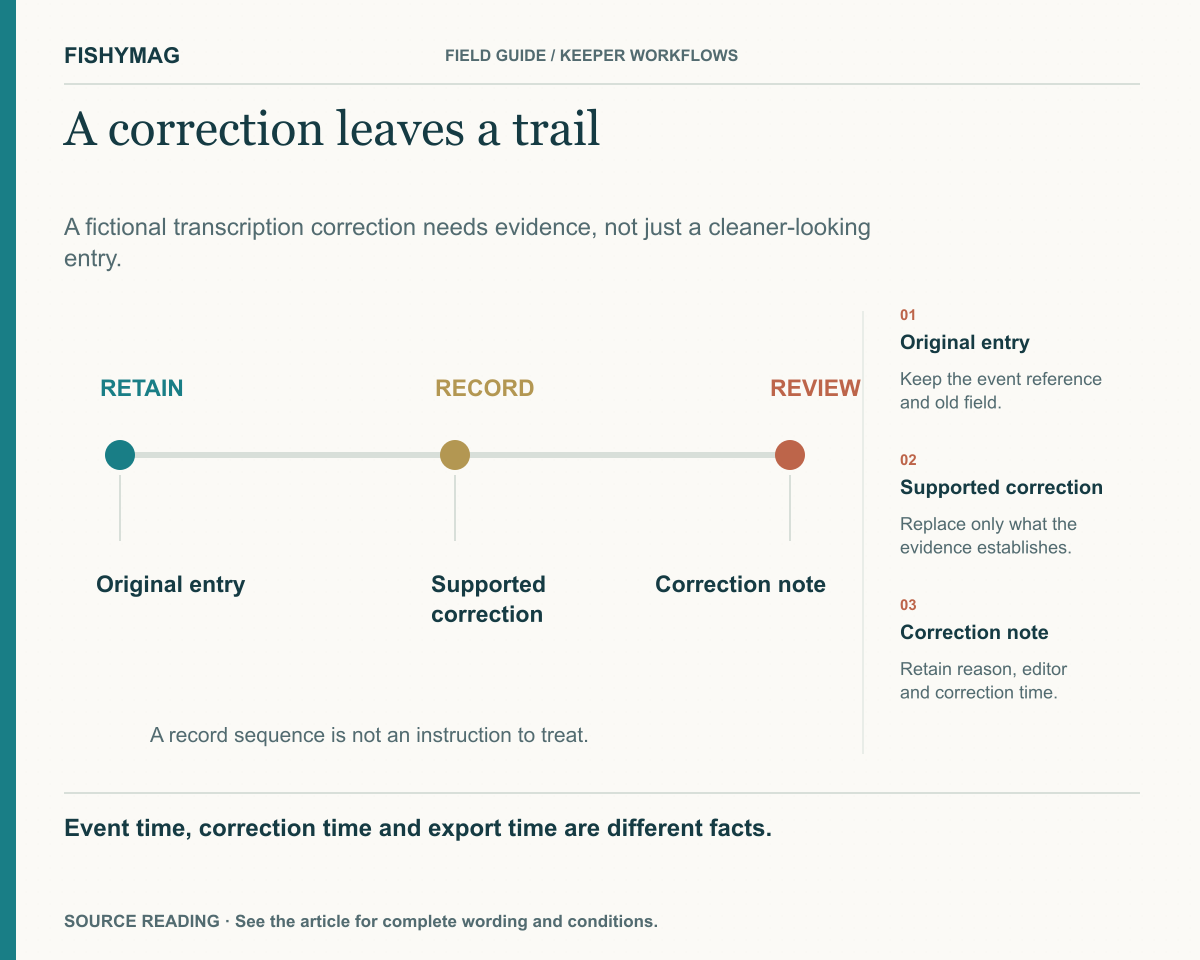
Figure data and explanation
A fictional transcription correction needs evidence, not just a cleaner-looking entry.
- Original entry
- Keep the event reference and old field.
- Supported correction
- Replace only what the evidence establishes.
- Correction note
- Retain reason, editor and correction time.
Event time, correction time and export time are different facts.
Identify the entry before editing it
Give the event a stable reference such as Tank-A-2026-11-08-01. Keep the original text or an export made before the edit. A timestamp on a new file alone does not reveal which field changed. If more than one keeper has a copy, identify which copy is current and how the correction will be communicated within the already agreed handover process.
Classify the change
A unit transcription error is different from newly discovering that an action may not have happened. In a fictional example, changing “5 L” to “5 mL” can be a documented transcription correction only if supporting evidence establishes that the actual action was 5 mL. If the action itself is uncertain, do not use a tidy corrected entry to imply certainty.
| Field | Fictional correction note | Boundary |
|---|---|---|
| Original | 5 L in event A-01 | Preserved, not silently removed |
| Replacement | 5 mL, supported by original action note | Does not reconstruct an unknown action |
| Correction time | Next day at 09:00 | Not the event time |
Write a compact correction note
Use five elements: event reference, original field, replacement field, reason or evidence, and correction author/time. Do not insert invented contemporaneous measurements. If a value remains unresolved, write the open question. This note can live beside an exported record even when the underlying tool does not provide an immutable audit-log feature.
Separate event time from correction time
An action at 18:00 on one day and a correction entered at 09:00 the next day are two timestamps. Keep both. Replacing the event time with the edit time shifts the chronology and can make later calculations misleading. Similarly, a file export time is not evidence that all its entries were created or verified at that moment.
Know the limits of local files
FishyMag’s current exports do not synchronise corrections among keepers or retract already shared copies. Save the corrected version with a clear filename, retain the old version where appropriate and mark it superseded in your own filing system. This guide describes a recordkeeping practice, not an assertion that the software provides tamper-proof records.
Put it into practice
Your checklist
- Keep the original field and reason beside the correction.
- Distinguish a transcription fix from uncertainty about the actual event.
- Retain event, correction and export times as different facts.
Sources and scope
This article distinguishes manufacturer statements from FishyMag’s own workflows and arithmetic examples. Linked formulation records retain their own evidence dates; publishing this article does not refresh those records.
AI-assisted writing and development. Not hands-on product testing or veterinary review. How we publish →
FishyMag reports what manufacturers say, quoted and linked. It does not diagnose illness or recommend a treatment, and it never infers that a product is safe from the absence of a warning — where no statement exists, it says so.
Formulations change. Always read the label on the bottle in your hand, and contact the manufacturer if your tank contains anything valuable or unusual.