Keeper workflows
When aquarium compatibility sources disagree
Distinguish two scope differences from one unresolved conflict between aquarium research results.
By FishyMag · Published
Original evidence audit · Not a clinical review or treatment recommendation.
Quick answer
The first two fictional pairs answer different questions because route, matrix or follow-up differs. Pair 3 matches on the recorded formulation, route, water, endpoint and period yet reports opposing observations. Keep that conflict unresolved until the methods can be reconciled.
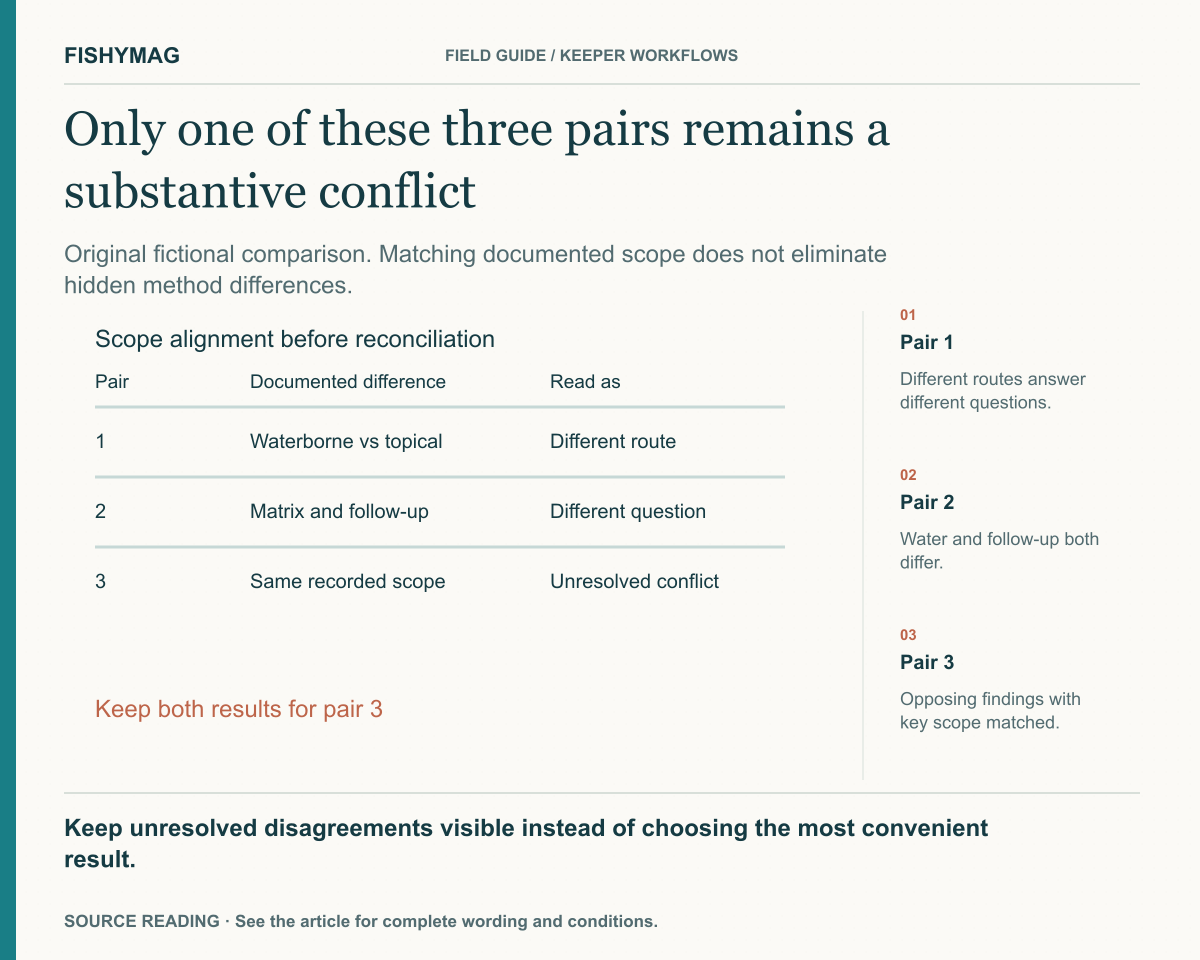
Figure data and explanation
Original fictional comparison. Matching documented scope does not eliminate hidden method differences.
- Pair 1
- Different routes answer different questions.
- Pair 2
- Water and follow-up both differ.
- Pair 3
- Opposing findings with key scope matched.
Keep unresolved disagreements visible instead of choosing the most convenient result.
Compare claims before comparing their direction
A chart says an aquarium study “found an effect” and a second “found none.” In the fictional file, pair 1 uses a waterborne versus a topical route. Pair 2 uses different water matrices and observation windows. Pair 3 documents the same formulation, route, matrix, endpoint definition and period, but one record reports a prespecified feeding change and the other does not.
Classify all three pairs
Pair 3 is unresolved as a substantive conflict at the recorded scope, not proof that the results are statistically incompatible. Uncertainty or hidden method differences may explain them.
| Pair | Match check | Finding |
|---|---|---|
| 1 | Route differs | Not a direct contradiction |
| 2 | Matrix and follow-up differ | Not a direct contradiction |
| 3 | Key recorded scope matches | Preserve opposing results and unresolved conflict |
Request facts that might explain pair 3
Look for actual exposure verification, experimental unit and sample size, missing observations, measurement method and uncertainty for both effects. The fictional packet does not provide enough detail to select one result or pool them. If later details expose a matrix or endpoint difference, revise the comparison and explain what changed.
Use your own details
When aquarium compatibility sources disagree worksheet
Download the editable text file, fill it in on your device and keep it with the relevant record. This blank worksheet records your information; it does not verify entries or approve treatment.
- Exact wording and source for each statement
- Formulation and route
- Matrix and measured exposure
- Endpoint and observation period
- Direction and uncertainty of each result
- Differences versus substantive conflict
- Methodological facts still needed
Put it into practice
Your checklist
- Align route, matrix, endpoint and period before comparing findings.
- Preserve both results and their uncertainty.
- Record what would distinguish a scope difference from substantive disagreement.
Sources and scope
This article distinguishes manufacturer statements from FishyMag’s own workflows and arithmetic examples. Linked formulation records retain their own evidence dates; publishing this article does not refresh those records.
- OECD weight-of-evidence guidance for chemical assessment; reviewed November 9, 2026 ↗
- Cochrane Handbook Chapter 15, applicability and interpretation; reviewed November 9, 2026 ↗
- Percie du Sert etal., ARRIVE2.0 explanationandelaboration,2020; reviewed November 9, 2026 ↗
AI-assisted writing and development. Not hands-on product testing or veterinary review. How we publish →
FishyMag reports what manufacturers say, quoted and linked. It does not diagnose illness or recommend a treatment, and it never infers that a product is safe from the absence of a warning — where no statement exists, it says so.
Formulations change. Always read the label on the bottle in your hand, and contact the manufacturer if your tank contains anything valuable or unusual.