Evidence literacy
Could the aquarium observer see the exposure group?
Follow an allocation key through a visible tank marker in a fictional masked-video study, without claiming that bias actually occurred.
By FishyMag · Published
Original research-appraisal case · Not a clinical review or treatment recommendation.
Quick answer
In the fictional packet, filenames are coded and scoring order is shuffled, but the scorer knows the group meaning of a visible tank marker. Group identity is still available through the frame. That identifies an information path; it does not prove the observer’s scores were biased.

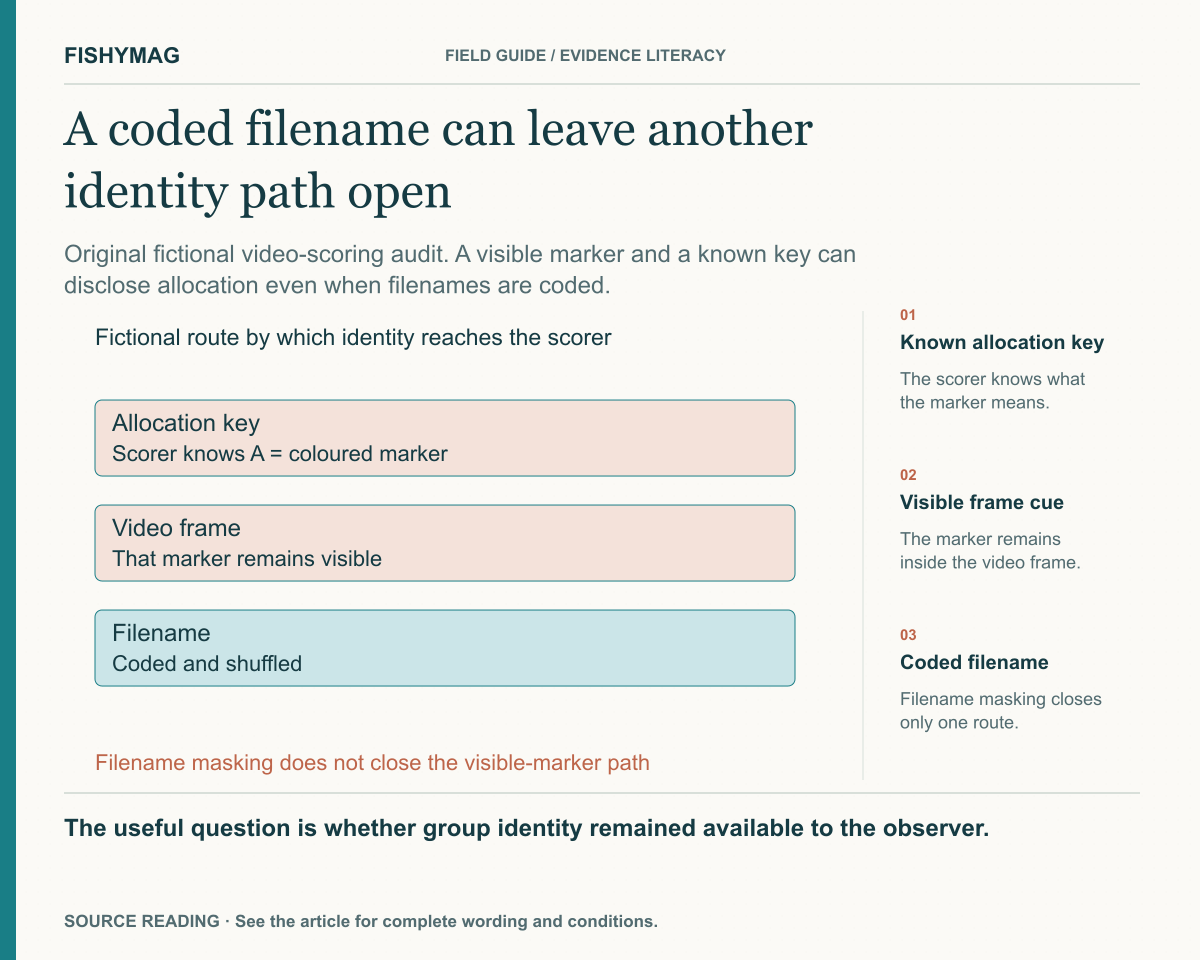
Figure data and explanation
Original fictional video-scoring audit. A visible marker and a known key can disclose allocation even when filenames are coded.
- Known allocation key
- The scorer knows what the marker means.
- Visible frame cue
- The marker remains inside the video frame.
- Coded filename
- Filename masking closes only one route.
The useful question is whether group identity remained available to the observer.
Follow the information, not just the word masked
ARRIVE treats awareness of allocation as stage-specific. A person may be unaware during one task and informed during another. This fictional case concerns only video outcome assessment: filenames have been replaced with codes, clips are shuffled, and a coloured tank marker remains inside each frame. The scorer knows that marker’s group meaning. No actual video or investigator is being evaluated.
Complete the identity-path audit
A coded filename closes one route to identity. It does not erase an informative cue in the image. The second branch below changes only the available evidence about the scorer’s knowledge.
| Information route | Record in the main case | Bounded finding |
|---|---|---|
| Filename to allocation | Codes used; scoring list shuffled | Direct filename identity hidden as recorded |
| Allocation key to marker | Scorer knows the marker key | Group meaning available |
| Marker to frame | Marker visible | Cue reaches the scorer |
| Frame to group identity | Known key plus visible cue | Masking incomplete for this route |
| Alternative: scorer’s key knowledge absent from packet | Visible marker, knowledge unknown | Actual identity availability unresolved |
| Bias in the scores | Not measured in this exercise | Do not claim demonstrated observer bias |
Ask the question that separates the two branches
When the key-knowledge record is missing, ask whether the scorer could interpret the cue during assessment. Do not replace unknown knowledge with either successful masking or certain unmasking. Retain who held the code, when access occurred, what remained visible and which endpoint was scored. The corrected main-case summary is precise: filenames were masked, while the known marker still disclosed group identity. A later statistical adjustment cannot be assumed to have removed that information path. Whether the path changed scores requires further evidence beyond the existence of the cue.
Use your own details
Could the aquarium observer see the exposure group? worksheet
Download the editable text file, fill it in on your device and keep it with the relevant record. This blank worksheet records your information; it does not verify entries or approve treatment.
- Outcome and scoring stage
- Filename coding and key access
- Visible markers or other group cues
- Who knew each cue’s meaning
- Frame, metadata and audio review coverage
- Scoring order and allocation masking
- Information paths still open
- Unknown key access and clarification request
Put it into practice
Your checklist
- Audit identity cues at the actual scoring stage.
- Separate a visible cue from knowledge of its key.
- Do not equate incomplete masking with demonstrated scoring bias.
Sources and scope
This article distinguishes manufacturer statements from FishyMag’s own workflows and arithmetic examples. Linked formulation records retain their own evidence dates; publishing this article does not refresh those records.
AI-assisted writing and development. Not hands-on product testing or veterinary review. How we publish →
FishyMag reports what manufacturers say, quoted and linked. It does not diagnose illness or recommend a treatment, and it never infers that a product is safe from the absence of a warning — where no statement exists, it says so.
Formulations change. Always read the label on the bottle in your hand, and contact the manufacturer if your tank contains anything valuable or unusual.