Keeper workflows
What a correction changes in aquarium research
Read three different publisher notices by the fields they change and the claims they affect.
By FishyMag · Published
Original source audit · Not a clinical review or treatment recommendation.
Quick answer
The fictional affiliation correction changes attribution only. The table replacement changes the affected endpoint interpretation. The expression of concern leaves an exposure-dependent conclusion unresolved. Each result follows from the notice’s contents.

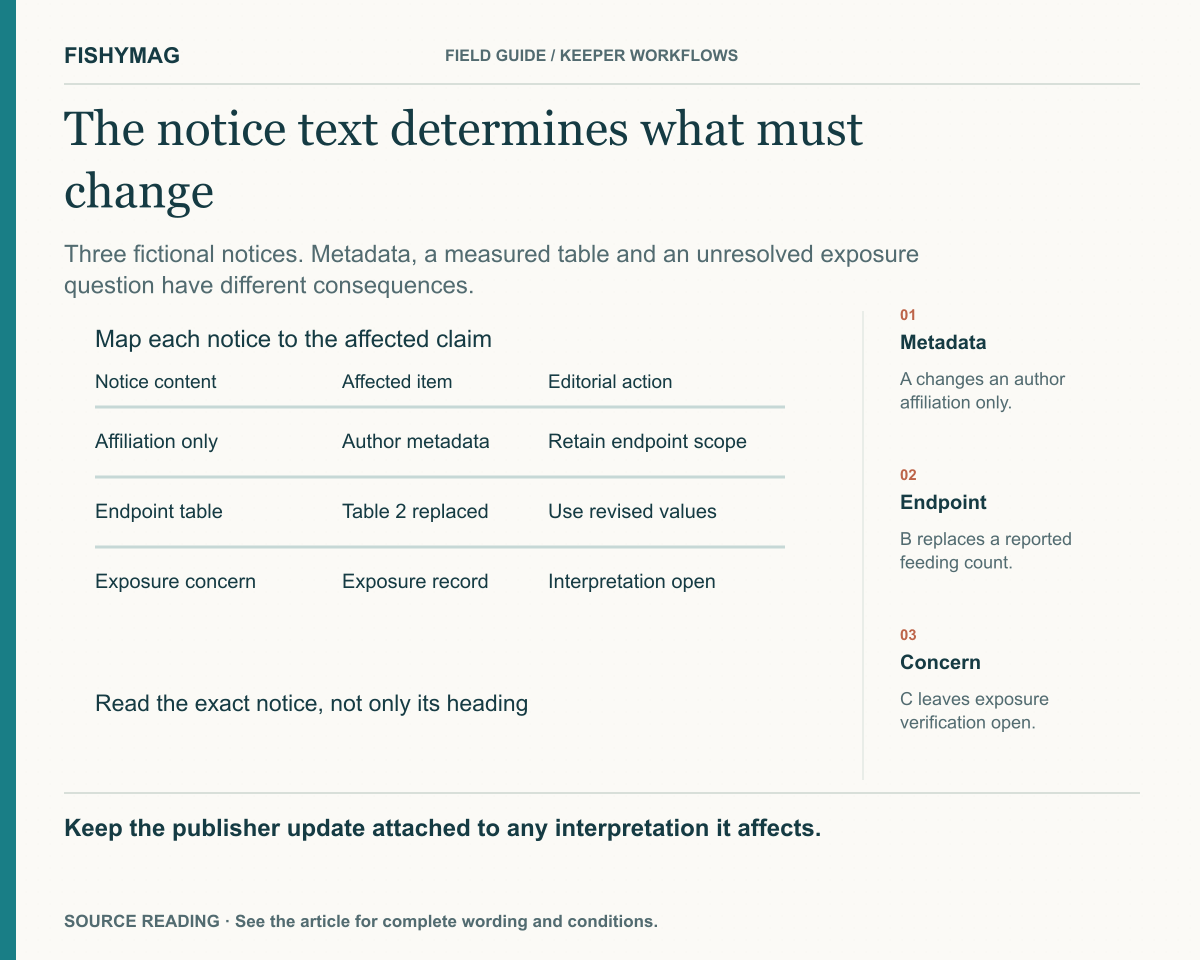
Figure data and explanation
Three fictional notices. Metadata, a measured table and an unresolved exposure question have different consequences.
- Metadata
- A changes an author affiliation only.
- Endpoint
- B replaces a reported feeding count.
- Concern
- C leaves exposure verification open.
Keep the publisher update attached to any interpretation it affects.
A notice name does not tell you which claim changed
The fictional packet contains three publisher notices. Notice A corrects an author affiliation and identifies no data change. B replaces Table 2 because the original count was transcribed incorrectly. C flags an investigation into exposure verification. COPE and Crossref guidance distinguish corrections and unresolved reliability concerns; the specific findings below come from the fictional notice text.
Work the finding affected by each notice
In B, the old cell stated 9 of 12 observed feeding at the check; the replacement says 6 of 12. The count changes while the denominator and stated check remain the same.
| Packet | Notice content | Reader-facing disposition |
|---|---|---|
| A | Affiliation only | Correct the affiliation; retain the original endpoint scope |
| B | Table 2 replaced; 9 of 12 becomes 6 of 12 | Use the corrected count and cite the notice |
| C | Exposure records under investigation | Keep the exposure-dependent interpretation unresolved |
Save both versions so a later reader can reproduce the change
Retain a copy of the original finding and the dated notice. In C, check later publisher updates before repeating a conclusion that depends on the disputed exposure. An expression of concern in the example is not a finding of misconduct. In A, leaving a result unchanged is not an independent validation of that result.
Use your own details
What a correction changes in aquarium research worksheet
Download the editable text file, fill it in on your device and keep it with the relevant record. This blank worksheet records your information; it does not verify entries or approve treatment.
- Paper and publisher notice identifiers
- Affected version and date
- Exact field, table or evidence affected
- Previous and corrected content
- Unchanged scope and limits
- Open concern and affected claims
- Date and source of follow-up check
Put it into practice
Your checklist
- Match notice to paper version and affected item.
- Replace the affected interpretation with the corrected one.
- Keep unresolved concerns visible until a relevant update arrives.
Sources and scope
This article distinguishes manufacturer statements from FishyMag’s own workflows and arithmetic examples. Linked formulation records retain their own evidence dates; publishing this article does not refresh those records.
- Crossref version control, corrections and retractions; reviewed November 9, 2026 ↗
- COPE retraction guidance; reviewed November 9, 2026 ↗
AI-assisted writing and development. Not hands-on product testing or veterinary review. How we publish →
FishyMag reports what manufacturers say, quoted and linked. It does not diagnose illness or recommend a treatment, and it never infers that a product is safe from the absence of a warning — where no statement exists, it says so.
Formulations change. Always read the label on the bottle in your hand, and contact the manufacturer if your tank contains anything valuable or unusual.