Keeper workflows
The water-clarity assumption behind an aquarium UV claim
Decide whether a comparable UV transmittance measurement falls within a stated claim envelope.
By FishyMag · Published
Worked filtration evidence example · Not a clinical review or treatment recommendation.
Quick answer
At the same wavelength and path length, 86% UV transmittance falls below the fictional claim’s 90% minimum. A visually clear aquarium with no UVT measurement remains unclassified. Neither finding justifies choosing a compensating flow.
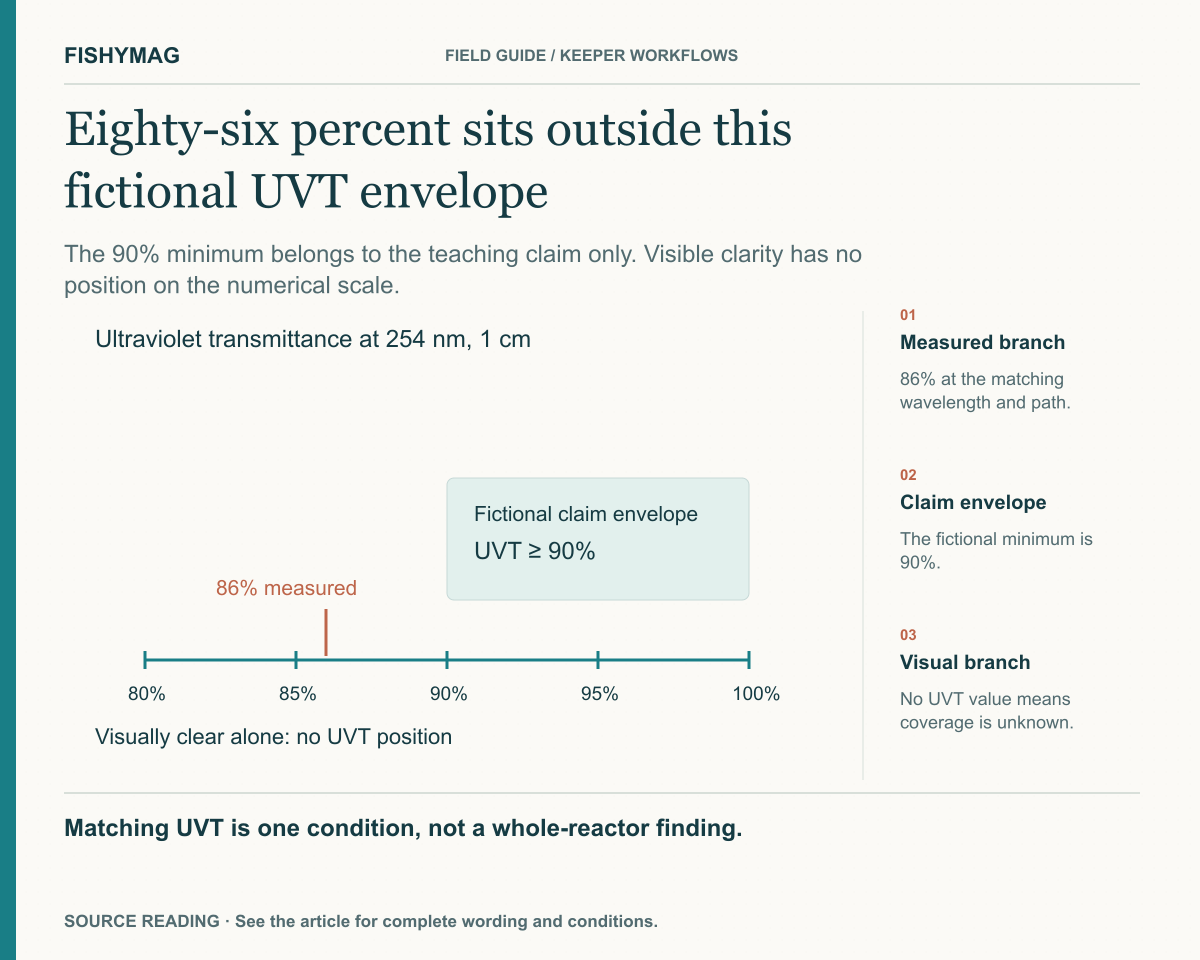
Figure data and explanation
The 90% minimum belongs to the teaching claim only. Visible clarity has no position on the numerical scale.
- Measured branch
- 86% at the matching wavelength and path.
- Claim envelope
- The fictional minimum is 90%.
- Visual branch
- No UVT value means coverage is unknown.
Matching UVT is one condition, not a whole-reactor finding.
UVT is not a visible clarity judgement
Ultraviolet transmittance is reported at a wavelength and path length. The NSF/EPA UVSwift test report states 84% UVT during its particular MS2 challenge; it separately describes other monitoring periods. That is a documented test condition, not a universal threshold. Our fictional claim requires at least 90% UVT at 254 nm referenced to 1 cm.
Complete the two aquarium evidence branches
The measured branch states 86% at the matching basis and assumes the reported uncertainty cannot place it at 90%. In the unmeasured branch, the observation is visual only.
| Record | Comparable to threshold? | Coverage finding |
|---|---|---|
| 86% at 254 nm, 1 cm | Yes, matching basis | Outside the stated UVT envelope |
| Clear by visible inspection | No UVT value | UVT coverage unknown |
| UVT at different wavelength or path | Not automatically comparable | Need method and supported conversion if applicable |
| UVT at or above 90% in another packet | Would meet this one condition | Other conditions still need checking |
Preserve the evidence gap without recalculating the equipment
An out-of-envelope value says the cited claim has not been established for that condition. It does not prove a particular biological outcome or authorize adjusting flow. EPA’s validation manual describes a conversion between specific path lengths for compatible measurements; it does not convert a visually clear tank into a numerical UVT. Keep the basis and method with the measured value.
Use your own details
The water-clarity assumption behind an aquarium UV claim worksheet
Download the editable text file, fill it in on your device and keep it with the relevant record. This blank worksheet records your information; it does not verify entries or approve treatment.
- Claim and exact reactor
- Minimum UVT and stated conditions
- Wavelength and reference path length
- Measured value with method and uncertainty
- Sample location and timing
- Inside, outside or unknown for UVT
- Other conditions separately checked
Put it into practice
Your checklist
- Match wavelength and path length first.
- Compare the measured value and its uncertainty to the stated condition.
- Keep visual appearance and other reactor conditions separate.
Sources and scope
This article distinguishes manufacturer statements from FishyMag’s own workflows and arithmetic examples. Linked formulation records retain their own evidence dates; publishing this article does not refresh those records.
- EPA UV Disinfection Guidance Manual, Chapters 3 and 5; reviewed November 9, 2026 ↗
- NSF/EPA 2002 UVSwift 4L12 verification report; reviewed November 9, 2026 ↗
AI-assisted writing and development. Not hands-on product testing or veterinary review. How we publish →
FishyMag reports what manufacturers say, quoted and linked. It does not diagnose illness or recommend a treatment, and it never infers that a product is safe from the absence of a warning — where no statement exists, it says so.
Formulations change. Always read the label on the bottle in your hand, and contact the manufacturer if your tank contains anything valuable or unusual.