Keeper workflows
UV lamp aging and sleeve fouling are separate assumptions
Track lamp aging and sleeve fouling separately and catch a double adjustment in a UV specification.
By FishyMag · Published
Worked filtration evidence example · Not a clinical review or treatment recommendation.
Quick answer
The fictional model multiplies 10 W by 0.80 for lamp aging and 0.90 for sleeve fouling to get 7.2 W. If a separate 7.2 W figure already includes both factors, use it on that basis. Reapplying them produces 5.184 W by counting the same assumptions twice.
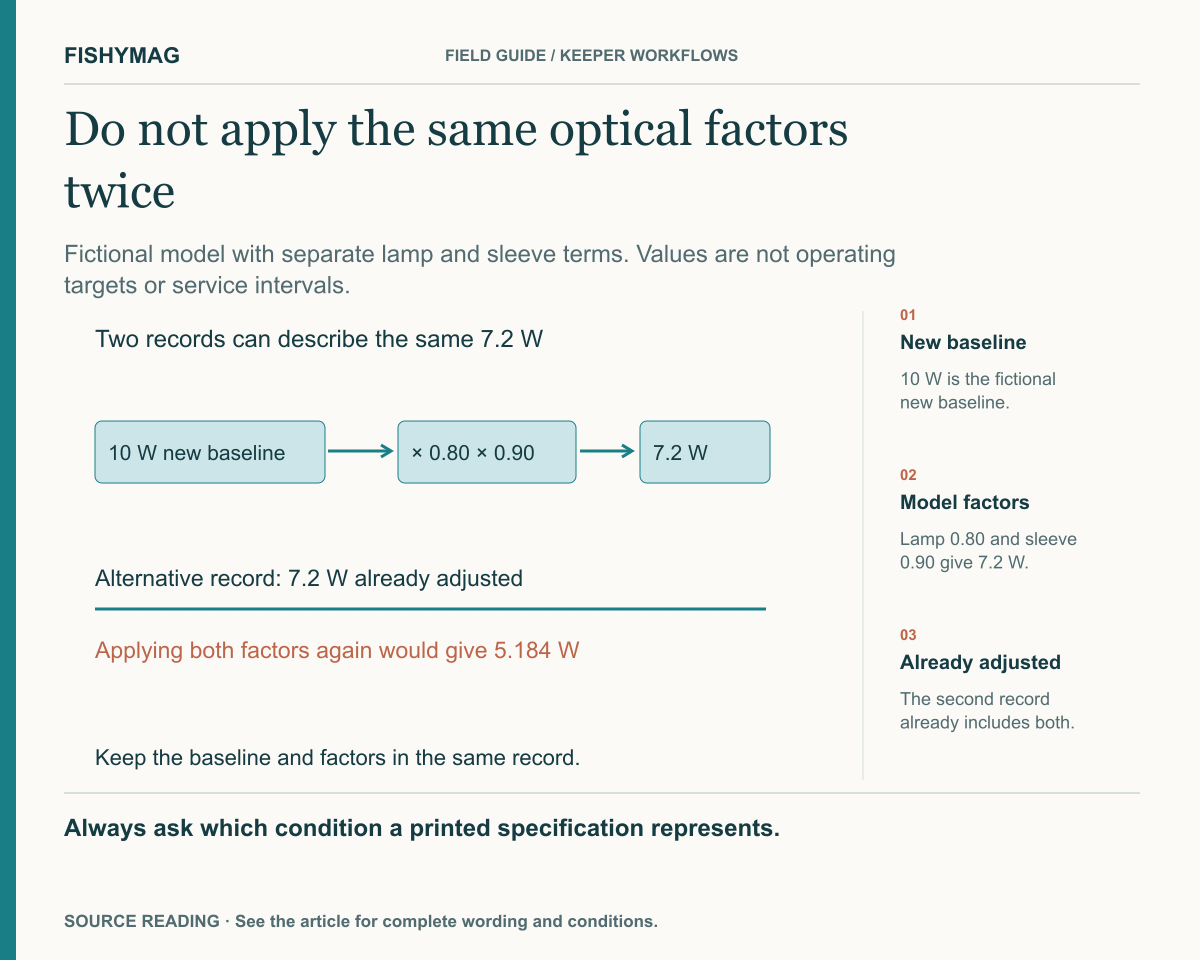
Figure data and explanation
Fictional model with separate lamp and sleeve terms. Values are not operating targets or service intervals.
- New baseline
- 10 W is the fictional new baseline.
- Model factors
- Lamp 0.80 and sleeve 0.90 give 7.2 W.
- Already adjusted
- The second record already includes both.
Always ask which condition a printed specification represents.
Find out what is already in the published number
Aqua Ultraviolet’s Classic 25 W series page describes its figures as calculated at end of lamp life. That wording is a reason to check the baseline before applying any further adjustment; it does not identify all other assumptions. The NSF/EPA UVSwift field report also distinguishes the lamp sleeves from a fouled sensor sleeve. A reading change at the sensor need not be identical to a lamp-output change.
Complete both branches of the fictional calculation
The factors are given assumptions of this model only. There is no claim that these exact values or their product apply to another installation.
| Record | Arithmetic | Interpretation |
|---|---|---|
| New baseline, two uncounted factors | 10 × 0.80 × 0.90 = 7.2 W | Adjusted optical model value |
| Already adjusted baseline | 7.2 W; no repeated adjustment | Same 7.2 W on its documented basis |
| Factors applied twice | 7.2 × 0.80 × 0.90 = 5.184 W | Incorrect for the stated record |
| Service or cleaning interval | Not part of the calculation | Unresolved |
Track the assumptions by component
A log should say whether the value includes age, sleeve transmission, sensor window effects or other parameters. If the specification only identifies end of lamp life, request the remaining assumptions instead of presuming a clean or fouled sleeve. The example gives neither a cleaning interval nor a delivered dose.
Use your own details
UV lamp aging and sleeve fouling are separate assumptions worksheet
Download the editable text file, fill it in on your device and keep it with the relevant record. This blank worksheet records your information; it does not verify entries or approve treatment.
- Exact model, lamp and sleeve
- New or already adjusted optical basis
- Lamp aging assumption and source
- Sleeve fouling assumption and source
- Sensor-window effect, if any
- Which factors are already included
- Scope of the corrected figure
Put it into practice
Your checklist
- Mark whether the baseline is already adjusted.
- Keep lamp, sleeve and sensor terms separately identified.
- Apply each specified factor at most once.
Sources and scope
This article distinguishes manufacturer statements from FishyMag’s own workflows and arithmetic examples. Linked formulation records retain their own evidence dates; publishing this article does not refresh those records.
- EPA UV Disinfection Guidance Manual, Chapters 3 and 5; reviewed November 9, 2026 ↗
- NSF/EPA 2002 UVSwift 4L12 verification report; reviewed November 9, 2026 ↗
- Aqua Ultraviolet Classic 25 W series specification; reviewed November 9, 2026 ↗
AI-assisted writing and development. Not hands-on product testing or veterinary review. How we publish →
FishyMag reports what manufacturers say, quoted and linked. It does not diagnose illness or recommend a treatment, and it never infers that a product is safe from the absence of a warning — where no statement exists, it says so.
Formulations change. Always read the label on the bottle in your hand, and contact the manufacturer if your tank contains anything valuable or unusual.